Eat the Ones You Love: A Novel
- By Sarah Maria Griffin
- Tor Books
- 288 pp.
- Reviewed by Tara Campbell
- May 13, 2025
An unsettling abuse narrative with a discussion-worthy conclusion.
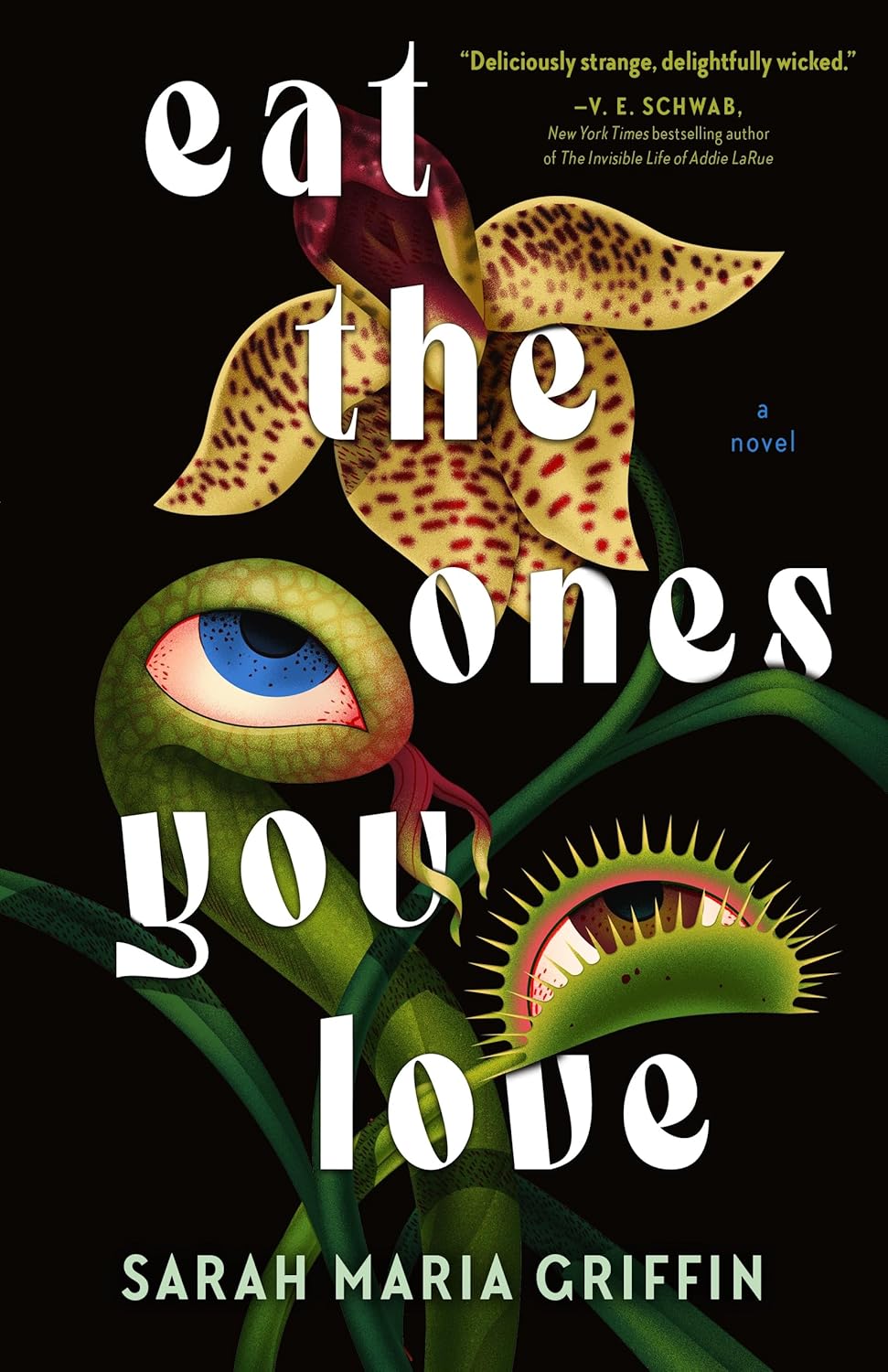
Sarah Maria Griffin’s horticultural horror novel, Eat the Ones You Love, is an emotionally unsettling, squirmy book. As soon as I finished it, I began wondering about how to review it. How do I talk about my reasons for feeling conflicted without giving away too much?
Shell (Michelle) is a 33-year-old Dubliner grappling with multiple setbacks, searching for a new position after being laid off from her design job, and struggling with the end of a seven-year relationship with her fiancé, Gav. She’s living at home, sleeping in her childhood bedroom, and feeling utterly defeated by life — until she sees the help “NEEDED” sign in a florist’s shop at the Woodbine Crown, a crumbling old mall that’s been on the verge of closing for years.
Smitten by the shop’s owner, Neve, Shell decides to apply and is instantly hired, launching her into what seems like a promising new career. She gains confidence as she works for Neve, learning the craft of floristry and starting a successful new online identity. At the same time, Neve invites her into a new friend group of other mall employees, one of whom is a charming younger man. As Shell flirts with both him and Neve, she begins to think her life might just turn around.
But Baby has other plans.
Yes, Baby, the sentient, murderous plant who has infiltrated Neve’s body and mind, taken over her life, and sees Shell as a means to accomplish his goal of completely subsuming Neve — consuming her, becoming one with her. This is Baby’s twisted version of love, the thing that would bring them absolute unity:
“There are all kinds of things I have managed to eat in this world, with my vines and petals and tendrils and mouth. But Neve’s heart, that red-gold thing in her, that was what would make me complete. What would make us complete. Us.”
Neve’s heart is symbolized by a ring she wears that’s made of her hair twisted together with that of her ex-girlfriend Jen, an American who moved to Ireland to be with her, but who eventually left because she could no longer understand Neve’s darkly weird behavior: the strange marks on her skin, her obsessive focus on the mall, and her “almost feral” attachment to one particular orchid in the Green Hall, the dilapidated glass-walled-but-dirt-obscured garden in the center of the mall.
Baby — this one particular orchid — thinks Shell will be a useful tool both as a distraction from Neve’s lingering attachment to Jen and in a more literal sense later on. But when Jen finds out through a mutual friend that Neve has hired a new assistant, she’s no longer able to ignore her misgivings about the darkness in the mall, especially given the unexplained disappearances that have happened in the past. Feeling obligated to step in before another innocent person is harmed, she races back to Dublin to investigate the plant, and the final showdown begins.
And we know a showdown is coming due to many instances of foreshadowing of the “though she didn’t know that yet” variety. This was heavier foreshadowing than I needed because I was invested enough in Shell’s future without frequent warnings of danger to come. I was rooting for her to put her life back together. Griffin does an excellent job depicting the camaraderie among the staff of the various shops and capturing the buzzy sexual tension of people falling into romantic entanglements. She also captures the pre-nostalgia of witnessing the end of an era, with the stalwart shopkeepers returning to a doomed mall that limps along day by day. With the lush imagery of floral fecundity against the decay of the scuzzy surroundings, I was fully immersed in this world.
So, why am I conflicted? Because at the heart of it, this isn’t just a monster story or body horror; it’s a tale about an abusive relationship. The evil, masculine-coded Baby maintains control over Neve and Shell — knowing they’re not willing participants — with classic abuser strategies.
He infiltrates people’s bodies and thoughts through his pollen and, when close enough, by sending filaments through their skin. Once he’s in, he’s able to see and sense what they see and sense, to the extent that most of the book is told from Baby’s perspective. What seems like a third-person chapter from Shell’s perspective is punctured by his commentary telling us what he’s allowing them to do versus what he’s suppressing; how he searches for vulnerable people, alienates them from their communities, and reminds them that he’s in control.
Baby began to infiltrate Neve when she was 16 and came to her aunt’s flower shop for refuge from a violent, bigoted household where she had no one to rely on. And now he has his sights on Shell:
“I will leaf my way into the parts of her that can hear and feel and I will assure her that the eyes of others slip off her like furniture, she is unremarkable, objectively ordinary. Her pain is a non-phenomenon.”
When Neve imagines an opportunity to be free of Baby, he tells her, “You will never be free of me, and she said, loud, through the chambers of her body. Yes, I will.”
Because Baby is a “he” and not an “it,” I had a hard time reading his non-consensual controlling behavior on the singular level of monster horror. Hence, I also had a hard time sorting out how to feel about the ending. Even though there’s a strong female lead (Jen) taking action against the abusive male, Griffin doesn’t let us off easily with a clean, satisfying feminist resolution.
I can’t give it away, but suffice it to say, I’d feel differently about how things turn out if Baby was an “it.” This novel doesn’t provide easy answers, but it could provide interesting fodder for book clubs that can handle the abuse narrative and aren’t afraid of a little body horror.
Tara Campbell is a writer, teacher, Kimbilio Fellow, and fiction co-editor at Barrelhouse Magazine. She teaches flash fiction and speculative fiction and is the author of two novels — including, most recently, City of Dancing Gargoyles — two hybrid collections of poetry and prose, and two short-story collections.
.png)
.png)