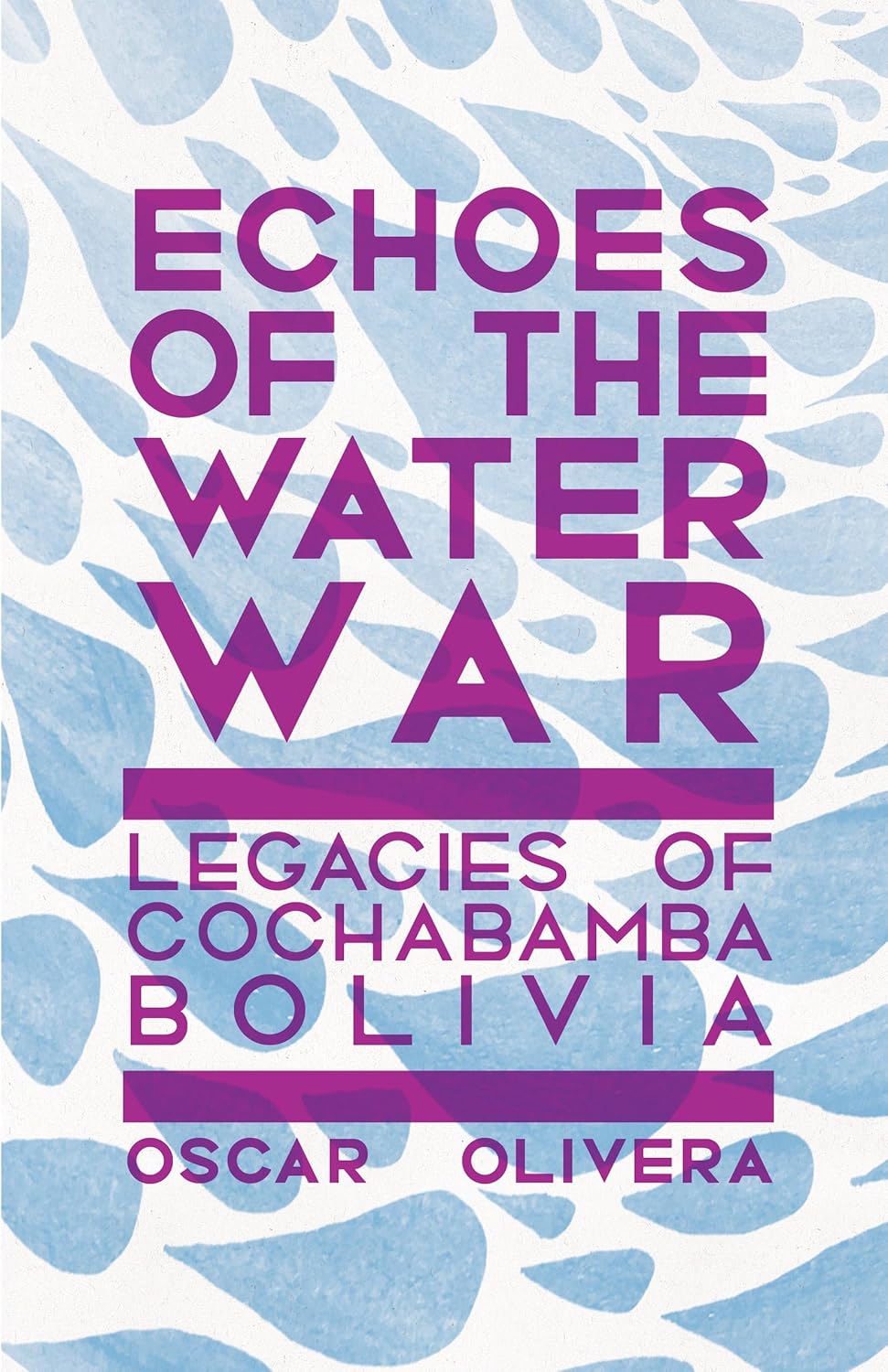
Echoes of the Water War: Legacies of Cochabamba, Bolivia
- By Oscar Olivera
- Common Notions
- 208 pp.
- Reviewed by Elizabeth McGowan
- June 27, 2025
A (mostly) heartening account of citizens fighting back.
At the turn of the 21st century, Bolivia was awash in the shrinkage of public services after economic reforms in the mid-1980s spurred a wave of privatization. For the people of Cochabamba, the last straw was a Bechtel Corp.-led consortium coming for control of their water in 1999. Instead of caving to a behemoth, working people organized and united to drive the transnational water company out of their city of 630,000 nestled in an Andean valley in central Bolivia.
The collective aim was not only to avoid water being placed under the control of a private operator but also to defend independent water systems in neighborhoods and ancient irrigation systems in rural zones. Echoes of the Water War is a retrospective of that April 2000 victory recounted by Oscar Olivera, a union leader instrumental in galvanizing the Coordinadora de Defensa del Agua y de la Vida (Coalition in Defense of Water and Life).
Cochabambans “taking to the streets and highways, recovered their full sovereignty, their voice, their dignity, their capacity to make decisions, and their strength,” Olivera writes. “They rose up with strength and pride in the multicolored aguayo (traditional woven textile) of rebellion, autonomy, and indignation, to declare in a mighty voice, ‘Here we are, yes, we exist!’”
Tension arose in June 1999 when the World Bank nixed the use of public subsidies to cover the cost of soaring water bills in Cochabamba. Both the World Bank and the International Development Bank had declared privatization as a condition for loans. That mandate was compounded by a regulation passed a few months later, Law 2029, that banned wells, cisterns, and cooperative water houses built to serve those not connected to the city’s central water system — roughly half of Cochabamba’s population. Law 2029 also prevented peasants from collecting rainwater in tanks.
Instead, Cochabambans would be beholden to the 40-year contract that the Bolivian government signed with the new water company, Aguas del Tunari, in September 1999. International Water, part of Bechtel, had the majority interest in the consortium, which also included Abengoa of Spain and four Bolivian companies.
The anti-privatization coalition, created that November, was having none of it. Olivera, then executive secretary of the Federation of Factory Workers, served as a lead organizer and spokesman while molding a mix of peasants, environmental organizations, teachers, and factory workers into what he christened the “conscience of the people”:
“In simple terms, for us, democracy answered — and still answers — the question: ‘who decides what?’ A tiny minority of politicians and businesspeople, or we ourselves, the ordinary working people? In the case of Cochabamba’s water, we wanted to make our own decisions.”
Beginning in January 2000, thousands of the “ignored, excluded and neglected” marched, erected road blockades, banged on pots, went on short-term strikes, and burned their water bills as repeated attempts at negotiations disintegrated. Protesters were tear-gassed and jailed after facing down the police and the military.
Three-plus months later, that solidarity triumphed when the government, albeit reluctantly, terminated the privatization and repealed Law 2029. It sparked a water movement that ricocheted around the world and led to Olivera being awarded the prestigious Goldman Environmental Prize in 2001.
In a time when democracy feels mighty wobbly in the United States, it’s opportune that publisher Common Notions opted to tell a story about people power that didn’t resonate far beyond the environmentally attuned when it actually unfolded.
One quibble, though. For being such a slim volume, the book is surprisingly full of repetition. Readers would’ve benefited if the final four chapters contributed by academics and activists —likely included to add heft, as they almost double the total page count — had been more carefully edited and streamlined. After all, who has the patience to wade through a chapter with the yawn-inducing title “Communal Uprisings and Plebeian Democratizations”?
A separate chapter presented as a Q&A is welcome because, in it, multimedia specialist Nelly Perez ably draws from Olivera the personal toll of activism. Separation from his immediate family has scarred him with deep sadness and hurt that still linger. But being among the masses was a balm for soothing that pain. “Recognition in the streets compensates for everything I couldn’t have in the family,” Olivera tells Perez. “Being…loved by my children and the people compensates for all the pains, betrayals, and frustrations I may have had, particularly in family life.”
Olivera doesn’t over-romanticize what was accomplished, however. He’s candid enough to admit disappointment that “we won the war, but we lost the water.” While Cochabamba’s Municipal Drinking Water and Sewage Service became public again, it remained inefficient and mired in corruption. Problems with sewage treatment, water quality, and planning persisted.
Yes, Olivera might be discouraged that the long-ago triumph didn’t induce lasting reform, but he surely can take heart from the sentiment Robert F. Kennedy directed to South Africans in his 1966 “Ripple of Hope” speech:
“Few will have the greatness to bend history itself; but each of us can work to change a small portion of events, and in the total of all those acts will be written the history of this generation.”
Longtime energy and environment reporter Elizabeth McGowan, based in Washington, DC, writes for the Virginia Center for Investigative Journalism. She has won numerous awards, including a Pulitzer Prize for “The Dilbit Disaster: Inside the Biggest Oil Spill You Never Heard Of” as a staff correspondent for InsideClimate News. Bancroft Press in Baltimore published her memoir, Outpedaling “The Big C”: My Healing Cycle Across America, in 2020. Follow her on X and Facebook.