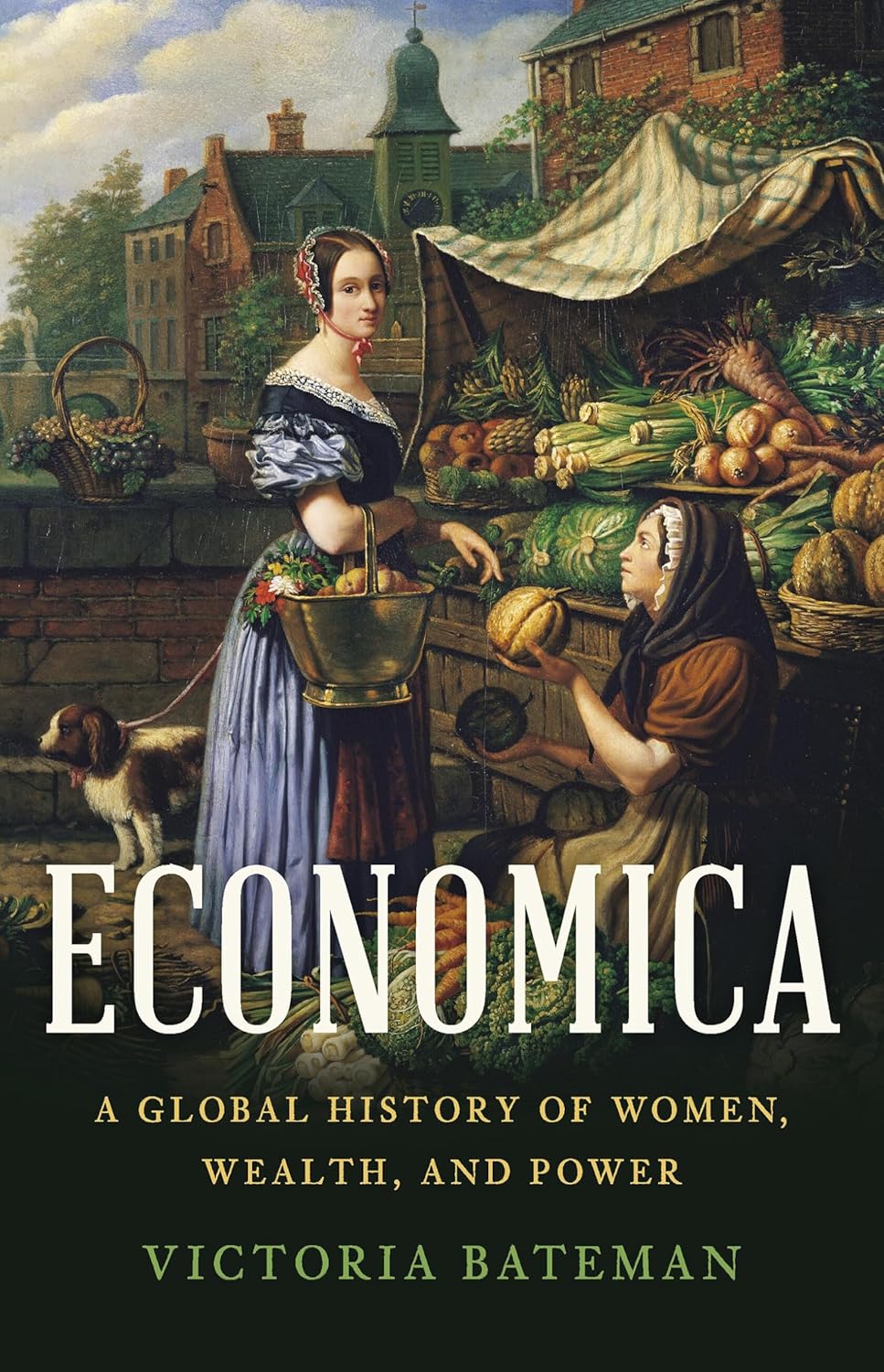
Economica: A Global History of Women, Wealth, and Power
- By Victoria Bateman
- Seal Press
- 480 pp.
- Reviewed by Elizabeth J. Moore
- December 31, 2025
So patriarchy isn’t good for anybody’s bottom line?
Those who think “traditional” gender roles mean women staying home and performing unpaid labor should note that this interpretation is not borne out by actual historical experience. Women have been integral drivers of economic prosperity since the dawn of humanity, and the lack of recognition of this fact is a gaping blind spot in history.
Such collective obliviousness owes its existence in large part to economics being a male-dominated field. But one of the scholars seeking to shine a light on women’s indispensable economic contributions is Victoria Bateman, an economist who has taught at both Cambridge and Oxford. Her longtime mission has been to use the lessons of history to point out that women’s active participation in the economy is more than just something that’s “nice to have.” It’s fundamental to societies’ success.
Her 2019 The Sex Factor: How Women Made the West Rich focused on northwestern Europe and how women’s relative freedom there in the early modern era was the precise reason this one-time economic backwater pulled ahead of the rest of the world in dramatic and unexpected ways. Now, in Economica, Bateman broadens this line of inquiry to the entire globe and broadens her timeline to include the Stone Age to the present. In spite of an “everything but the kitchen sink” approach that occasionally obscures her arguments, the author marshals an impressive body of evidence that women are the “hidden figures” in the history of global economics.
A prime example is women’s labor in textile production, an age-old key driver of economic prosperity both at home and abroad. After all, it was women who wove the highly sought-after silk for which the Silk Road was named, as well as the cotton cloth at the center of the Industrial Revolution. But women’s ability to succeed in the economy wasn’t simply a matter of whether they were “working,” which could be indicative of exploitation or outright slavery. Rather, the determining factor was whether they lived in a society that allowed them to earn, spend, invest, and share their money as they chose.
This stands in contrast to patriarchy — the privileging of men over women in all aspects of life — which Bateman’s research shows correlates with economic stagnation. She uses this female-empowerment-versus-patriarchy dichotomy to explain the “mystery” of why some societies thrived, had a golden age followed by downturn or ruin, or never took off at all.
Ancient Athens is an especially intriguing case because it pairs cultural and political glories with economic malaise. Why? Women were shut out of society in ways reminiscent of Taliban rule: They endured mandatory veiling, a lack of legal autonomy, and the inability to earn their own income.
This vulnerability rendered Athens ripe for conquest by the far more economically vibrant Roman Republic — where, not coincidentally, women enjoyed greater autonomy than their Athenian counterparts. It’s a rich irony that Rome’s own fall was hastened by its replacement of the Republic with the Roman Empire, which imposed draconian restrictions on women’s freedoms.
Then there are the regions where ancient women enjoyed liberties unknown to their modern counterparts. These include what are now Egypt, Iraq, Iran, and Pakistan. Millennia ago, these lands were parts of empires that were economic superstars and whose women were free to travel, own property, control their own assets, arrange their own marriages, and run businesses.
As in Rome, crackdowns on women’s freedoms eventually sent these areas into an economic decline they’ve yet to recover from. Incidentally, for centuries, China was another powerhouse-turned-backwater (its fortunes also rising and falling according to its treatment of women, including their being literally hobbled by the horrific practice of foot-binding). Chinese women’s post-1949 liberation from patriarchal family structures and their inclusion in the paid workforce, however, helped lay the groundwork for the country’s remarkable economic comeback in the late 20th century.
Conversely, northwestern Europe — particularly Britain — saw a transformation from economic weakling to economic dynamo (via the Industrial Revolution) in the late 18th century. Why and how this happened is frequently depicted as a head-scratcher, but Bateman asserts that the missing piece of the equation is women.
Thanks to certain vagaries of demographics and geopolitics, this part of Europe ended up with a large population of nuclear families in which girls and women worked for wages, married relatively late, had fewer children than their counterparts elsewhere, and ran their own households. Such freedom at home translated into freedom in the marketplace, with a skilled and relatively high-wage workforce incentivizing nascent entrepreneurs to cut costs through mechanization.
Although Bateman’s arguments are mostly convincing, her cause-and-effect approach might have been clearer if she hadn’t tried to cram all of world history into her book. Instead, she could’ve had a sharper focus on those places and eras where the treatment of women was most discernably tied to a region’s economics and limited her individual profiles to those women who played truly significant roles (e.g., Priscilla Wakefield, who revolutionized British banking in the 1700s), rather than including so many female pirates and rulers who were interesting but not game-changers.
These mild criticisms aside, Bateman’s message is crucial, timely, and a warning. The various factors that led to past backlashes against female autonomy — religious revivals, obsessions with sexual “purity,” calls by governments for more baby-making, and the perception that women are usurping male prerogatives — persist in populist governments today, including our own. Can serious economic backsliding be far behind?
Elizabeth J. Moore is a freelance writer in the Washington, DC, area. She was a longtime senior analyst and instructor who worked in the Defense, State, and Treasury departments, on the Office of the Director of National Intelligence’s President’s Daily Brief staff, and at the National Security Council, the National Intelligence Council, and the Central Intelligence Agency. Her proudest achievement was raising awareness of the status of women as a strategic analytic issue. She holds a master’s degree in international politics from American University.