An over-the-top tale for our over-the-top times.
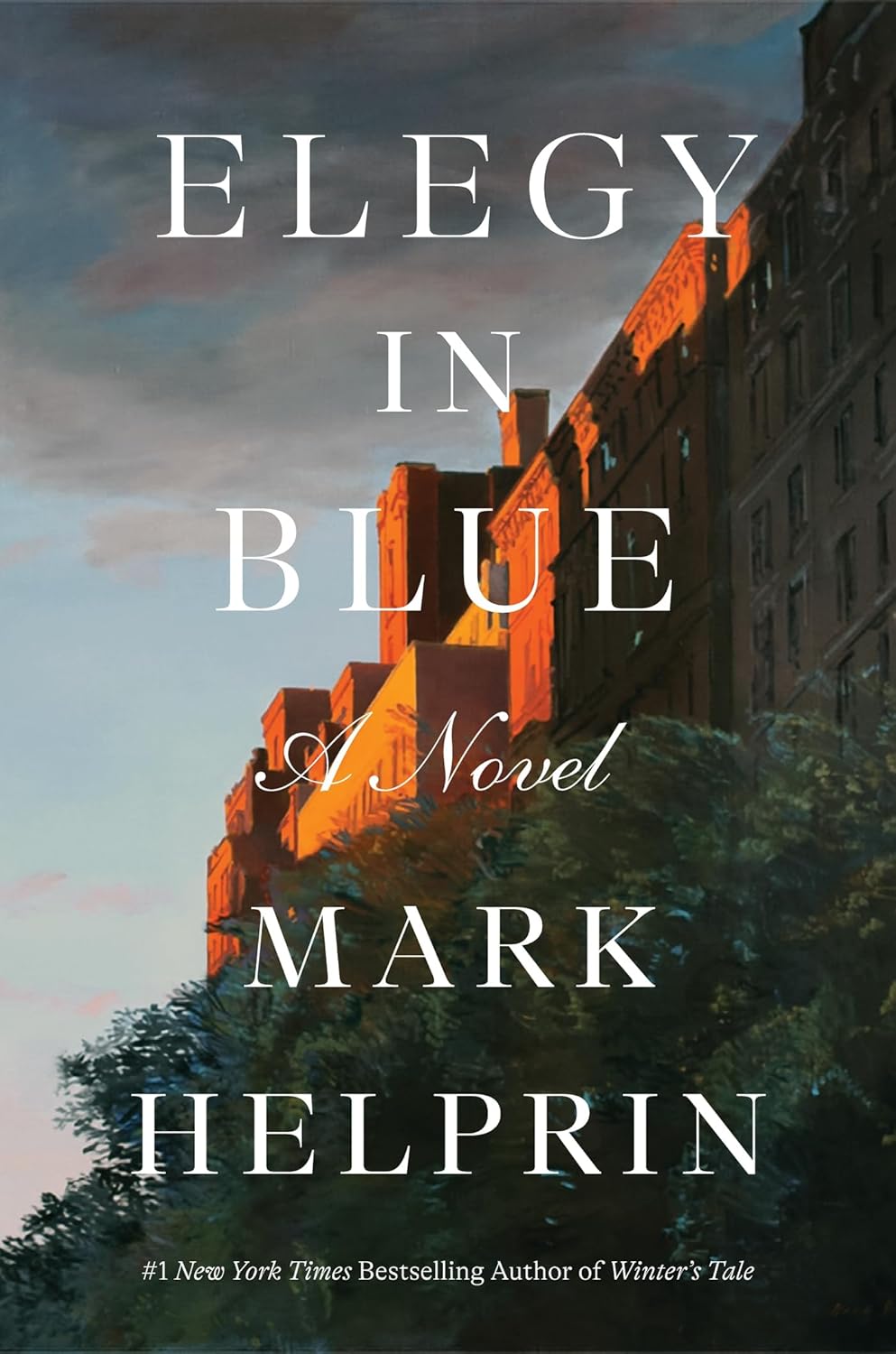
The narrator of Mark Helprin’s Elegy in Blue wants us to pay attention. To the blue of the sky and that of the ocean. To the beauty of art and nature. To the sensuality of well-made clothing. All this is evidence of God, and if we pay attention, we may touch the divine. I believe him. I am not sure what the story “of love in a time of violence” at the heart of this novel has to do with these ideas, but I think the ideas are true.
That story is action-packed — when it opens, our 81-year-old narrator is waiting for someone to burst into his apartment to kill him — and entertaining. Helprin’s unnamed narrator was raised by a widowed mother who was just barely able to provide food and clothing for her son. Still, their poverty was never total: They lived in a rambling Westchester County house with a view of the Hudson and a world-class collection of modern art inherited from the narrator’s father, who “never came home from the war.”
He also left them a small shack in the Hamptons, where the narrator spent his summers glorying in the natural beauty of the sea. So he grew up poor and uncorrupted by materialism, but also surrounded by many of the finer things wealth has to offer.
Without paying much attention to his education or adolescence, the narrator recounts coming out of Harvard and forming a Wall Street investment company despite knowing and caring nothing about investments. Within a few years, he is impossibly wealthy, has met Clare, a beautiful woman who returns his love at first sight, and has moved with her and his inherited art to Brooklyn Heights.
There is a dark undercurrent running through all this American Dreaminess, however. There is that father who never returned from World War II, and the narrator’s son, Charlie, who has been killed in Iraq. Every few pages, the narrator refers to his own service in Vietnam, which goes undescribed but seems more harrowing with each mention. Clearly, the world of beauty and opportunity interrupts itself occasionally with horror and violence.
We have been promised that violence from the outset, and it arrives while the narrator and Clare are walking arm-in-arm through their beloved Brooklyn and come across a neo-Nazi attacking a group of Hasidic schoolchildren with a machete. Despite being elderly, the narrator springs into the kind of action usually associated with Hollywood versions of the Navy SEALs and disarms the man, killing him by snapping his neck.
But Clare is mortally wounded in the fracas. Crippled by grief, the narrator withdraws into his art-laden home and does nothing when the neo-Nazi’s family sues him for wrongful death. Since the world is often corrupt and the lawsuit goes uncontested, the narrator loses everything. Even his Social Security is garnisheed. Material goods may be of limited value, but homelessness is still a problem.
There follows a number of adventures — each as puzzling, implausible, and entertaining as the ones already recounted. The narrator survives to find shelter and settles into simply waiting for death and the reunion with Clare it will bring. Until, that is, he discovers that the kindly custodian of the subsidized housing tower he now lives in is under threat from a vicious drug cartel. He now shifts from philosophical Navy SEAL to cunning secret agent and sets out to defeat the cartel with a plot that would be worthy of a “Mission: Impossible” sequel, except that Tom Cruise is too young for the part.
Obviously, this endless, offbeat implausibility is purposeful. We know right away that the sky above Brooklyn was never this blue, that the course of true love never ran this smoothly, and that very few octogenarians can disarm terrorists, let alone kill them with their bare hands. In case a reader is tempted to take things too seriously — skinhead thugs certainly exist, for example — Helprin has laced his prose with jokes and clues to temper the sobriety.
There is, for instance, a running gag around characters’ names. The neo-Nazi is “Werner Warner Weenis,” and there is a delightful section in which the narrator mocks his upper-class colleagues “Angier Francis Dipthahng,” “Hodgkins Chalmers and his cousin Chalmers Hodgkins,” and, of course, “Hutchins Hutchins Hutchins.”
All of this — the action, the humor, and the reflections on the material and spiritual worlds — is delivered in prose that is both vivid and musical.
So, there’s much to like about Elegy in Blue. If you’re drawn to action novels like those from Robert Ludlum, you’ll find much to enjoy here. If you’re partial to thinking about what really matters in life, you’ll appreciate Helprin’s reflections on materialism and eternity. And if you’re smarter than me, you may figure out what the two have to do with each other.
John P. Loonam has a Ph.D. in American literature from the City University of New York and taught English in New York City public schools for over 35 years. He has published fiction in various journals and anthologies, and his short plays have been featured by the Mottola Theater Project several times. He is married and the father of two sons; the four have lived in Brooklyn since before it was cool. His first novel, Music the World Makes, will be published by Frayed Edge Press later in 2026, while a collection of his short stories, The Price of Their Toys, came out in February.