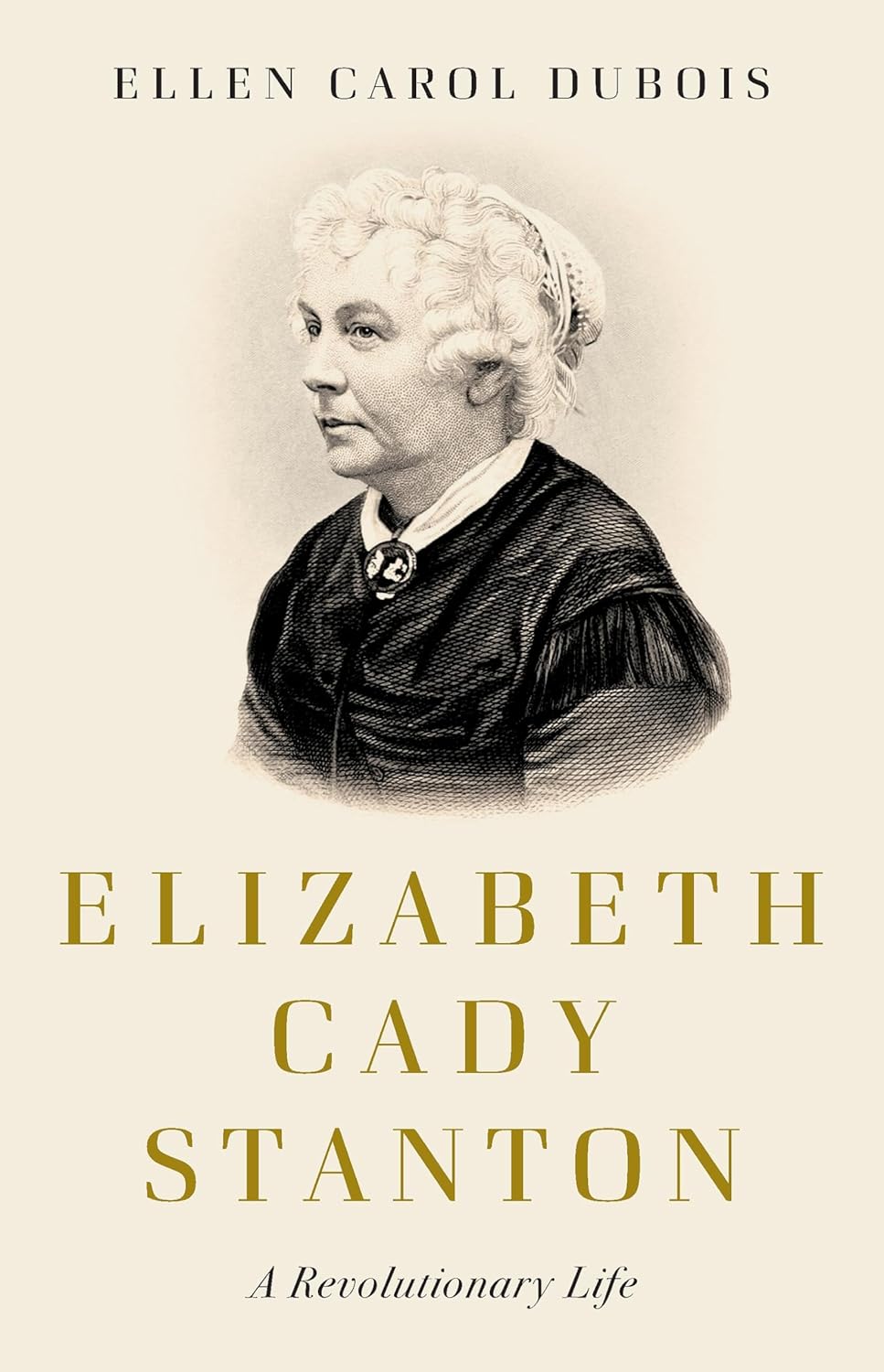
Elizabeth Cady Stanton: A Revolutionary Life
- By Ellen Carol DuBois
- Basic Books
- 496 pp.
- Reviewed by Kitty Kelley
- April 15, 2026
The 19th-century suffragist remains controversial today.
The recipe seems simple: Multiply Abigail Adams by four, add Eleanor Roosevelt squared, throw in a dollop of Hillary Clinton, and you have the formula for the fierce activist who led the 19th-century stampede for women’s rights in America — and did it without the benefit of being married to the president.
Elizabeth Cady Stanton (1815-1902) insisted on using her full name, lest she be referred to as “Mrs. Henry Stanton,” an accessory to her abolitionist husband, or worse, be known simply as “Mrs. Stanton,” the mother of seven children. As an author, the suffragist warrior sometimes wrote under the byline of E.C. Stanton so that her words would be taken seriously by men. Since her time, the status of women has progressed to the point that a professor emerita of history and gender studies at UCLA can now proudly publish Elizabeth Cady Stanton: A Revolutionary Life under her own full name, Ellen Carol DuBois.
In her introduction, DuBois admits that she struggled to find a balance between Stanton’s “most forward-looking and most backward ideas.” The professor finally emerges as one who does “not find the lessons of her [controversial subject’s] entire legacy tainted by her prejudices.”
Those “prejudices” sprang from Stanton’s sense of her own superiority. The elitist daughter of a New York Supreme Court justice, she frequently made racially insensitive remarks and stated that educated white women were more deserving of the vote than were any of the formerly enslaved. She also pronounced that women needed to protect themselves from the brutality of Black men.
In advocating for women’s rights, Stanton had a stalwart ally in Susan B. Anthony. They joined forces with abolitionist Frederick Douglass in support of the 13th Amendment, which ended slavery, and in the 14th Amendment, which granted citizenship and equal protection under the law to African Americans. But the two women stopped short of supporting the 15th Amendment, which prohibited the government from denying a citizen’s right to vote based on race, color, or previous condition of servitude. They believed sex should be included as a condition of servitude.
The formerly enslaved Douglass, however, insisted the right to vote was “a matter of life and death” for Black men and conceded that it was, too, for Black women, “but not because she is a woman but because she is black!” He also called out Stanton for her “employment of certain names such as ‘Sambo’ and the gardener and the bootblack” when referring to Black men. Eventually, their friendship would rupture.
Following the Seneca Falls Women’s Rights Convention in 1848, Stanton wrote the Declaration of Sentiments, a founding document of the women’s rights movement, stating that American women should be accorded full citizenship. She pushed for passage of a Married Women’s Property Act in the New York legislature and later addressed lawmakers on “the property rights of married women,” saying that a husband’s drunkenness should constitute cause for divorce.
When Stanton and Anthony were barred from the all-male Temperance Union, they founded the New York State Women’s Temperance Society. They also established the Women’s National Loyal League, initiated the American Equal Rights Association, and published a women’s rights newspaper called the Revolution. They formed the National Woman Suffrage Association in 1869, which later merged with the American Woman Suffrage Association to become the National American Woman Suffrage Association and, eventually, the League of Women Voters.
Years later, Stanton and Anthony collaborated on the History of Woman Suffrage, which eventually grew to six volumes. In their preface, they wrote:
“We hope the contribution we have made may enable some other hand in the future to write a more complete history of ‘the most momentous reform that has yet been launched on the world — the first organized protest against the injustice which has brooded over the character and destiny of one-half the human race.’”
In 1878, Stanton and Anthony arranged for Congress to be presented with an amendment giving women the right to vote. This eventually became the 19th Amendment to the U.S. Constitution in 1920. Neither woman lived to see its passage but both believed they were instrumental in securing the ability of women in America to attend college alongside men and to be considered equal partners in marriage.
Here would be an ideal place for a rest-in-peace benediction on an activist life; unfortunately, as she aged, Stanton became even more aggressively opinionated. In one article, she railed against immigrants and, according to DuBois, used “her harshest language and most fearsome images yet to make her point,” writing:
“The violent mob element that always appears on the surface when honest labor strikes for better wages is chiefly foreign, so are the criminals in our jails and prisons, the paupers in our charitable institutions, the diseased idiots and lunatics in our hospitals. The majority of our brewers, liquor dealers and saloon keepers are foreigners, and the 20,000 young girls imported annually for the vilest purpose brought here by foreigners.”
During her final years, Stanton labored on The Woman’s Bible, a collection of essays challenging the Bible as produced by Johannes Gutenberg in the 15th century. Stanton declared the Old Testament’s first five books — Genesis, Exodus, Leviticus, Numbers, and Deuteronomy — not divine and completely demoralizing to women.
Hours before her death on October 26, 1902, Stanton dictated a letter to President Theodore Roosevelt, pleading with him to send Congress a message urging passage of the suffrage amendment:
“Abraham Lincoln immortalized himself by the emancipation of four million Southern slaves. Speaking for my suffrage coadjutors, we now desire that you, Mr. President,…immortalize yourself by bringing about our complete emancipation from the slavery of the past.”
The suffragist took her last breath before she could sign it.
Kitty Kelley is the author of seven number-one New York Times bestseller biographies, including Nancy Reagan, Jackie Oh!, and Elizabeth Taylor: The Last Star. She is on the board of the Independent and is a recipient of the PEN Oakland/Gary Webb Anti-Censorship Award. In 2023, she was honored with the Biographers International Organization’s BIO Award, which is given annually to a writer who has made major contributions to the advancement of the art and craft of biography.