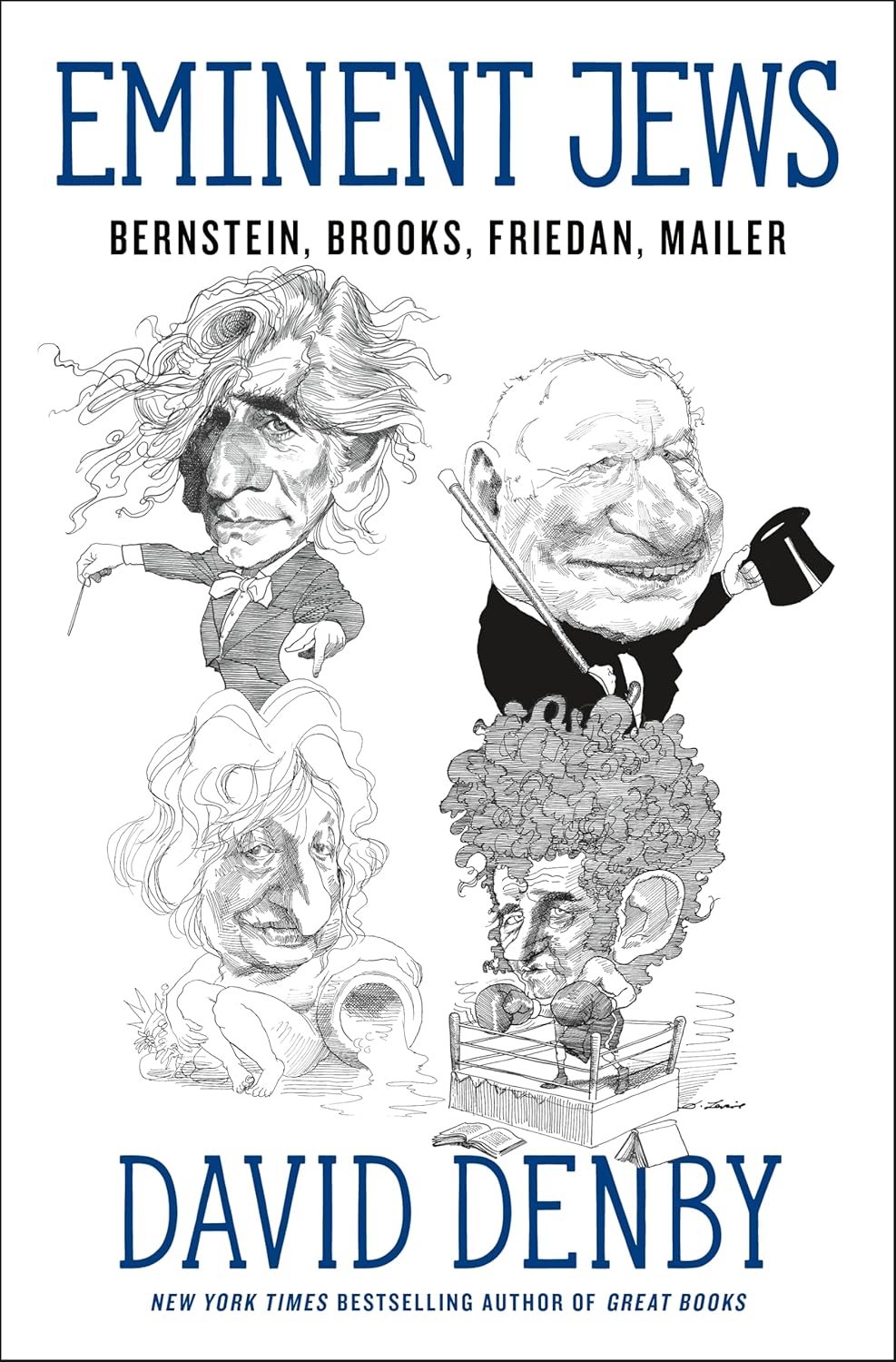
Eminent Jews: Bernstein, Brooks, Freidan, Mailer
- By David Denby
- Henry Holt and Co.
- 400 pp.
- Reviewed by Eugene L. Meyer
- May 1, 2025
A quartet of remarkable — if not equally eminent — American Jews.
What does it mean in 2025 to be a Jew in America? It is sometimes to be demonized by the far right and the radical left. Or to be a pawn in the political wars, where antisemitism has become not so much anathema as, in the hands of demagogues, opposition to it has become a cynical tool, an excuse to achieve other ends — like withdrawing federal funds from universities or criminalizing free speech.
But it wasn’t always so. In the mid-20th century, “eminent” Jews in literature, in music, and in entertainment were almost universally celebrated, first as eminent Americans who, by the way, happened to be Jewish. In those decades, “American culture seemed almost Jewish,” we are told by author and essayist David Denby. It is this world and worldview that Denby highlights in his latest book, Eminent Jews: Bernstein, Brooks, Freidan, Mailer.
It is an ambitious, often entertaining, and engrossing collection of mini-biographies of four prominent figures, three of whom he previously profiled for the Atlantic and the New Yorker, where, for many years at the latter, he was its film critic. He is, Denby says, not a hagiographer but a biographer, whose “task is to celebrate” his subjects. This he will do, while including the “messy intricacy” of their lives. Whether his chosen four rank as most eminent is, perhaps, open to question. But they certainly are an engaging lot.
Given current events, the book seems both timely and wistful, harking back to a time when, despite their cultural acceptance, Jewish Americans changed their names to sound less “Jewish” to avoid the quiet but still existent prejudice in the subdivisions and hotels that were “restricted,” and in the country-club antisemitism portrayed in Laura Z. Hobson’s Gentleman’s Agreement, a novel made into a 1947 Oscar-winning film.
So, we learn that Mel Brooks’ birth name was Kaminsky; Brooks was a shortened version of his mother’s maiden name, Brookman. Norman Mailer was born Nachem Malech Mailer. Betty Friedan was a Goldstein before she married Carl Friedan, who’d shortened his name from Friedman. All four — even the maestro Leonard Bernstein, who grew up in a middle-class family in a Boston suburb — had ancestral roots in the shtetls of Central and Eastern Europe, as does Denby. Friedan’s immigrant father landed in the Midwest, where he had a jewelry store in Peoria, Illinois. How American is that?
Denby grew up in Manhattan; his father had changed their surname from Demboski, again to sound more American. So, they all managed to assimilate while, according to Denby, clinging (if only casually) to Yiddishkeit, a love of Jewish culture. Brooks was born into a low-income family in Brooklyn; his father died when he was an infant, and his mother worked 10-hour days in the garment district. He would go on to marry actress Anne Bancroft (born Anna Maria Louisa Italiano), from an Italian immigrant family in the Bronx.
Both Brooks and Bernstein apprenticed in show business but in very different worlds: Bernstein as a 21-year-old one summer at Tanglewood, the music venue in western Massachusetts where he would later conduct the Boston Symphony Orchestra, and Brooks in the Catskill Mountains Borscht Belt hotels, where he was a teenage tummler, tasked with amusing poolside loungers.
In one of my favorite Mel-as-tummler stories Denby tells, the young kid paid to make people laugh climbs onto a diving board in a black derby and heavy winter coat, holding two suitcases. “Business is terrible! I can’t go on!” he exclaims as he jumps into the water, only to be rescued by a large Gentile lifeguard.
Except when chronicling Brooks, whom Denby interviewed on several occasions and who lives on at 99, the author appears to draw heavily on secondary sources. In writing about Friedan, he refers extensively to her own memoirs, especially Life So Far, published in 2000. His relationship with his subjects is clear upon their second reference. It’s always Mel but not always Betty or Lenny, and never Norman. This makes the Brooks profile feel most authentic, and frankly, it’s the most fun to read.
Freidan’s 1963 book, The Feminine Mystique, sparked a revolution by critiquing the limited role of wives and mothers in postwar America. Ironically, the second-wave feminists turned on her as she extolled the virtues of a traditional family and long declined to take up the cause of abortion. Brooks’ crude humor broke barriers of taste that would most likely be frowned upon today. Both Mailer and Bernstein were sui generis — Mailer the pugilist from Brooklyn who fought his way to the top literally and professionally; Bernstein the musical genius whose bisexuality, as much as his unmatched musicality, helped define his outsized personality.
Where appropriate, Denby relates the past to the present. For example, in discussing Friedan’s portrait of “a culture we thought had vanished,” he asserts, “What remains of these attitudes now, in the actions of rightwing politicians, judges, and media pundits, attacks our lives as a returning nightmare.”
This reviewer’s initial reaction, both to the book’s title and its subject matter, was why? If, as Denby concludes, “they were 100 percent American and 100 percent Jewish,” what makes their religious and ethnic background especially unique and relevant? And why write about these four in particular? To use an overworked nonfiction term of art, what’s the throughline?
Denby presents us with a “fractured group portrait of unruly Jews living in freedom…The combination of asserted freedom and ethical purpose unites these four as examples of a new kind of American Jews,” he explains. “All opened doors for Americans of many kinds who came after them.” That alone seems to qualify them as “eminent.” What further distinguishes them, the author concludes, is their shared ethnic identity, however manifested, as Jewish Americans.
Denby had “little desire to write about Jewish scholars, jurists, scientists, religious leaders.” Instead, he has sought to expand “the notion of eminence” among Jews. Yet, one suspects, his choice of these four may stem from the fact that he’d already extensively profiled three of them. I’m not sure that justifies their inclusion.
Eugene L. Meyer, a member of the board of the Independent, is a journalist and author of, among other books, Five for Freedom: The African American Soldiers in John Brown’s Army and Hidden Maryland: In Search of America in Miniature. Meyer is the editor of B’nai B’rith Magazine and has been featured in the Biographers International Organization’s podcast series.