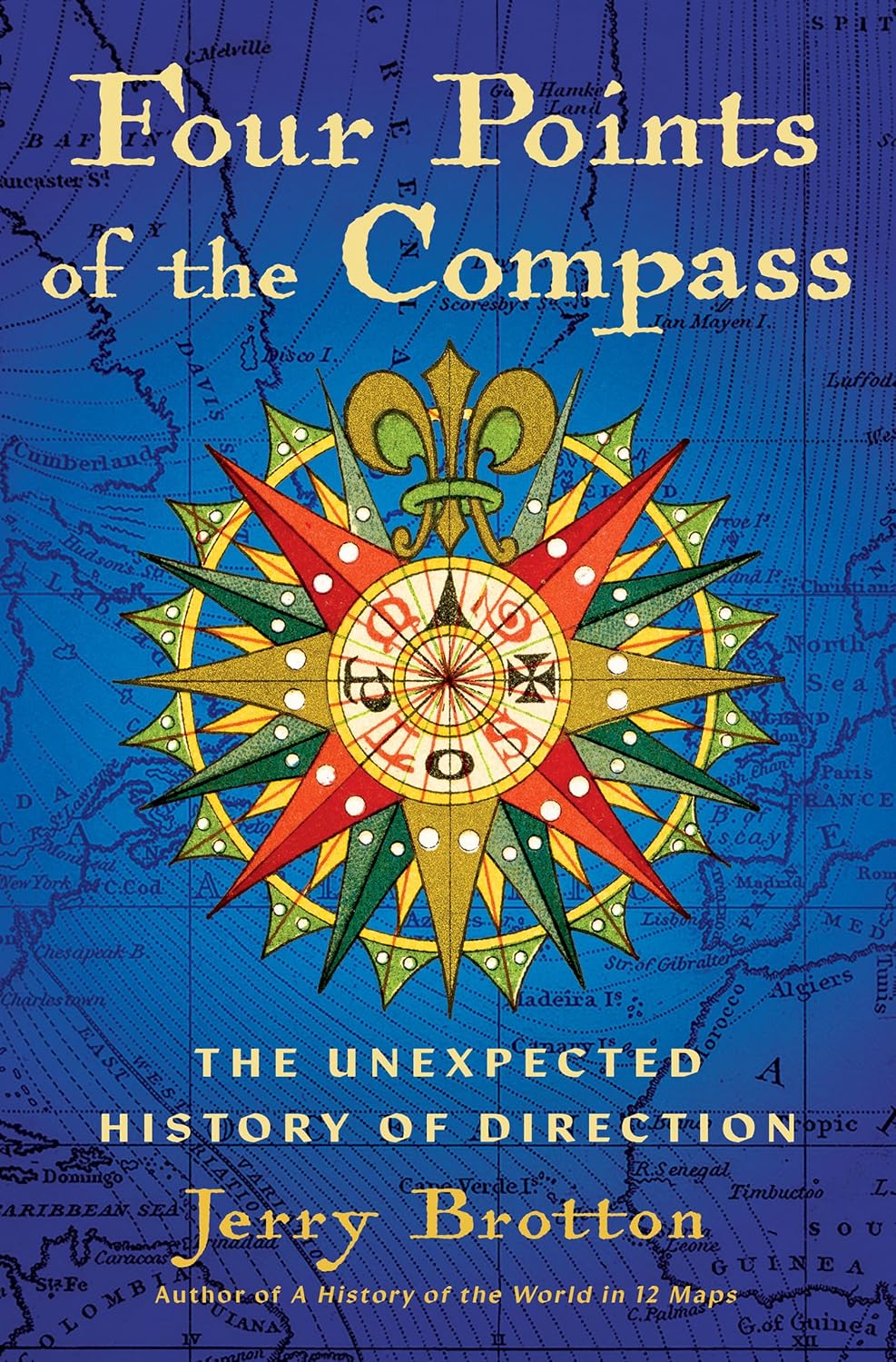
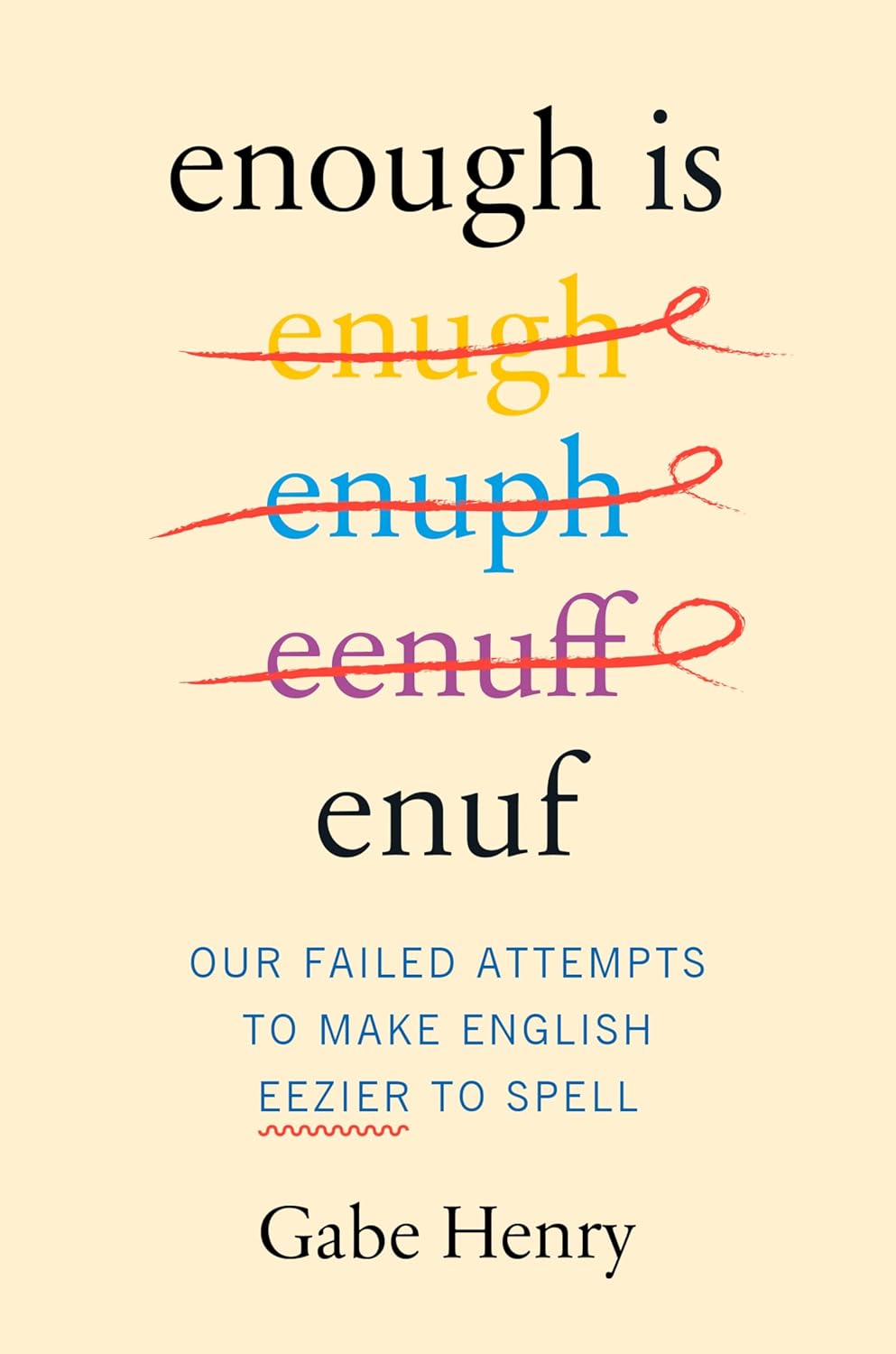
enough is enuf: Our Failed Attempts to Make English Eezier to Spell
- By Gabe Henry
- Dey Street Books
- 304 pp.
- Reviewed by Randy Cepuch
- May 5, 2025
It’s “I” before “E,” except after…oh, screw it.
“Simplified spelling is all right, but like chastity, you can carry it too far.”
– Mark Twain
What words in the English language do you think should be spelt, er, spelled differently? No matter which ones they are, you’re likely to have notable allies — perhaps even including Andrew Carnegie, Benjamin Franklin, C.S. Lewis, George Bernard Shaw, and Upton Sinclair, all of whom advocated for simpler spelling.
And it’s not that they (and you) don’t have a point: English spelling is often illogical and even nonsensical. As author Gabe Henry observes in enough is enuf, we have 26 letters but 44 sounds, with so many letters doing double duty — such as c in cup, lace, and charge, or h in honor, thicket, and laugh. Also, there’s an average of four ways to spell each of those 44 sounds; consider cat, kid, chrome, and queen.
Hundreds of years ago, nobody cared. Shakespeare wasn’t consistent with the spelling of his own name. But as books became more common and literacy more widespread, adhering to standards made life easier for printers and readers. In 1755, British writer Samuel Johnson published his A Dictionary of the English Language — eight years in the making — then by far the most ambitious effort to establish what words meant and how to spell them.
Meanwhile, across the Atlantic, the Revolutionary War was underway, and Americanisms were evolving, partly out of hatred for the British enemy. When the war ended, still angry but newly independent Americans talked of adopting a language other than English.
Noah Webster, who’d previously peddled spelling books based on Johnson’s dictionary, suggested a more manageable compromise: no-nonsense spelling. He set to work on an American Dictionary that dwarfed Johnson’s project, including more than 70,000 words versus Johnson’s 40,000. Its publication in 1828 effectively launched American English, generally by simplifying British English. Among the examples: “Draught” became “Draft,” “Cheque” became “Check,” “Programme” became “Program,” and “Colour” became “Color.” (Founding Father Ben Franklin, a budget-conscious printer who complained that silent letters were costly, would’ve approved.)
Still, it wasn’t enough for some people, and their stories — mostly well-intentioned but amusing failures — fill the remaining pages of enough is enuf. Brigham Young, for one, promoted a new alphabet he felt would help distinguish the Mormon Church and serve as “a symbol of unity and a barrier to assimilation,” but his flock chose not to follow.
Andrew Carnegie, responsible for building more than 2,500 libraries across the country, formed the Simplified Spelling Board in 1906 and was roundly ridiculed by the press. Less than 30 years later, though, the Chicago Tribune introduced what it called Saner Spelling — changing the way 24 words were spelled in the daily paper (e.g., “hockey” became “hocky” and “definitely” became “definitly”). Readers didn’t respond favorably.
Mark Twain waffled on the desirability of consistent spelling. At one point, he opined, “Sameness is tiresome; variety is pleasing.” But he also said, “Simplified spelling is all right, but like chastity, you can carry it too far.”
George Bernard Shaw did go too far, endowing part of his estate to fund the construction of a new alphabet with at least 40 letters. We still use the same old 26.
Of course, English evolves. New words appear and old words change: “aeroplane” became “airplane,” for instance. And advertisers have long teased us with creative spellings (Cheez-It, Tastykakes, Kleenex, Kool-Aid, Krispy Kreme, Kit-Kat) and claims of services that will make your life “EZ.” Prince was using “U” for “you” well before texting arrived to make that terser alternative near-ubiquitous.
For its part, rock ‘n’ roll has given us band names like U2, Split Enz, and Def Leppard, plus song titles like “Thank You (Falettinme Be Mice Elf Agin)” and “Cum on Feel the Noize.” In most cases, these represent intentional rebellion and haven’t spread. But only a pedant would argue that the Who’s “The Kids Are Alright” isn’t spelled just as it should be.
Whether or not you’re one of those people who’s even now turning the aforementioned into “all right,” you’re likely to enjoy this book if you’re curious about our language. A minor caveat, however: If you have some pedantic leanings (guilty!), there may be a few too many “cleverly” spelled bits, including several chapter titles (“A Nue Merrykin Dikshunary,” “The Sentinial Ekspozishun,” “Ruzevelt Spelling,” etc.). Proceed with cawshun.
Randy Cepuch is a member of the Independent’s board of directors, a frequent reviewer, and a big fan of Cheez-Its. He has a list of the 28 different ways he’s seen his own last name misspelled — most more or less plausible and a few that might be distinct improvements.