Enshittification: Why Everything Suddenly Got Worse and What to Do About It
- By Cory Doctorow
- MCD
- 352 pp.
- Reviewed by William Rice
- October 13, 2025
Believe it or not, Big Tech can be reined in.
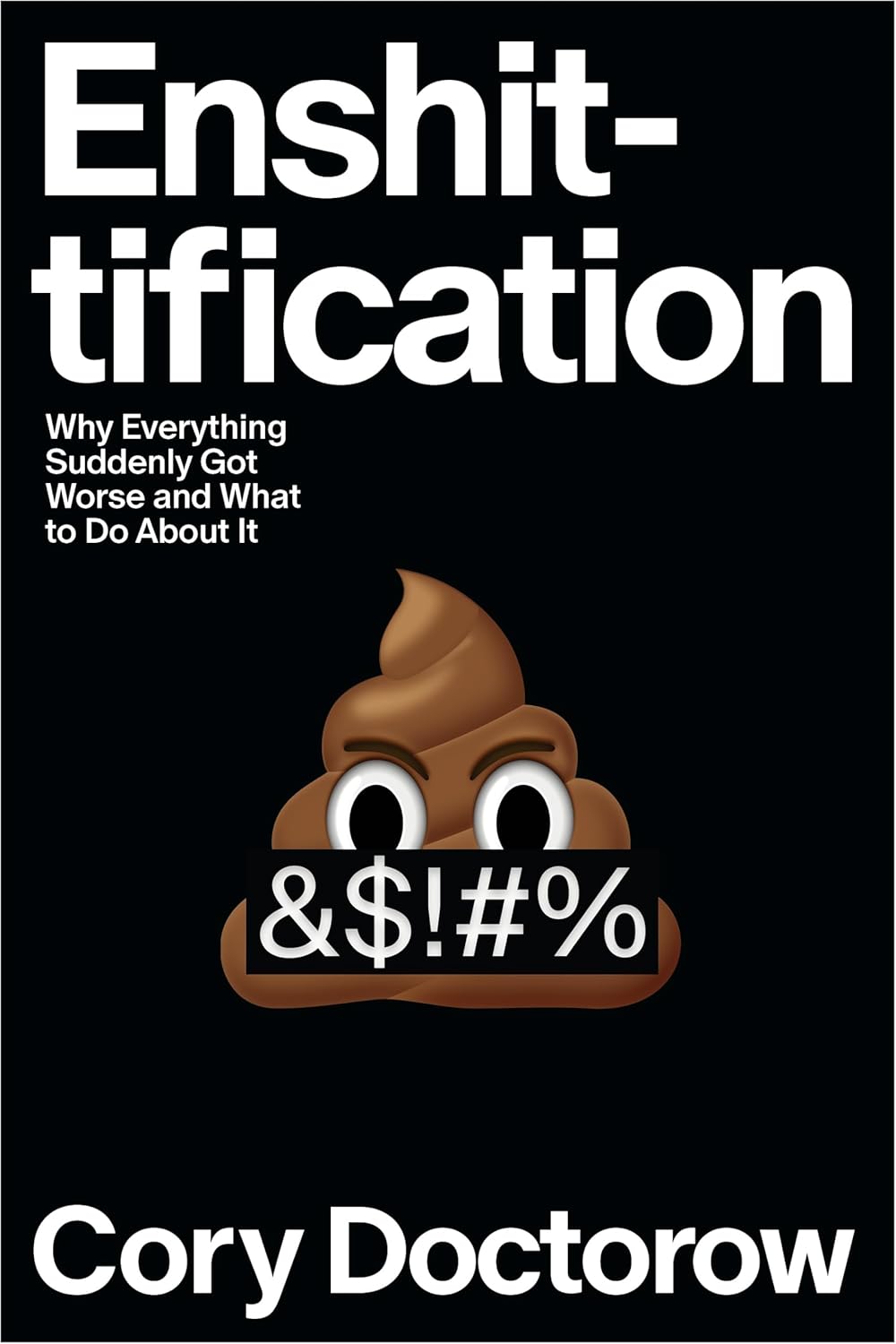
This book’s title (and the many variations of it contained in the text) raises a different objection in my old-fashioned brain than the one so energetically pursued between its covers. There, author Cory Doctorow makes a masterful case against the increasingly predatory behavior of monopolistic Big Tech. The title Enshittification, which I assume the Independent will dutifully publish without elision [editor’s note: Indeed!], is to my delicate sensibility evidence of an unnecessary coarsening of public discourse and a corresponding weakening of scatological language through overuse.
But enough about that. His point is important.
The phenomenon Doctorow so rudely but effectively describes is the tightening profit squeeze on everyone who interacts with Apple, Meta, Google, Microsoft, and our other few corporate overlords. The inescapable nature of modern technology combined with decades of business consolidation — unimpeded by the rusting mechanisms of anti-trust laws — have created money-making monsters that can freely jack up the prices of their goods and services while simultaneously diminishing their quality.
Whether it’s an iPhone user legally prohibited from having his device repaired at the local fix-it shop, a small business whose products are cloned by Amazon, or an Uber driver inadvertently pushing down her own wages by working too hard, Doctorow makes it clear that we’re all suffering from the same problem: too much power in too few hands.
What makes this book a welcome departure from similar jeremiads abundant in these troubled times is its unexpected and irrepressible cheer that shines through the gloom. Even before we reach the proposed solutions at the end of his story, the author ensures us everything he’s complaining about can be remedied and, in fact, that the tide is already turning.
Despite some histrionics and personal animosities, Doctorow acknowledges that the people running these profit-hungry monopolies are not inherently evil. They’re simply following the capitalist creed of maximizing profits by any means necessary. If we, the public, want to be treated decently, it’s up to us to enforce some limits through public regulation. The assumption that corporate misconduct lay in human villainy rather than in human nature was what fooled the founders and admirers of Google into believing that its self-admonitory slogan (“Don’t be evil”) would keep the company free of sin.
The book tells us that the money Google and Co. are making is not really profit but rent (as that term is more broadly used by economists). In Doctorow’s definition, profit is what you get from selling a product or service for more than it costs to create, while rent is what you get from the mere act of owning something — whether an apartment building or an online platform. He says that copyright and other laws covering intellectual property have been so radically reinterpreted that they’re now being used to protect the rights of owners rather than creators. He maintains that the rentiers win out over the true capitalists when “the government steps in to defend people who own things from people who do things.”
The instruments of Big Tech’s control are familiar to many of us but are made extra vivid by Doctorow’s punchy prose. In describing the high “switching costs” of quitting a social-media platform — you can’t easily pack up all your posts, photos, and especially friends — the author notes:
“Facebook users can’t help but take one another hostage.”
Some of Doctorow’s relative cheer may stem from the fact that he’s not American, especially during one of the most painful periods to be one. A Canadian, he has proximity combined with just enough distance (a winning combination shared by Canuck comedians and other social commentators) to offer a clear-eyed critique of what’s wrong with the United States — in this case, how and why we aren’t properly taming the beasts that have emerged from Silicon Valley.
The abuses described are often pretty bad. Court records show Google decided to make its search results worse so that users would need to keep searching and thus be exposed to more ads. Amazon drove Diapers.com out of business by temporarily and unsustainably undercutting its prices, both to rid itself of a competitor and as a warning to others. After boasting that it was blocking attempts by others to spy on its users, Apple engaged in the same kind of surveillance. And the dominant internet platforms pocket over half the revenue generated by their customers’ ads.
Still, Doctorow counsels against regulation that tries to improve the behavior of the tech giants rather than cut them down to size. “We can make the platforms less important,” he writes, “rather than making them less terrible.” He sees another solution in the reinvigorated labor movement, since the idealistic, once-scarce tech workers who used to be a check on company misdeeds are becoming increasingly expendable. And a four-decade misinterpretation of anti-trust laws must be corrected, a process that had a promising beginning in the Biden administration.
The author’s exhaustive and exacting indictment of Big Tech creates the kind of outrage reflected in his indelicate title and attendant verbiage. But for this reader, at least, it could’ve been more elegantly expressed.
William Rice is a writer for political and policy-advocacy organizations.
.png)