Evelyn in Transit: A Novel
- By David Guterson
- W.W. Norton & Company
- 256 pp.
- Reviewed by Marcie Geffner
- January 28, 2026
Is a woman’s young son a reincarnated Buddhist lama?
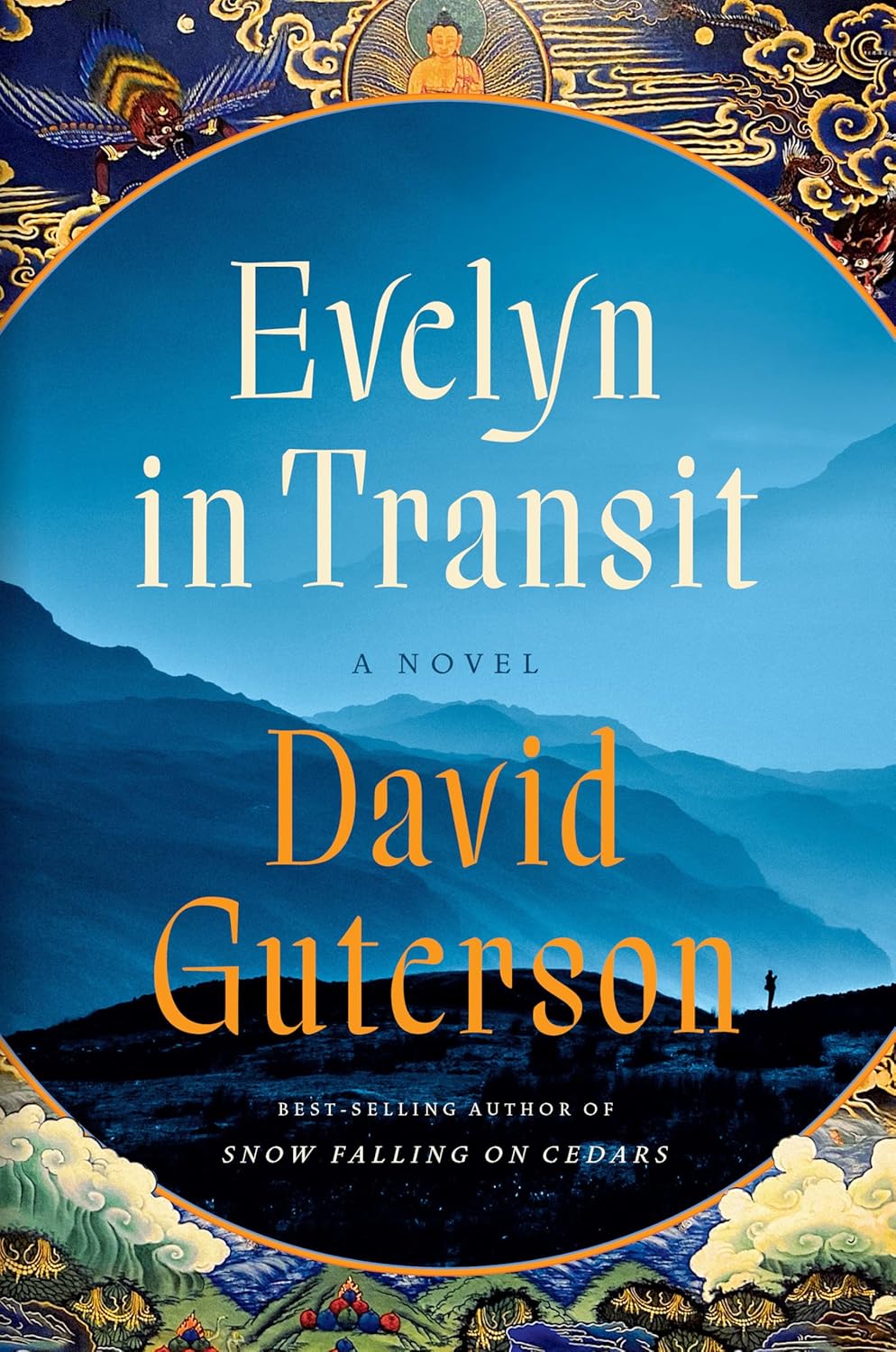
The two main characters in David Guterson’s thoughtful and thought-provoking new novel, Evelyn in Transit, never meet each other during their lifetimes.
Or do they?
The answer isn’t clear. Nor should it be. Because while Guterson’s story explores the tension between the Christian promise of an afterlife and the Tibetan Buddhist concept of reincarnation, that’s not his only or even his main interest. He also considers how what people believe will happen to them after death affects their choices and relationships in life.
Born in Evansville, Indiana, in the 1960s, Evelyn Bednarz is a curious, playful, rebellious girl who’s expelled from her Catholic school for repeatedly kicking a soccer ball over the school’s fence in violation of the rules. As a teenager, she excels at dead-end jobs as a dishwasher in a fried-chicken restaurant and a cleaner in an eldercare home.
Then she walks away:
“It was late June. She could sleep outside. Nothing would be better or worse than the next thing. Everything would be equal. There’d be nothing to complain about. Whatever it was, it would be her own doing. All she wanted was to live the right way, if that wasn’t asking too much from life.”
In the months that follow, Evelyn hitchhikes to Minnesota and beyond, picking up work as a day laborer and caregiver. At a Buddhist retreat center, she carries rocks up a hillside and meets a teacher, Lama Lobsang, who introduces her to Buddhist thought. Back on the road, she hooks up with Scott Widera, a talkative control freak and fellow nomad who abandons her days before she realizes she’s pregnant.
Born in Tibet, Tsering Lekpa is sent at age 6 to live with his great-uncle, a Buddhist monk, in a primitive hut that’s accessible only by a ladder. Once Tsering learns to read and write, he’s moved to a community of a thousand monks, where he’s informed that he’s the sixth incarnation of Norbu Rinpoche, a respected Buddhist leader, and that signs and omens have shown he’s destined to become the monastery’s abbot.
Then he walks away:
The next morning Tsering said to [his brother] Sonam, “I’m running away.”
“How come?”
“I’m tired of the monastery. Tired of studying.”
They went to the stables. “Which donkey is the oldest,” Tsering asked. “I’ll take the oldest. When they ask, just say I’ll replace it with a younger one. Eventually. When I return.”
During his travels, he encounters antelope hunters, European photographers, and monks from other monasteries. Upon returning, he’s appointed to his promised position, but soon after, he’s forced to flee and later meets an American professor who will change his life.
Despite their disparate backgrounds, Evelyn and Tsering have two traits in common: They’re discontented with their lot in life and compelled by their circumstances to wander in search of something they can’t identify but sense is missing.
That may all sound like a setup for a slow-moving story, but the pace of Evelyn in Transit rarely falters as the seemingly episodic events and chance encounters of Evelyn’s and Tsering’s travels eventually result in a destiny that entwines them together.
The secret of their connection is revealed late in the novel when a trio of Tibetan lamas arrives at Evelyn’s home with some startling news: They believe her 5-year-old son, Cliff, born 10 months after Tsering’s death from heart failure, is the seventh Norbu Rinpoche. The lamas’ hope is that Evelyn will take the child to Nepal to live in the Thaklung monastery and eventually become its abbot.
Evelyn’s mother, older sister, and brother-in-law scoff at the notion that Cliff is a reincarnated anything, but Evelyn isn’t so sure. The narrative stalls at this point with too much detail about Cliff’s very ordinary little-boy interests in toy trains, bologna sandwiches, coloring books, and cartoons that feature airplanes. The tension then builds again as Evelyn’s doubt about her son’s identity impels her to resume her wandering in search of answers, this time with Cliff — or is he Norbu Rinpoche? — in tow.
The author of 13 books, Guterson is best-known for his tedious and cringey 1994 blockbuster, Snow Falling on Cedars. Set on an island in Puget Sound in 1954, the novel combines a racially motivated murder trial with a forbidden interracial romance and lengthy descriptions of windy and snowy weather.
While Evelyn in Transit may seem less ambitious, it’s equally sweeping in its worldview and offers a surprising and life-affirming ending that reveals the unnamed narrator’s identity and purpose in telling the story. With a more mature and less sentimental voice, better pace, and more authentic characters, it’s arguably a better novel than Guterson’s earlier bestseller.
Marcie Geffner is a journalist, essayist, and book critic in Ventura, California.