Facing Infinity: Black Holes and Our Place on Earth
- By Jonas Enander; translated by Nichola Smalley
- The Experiment
- 368 pp.
- Reviewed by Paul D. Pearlstein
- November 28, 2025
Lay readers can handle this semi-deep dive into a challenging topic.
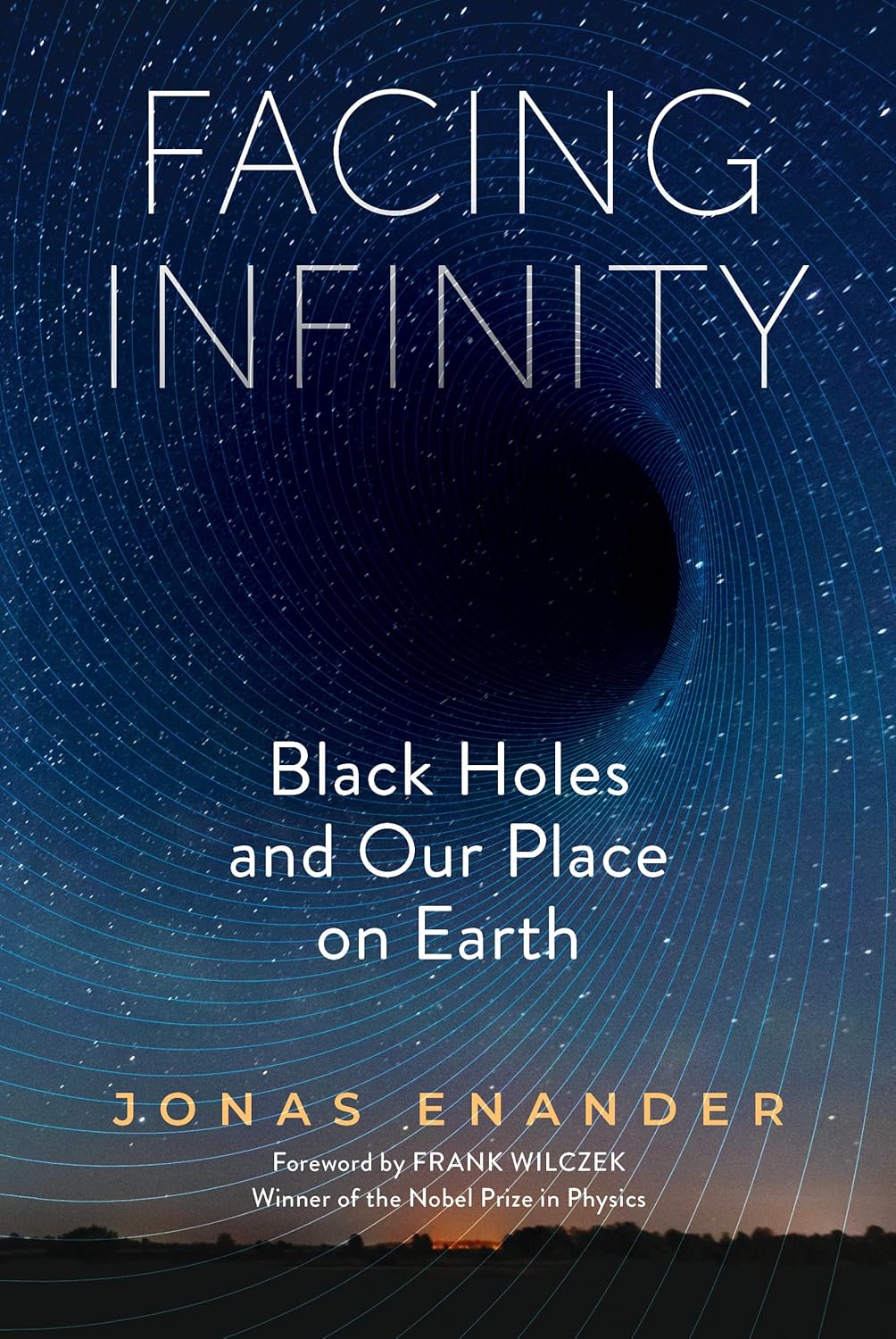
Though the putative subject of Facing Infinity is black holes, the book also serves as a good general course on physics and astronomy. In it, author Jonas Enander, a Swedish physicist, discusses both the history and science of black holes, making for a complex read on an altogether fascinating topic. Kicking off the proceedings is Nobel Laureate Frank Wilczek, whose foreword provides a short but excellent introduction of what’s to come.
Enander has worked as a science communicator and podcaster, so I expected him to make his complicated material understandable to a nonscientist like me. He succeeds at least partly, but Facing Infinity offers no free ride. I had to re-read several pages before some of the information sank in.
Our tale begins in 1767 with John Michell, a British priest who believed he’d detected solar objects that did not emit light. A celebrated former scientist, the vicar was trying to find a method to measure the distance of other stars from Earth by weighing those stars. He felt this could be done by measuring the light of the subject star as affected by gravity.
Michell was surprised to observe that some apparent stars didn’t emit light. He couldn’t see them, but he suspected they existed because other stars moved around the dark spaces, suggesting a gravitational field. But Michell’s hypothesis wasn’t accepted for centuries; even Albert Einstein was a skeptic at first. Black holes, in fact, weren’t definitively observed until the 21st century. The first photograph of one was captured in 2019; the first Nobel Prize for work on them was awarded a year later.
Black holes, Enander explains, result when stars explode or collapse at the end of their life cycle, leaving behind an extremely dense core mass called a singularity. This core is so dense that it prevents anything from escaping it, including light. Hence, a black hole. (The late Stephen Hawking theorized that black holes may actually emit some light. If he is proven correct, our current understanding of them will need to be revised.)
Most dying stars, however, don’t form black holes. Instead, they may become white dwarfs, black dwarfs, or neutron stars. White dwarfs — which lack sufficient mass to create black holes — are the debris from a recently exploded star, while black dwarfs are cooled-down white dwarfs that have stopped emitting heat and light. Neutron stars, comprising the remains of enormous exploded stars, have exceptionally compact cores and powerful magnetic fields that produce light and heat.
Illuminating these heavenly phenomena like interstellar searchlights are quasars — incandescent electromagnetic radiation emitted by material in distant galaxies being sucked into black holes — and pulsars, highly magnetized, rotating neutron stars that emit beams of electromagnetic radiation at the rate of a thousand pulses per second.
To tell his cosmic story, the author transports readers to many of the world’s finest observatories and introduces us to some of his colleagues. Amid the occasionally gossipy tale are meatier explorations of, among other topics, Newtonian gravity, the Special and General theories of Relativity, quantum mechanics, non-Euclidian geometry, dark matter, and, of course, black holes themselves.
We learn from Enander that there “may be more than a hundred million black holes in the Milky Way galaxy alone,” and that a gigantic one named Sagittarius A* sits at its center. (More startling is learning that there exists a black hole in the universe that’s 68 billion times the mass of our sun.) We’re informed that Sirius, the most brilliant star in our night sky, is the closest neighbor to the sun (at 8.6 light years away), while the bright red supergiant Betelgeuse, in the constellation Orion, is 640 light years away.
In describing the study of black holes, Enander pays tribute to more than 200 of the people (past and present) in the field. A good deal of Facing Infinity is taken up by biographies of prominent figures like Copernicus, Galileo, Hawking, and J. Robert Oppenheimer, along with lesser-known individuals like Hermann Minkowski (Einstein’s first math teacher) and mathematician Marcel Grossmann, Einstein’s classmate and friend. The author personally interviewed many of the contemporary scientists discussed.
Because black holes are as much the stuff of imagination as they are of science, their study isn’t just for astronomers. Research on black holes led the way to the invention of Wi-Fi, GPS, and the global navigation of satellites. The study of black holes may even help us understand climate change: Quasars, for example, can be used to measure continental drift and the rising sea levels drowning islands in the Pacific.
We’re just beginning to learn how Earth is affected by astronomical oddities like black holes. There’s speculation that our planet may be on the edge of one (or even inside one). Perhaps our entire universe is just one big black hole? Hopefully, higher-tech telescopes will one day be able to tell us. Stay tuned.
Paul D. Pearlstein is a retired lawyer who has always been fascinated by our universe.