Fair Ones: A Double Novel
- By Lydia Millet
- W.W. Norton & Company
- 384 pp.
- Reviewed by Jennifer Bort Yacovissi
- November 19, 2026
Life might be insane, but finding your peeps makes it bearable.
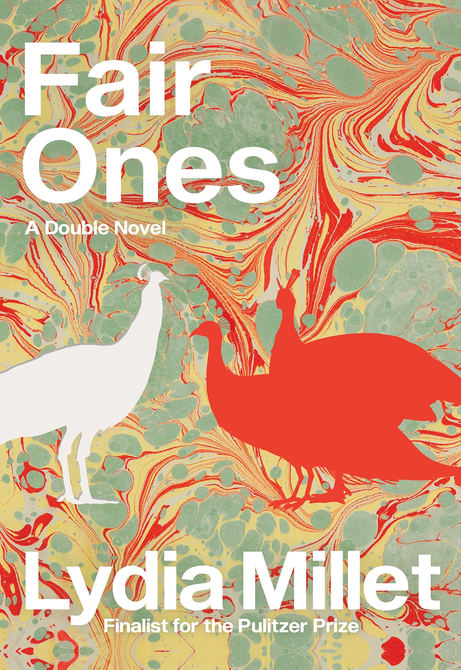
If, in the aftermath of reading Lydia Millet’s A Children’s Bible, you’re still feeling a little like Wile E. Coyote after the TNT explodes in his paw, here’s a chance to recover your equilibrium. Though it touches on many of the same themes as that Pulitzer-finalist novel of societal collapse, the author’s Fair Ones is far gentler — funny, warm…dare I say, even hopeful.
That’s not to say it isn’t fraught.
Claire, Jen, and Mara meet in college and team up to take New York by storm, at first living together before deciding they should pull toward adulthood by finding their own places in the city. Now, they are in their early 40s.
Gorgeous Claire is the eternally good one, living modestly and seeing the best in everyone as she works as a public-school guidance counselor. Mara is a private tutor for the kids of well-heeled parents, and Jen is the snarky, cynical ex-journalist now working at a soul-sucking job as “an editor at a former magazine company, recast as a multimedia content platform.”
Mara grew up with her mother, Fern, in Maine and had to drop out of high school to work, get her GED, and pay her way through college. Claire’s was a heartland family in Iowa, scraping by but intact. Jen lived a privileged life of boarding schools and endless opportunity, though it turned out that all of it was paid for by her father’s talent for embezzlement.
The book opens at a gathering at Claire’s favorite neighborhood restaurant immediately after her memorial service. Claire has been killed in an accidental shooting at her regular bus stop. “Inside the restaurant, people were gathered for our best friend’s wake,” Mara reports. “It was unthinkable and also a fact. This is unreal, we’d said to each other first. This is surreal, this is hyperreal. In the end we had to settle for real.”
Given the gravity of the situation, readers may be surprised at the comic, even antic, tone they’ll find. Mara and Jen have agreed to avoid the topic of Claire’s death — “the event” — even as they are hosting her wake, so their conversations skip across the surface. The women know few of the wake’s attendees beyond Jen’s significant other, Richard, and Claire’s family.
One unexpected guest is an old, bad boyfriend, a finance bro who goes by Jase and whom nobody but Claire ever liked. “They’d been one of those couples where, from start to finish, the woman’s friends chant from the sidelines: Please, get away! Run away now!” But Jase is flush with money and drugs, the latter of which is irresistible to Jen. Improbably, they end the night in Jase’s huge loft with his posse and some other mourners.
From this start, the story simply flows from one incident to the next as the days after Claire’s death unspool. It’s curious that Millet calls this a “double novel,” when it’s really just a story told in two distinct parts. Mara narrates the first half, “Fair,” which takes place over the course of the year immediately following Claire’s death, and Jen relates the second, “Ones,” also over a year, though a slightly later one. The parts would not effectively stand on their own; both halves are crucial to weaving the tale into a meaningful and affecting whole. It is Millet’s talent for such weaving that makes the book so captivating.
The antic pace gradually begins to ease — not so much slow as sober up, like a user coming down off a high — as the two best friends, groping their way through Claire’s loss, begin to gather to themselves their own unlikely posse.
The first is Claire’s dog, Hombre, aka “the hound,” whom Mara had casually agreed to take should anything ever happen to Claire. There is Richard, whom Jen prefers to keep at long distance; Pavan, the memoirist and ghostwriter from Claire’s book club whom they meet at the wake; Caleb, Claire’s in-recovery brother; Richard’s teenage daughter, Lee, who should be insufferable (with her dictates and huge suitcase) but somehow is not; and Lauren, Jase’s current/erstwhile squeeze, whose help manages to offset her insufferableness. There’s also Emmie, another book-club member whose special-needs child consumes her existence; Fern, who now requires memory care; Eli, the parent of Josh, one of Mara’s tutees; and, perhaps most especially, Josh himself.
That posse, in various formulations, is called to ride when Jen goes off the grid and needs to be tracked down; when Jen’s suspicions about the circumstances of Claire’s death prove prescient, and the gang marshals its facts to present to the police; when Mara needs to spend more time in Maine with Fern; as members fall in love or further in love; and when other episodes demonstrating all that is tragic and ridiculous in life rear their heads and remind us that having a dependable crew makes things bearable.
But this is a book about which it feels like a disservice to tick through plot points, because the joy is mainly in how Millet simply relates her story of people finding each other and themselves in an insane world.
All of the existential issues pressing down on us in our current timeline are here, including Jared Kushner. Richard worries that Lee will be choosing which pair of shoes to wear as the floodwaters rise around her, and Mara finds herself beset by visions of desiccation and decay. But Josh, who is reticent to the point of muteness with his teachers, leads Jen and Richard on a weeklong journey into the wilderness that offers a glimpse of other, brighter possibilities.
In the times we’re living in, we could all use that glimpse.
Jennifer Bort Yacovissi’s novel, Up the Hill to Home, tells the story of four generations of a family in Washington, DC, from the Civil War to the Great Depression. She reviews regularly for the Independent and serves on its board of directors as president. Follow Jenny on Bluesky at @jbywrites.bsky.social.

