Family of Spies: A World War II Story of Nazi Espionage, Betrayal, and the Secret History Behind Pearl Harbor
- By Christine Kuehn
- Celadon Books
- 272 pp.
- Reviewed by David A. Taylor
- December 22, 2025
Think you’ve got skeletons? Meet this subterfuge-soaked clan.
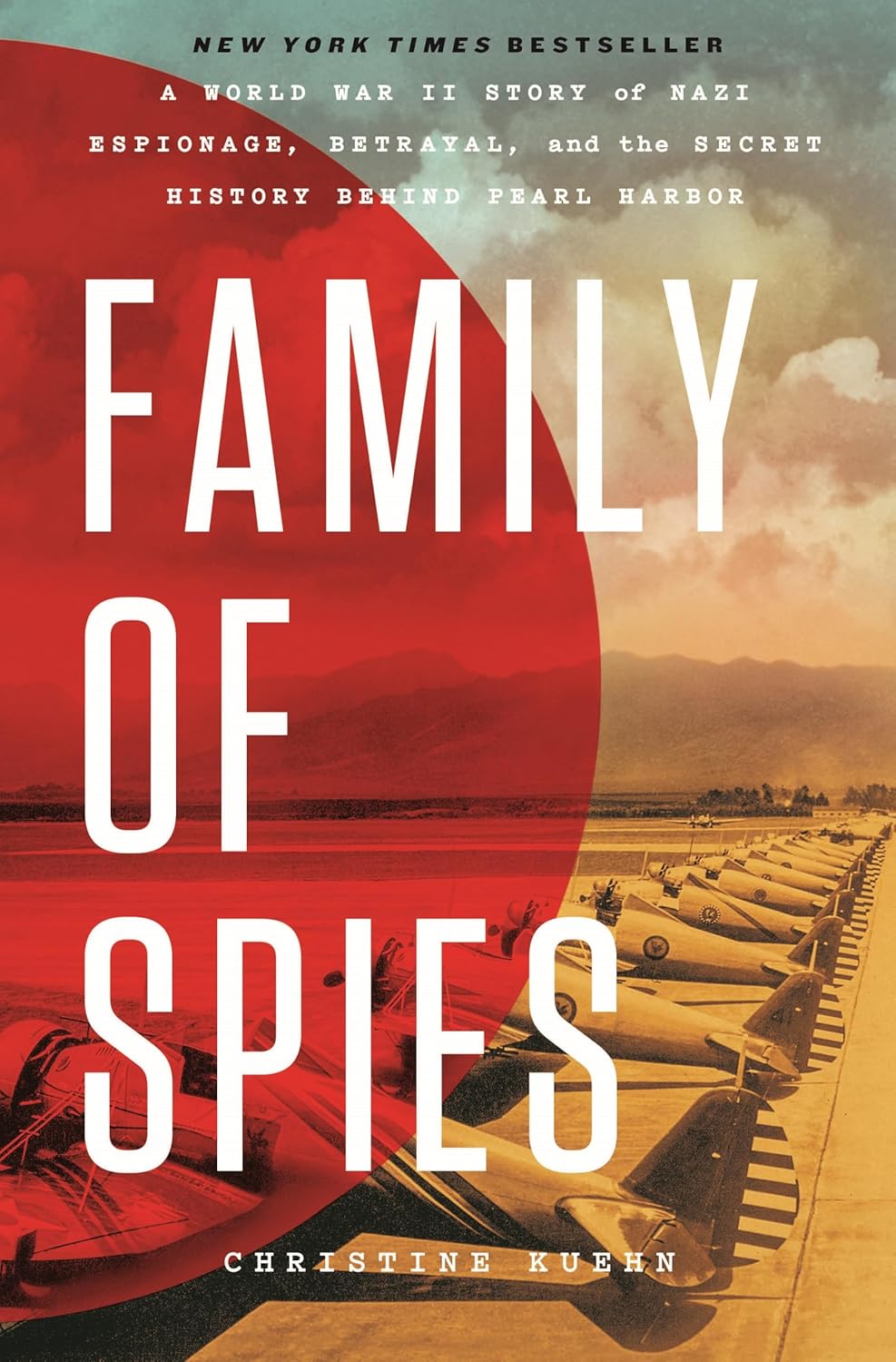
Family secrets: We all have them. But few have darker ones than Christine Kuehn. Her story starts harmlessly enough: Her big, goofy father liked to tell “fantastic, almost unbelievable tales of alligators appearing out of the weeds” hungry for a taste of their family dog, or of how he once found a small boy lost by the road and saved him.
One tale he never told — except very selectively — involved his childhood in Hawaii and what his parents did there. Mostly, aside from sharing an outrageous tale of playing with child star Shirley Temple, he was mum about his real-life upbringing.
But when the author connects with her long-lost Aunt Ruth, there begins a fitful journey across decades and a minefield of guilt and terror. She even asks her boyfriend to accompany her to meet this mysterious relative. “Not your classic date,” he replies, “but sure.”
In Family of Spies, Kuehn patiently uncovers the tale that her aunt tried to scare her away from pursuing. The author probes her father as his memory starts to fade. She finds documents and old press clippings, reconnects with relatives she never knew, and finally gets an FBI file that fills in gaps. From the author’s German grandparents’ exile from Berlin’s inner circle and journey to Oahu in the 1930s, the narrative builds like a typhoon, strengthening slowly and unleashing the shock that brings the United States into World War II on Dec. 7, 1941.
Even if you studied the Pearl Harbor attack in school, Kuehn relates the events in a way you’ve never heard. Hers is a view inside a family of Nazi spies who secretly helped plan the attack. A man dressed as a ship steward appears topside for a minute and then returns belowdecks, having surreptitiously exchanged messages with someone. Aunt Ruth later escorts the man, a spy from Japan, around the island. Meanwhile, when an FBI special agent swoops in from the mainland to ferret out spies, he’s frustrated at being frozen out of Honolulu’s Asian community. So he hires a Japanese American college student who comes to live with him and his wife, becoming a kind of “adopted daughter” — even though he can’t pronounce her name.
The book’s strand about the FBI’s effort to uncover espionage and sabotage operations in the months before the attack is especially tense. Then there’s the indiscriminate roundup of the Asian community after the attack and the unwarranted detention of so many “enemy aliens” in inadequate camps on a spit of sand.
That sidebar story about the FBI agent, Robert Shivers, and what he learned from going to Hawaii is haunting. The college student, whom he called Sue, opened a window and humanized an entire community for him. “He was astonished to find, contrary to what he had heard in Washington, that many Japanese Americans were fiercely loyal to their adopted country,” writes Kuehn.
Because of Sue, Shivers fought an order from J. Edgar Hoover and President Franklin D. Roosevelt to detain Hawaii’s entire Japanese American population — 160,000 people. Meanwhile, on the mainland’s West Coast, 120,000 people of Japanese descent had no such protection and were incarcerated in remote camps, without due process, for the duration of the war.
The saga of Kuehn’s family is wrenching, and the author deserves credit for her unflinching research and honesty in painting what may be the least flattering portrait ever of one’s own grandparents. She seems aware that she is serving history, so this is not a vanity project (although it does acquit her father — a teenager in 1941 — of playing any role in his Nazi parents’ clandestine activities).
Kuehn has structured the book with a keen sense of drama, balancing foreshadowing with suspense so that her recounting of the horrific Pearl Harbor attack manages to grip the reader, and its aftermath unfolds with an air of tragedy. She also weaves in the process of her research, sharing how each revelation brought both dread and excitement.
There are a few places in the narrative where repetition mars an otherwise well-written tale, but no matter. Anyone curious about complicated filial dynamics and how they get wrapped around history’s axle will want to pick up Family of Spies.
David A. Taylor’s books include Soul of a People, about the WPA writers, and Cork Wars: Intrigue and Industry in World War II, which received an Independent Publishers Book Award for world history. He teaches writing at Johns Hopkins University and produces a history/culture podcast, “The People’s Recorder,” which was awarded a 2025 Signal Award.