Few and Far Between: A Novel
- By Jan Carson
- Scribner
- 336 pp.
- Reviewed by Nicole Schrag
- October 6, 2026
A fictive Northern Ireland archipelago houses a slew of unusual folks.
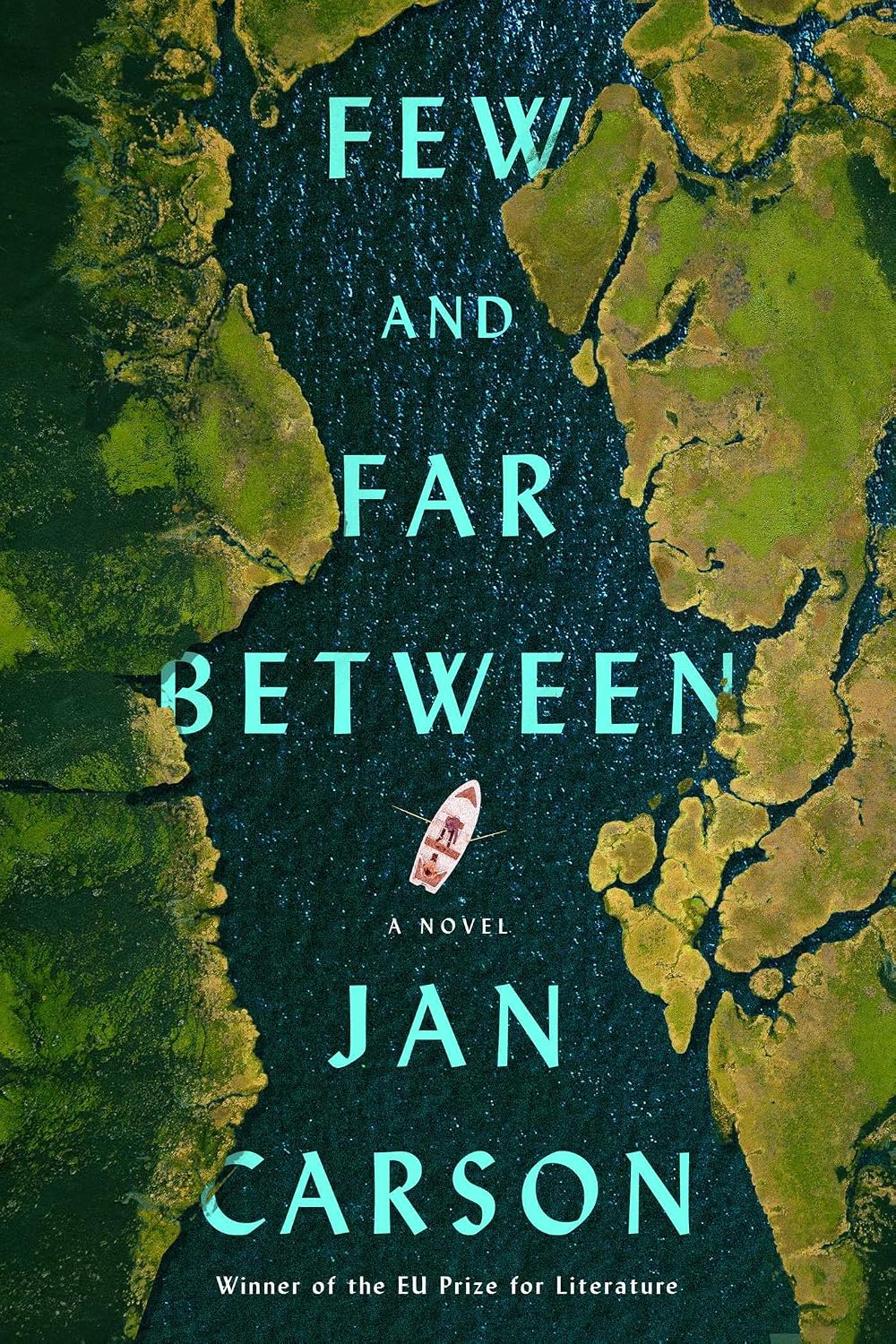
In the 1950s era of the Troubles, a Northern Irish politician advocated draining the region’s largest lake, Lough Neagh, to form a seventh county. The project never came to fruition, but in Jan Carson’s Few and Far Between, it inspires an alternate history in which the lake was indeed drained, and the archipelago that formed in its wake, nicknamed the Ark, provided a home for ghosts, a haven for the mysteriously comatose, and a utopian community for people who didn’t fit in with polite society, especially people in Protestant-Catholic marriages.
In 1972, a gregarious anthropologist named RJ Connolly and his family went to live on the Ark so that RJ could study the community. Decades later, long after his death, two of his aging children, Marion and Robert-John, serve as the primary caretakers of the Ark, which now has few residents. As the novel begins, the Connollys are confronted with two pieces of news. First, the government is seriously considering flooding the lake (and, thus, the Ark) in an attempt to wash away the toxic blue-green algae infesting local waters. Second, Alex Anderson, a young recipient of an anthropology fellowship named for RJ, is returning to the Ark, where she spent part of her childhood, so she can do some fieldwork to put the finishing touches on a book about the area’s cultural and ecological significance.
As the three endure awkward shared meals and boat rides between islands, Robert-John and Marion both attempt to curate the story that Alex will tell: of the Ark as a heritage site, as a wildlife refuge — anything that will build the case for its preservation, so they can stay in their home on their beloved island of Small Flat. But the siblings have plenty to hide, too, both from Alex and from each other. Although Alex arrives with mostly favorable memories, Marion and Robert-John are sorely stretched to sustain an idealized portrait of the Ark and its founder for their smart and nosy houseguest.
Chapters alternate between a close-third-person narrator who follows multiple characters and excerpts from Alex’s book-in-progress, which gives vital context about the origins of the utopian project and about some of the Ark’s distinctive history. From Alex, we learn about the islands’ particular characteristics, which verge on the surreal. Carson expertly uses these multiple narrative modes to pace readers’ gradual discoveries: Who are the Almost-Deads on Church Flat? Why does Marion so hate stopping at Tom’s Hard while on her rounds?
The author’s vivid, idiosyncratic worldbuilding complements a large and richly drawn cast. Seamus, in the manner of his father before him, delivers supplies to the islands; Sandra, a trans woman, paints and lives in near isolation, terrified by the idea of returning to the mainland after 50 years on the Ark; Rosemary, Robert-John and Marion’s older sister, lives on the mainland and gives Marion a phone that she loves but has to hide from her technophobic brother; and Darragh, an ethically conflicted government ecologist, surreptitiously collects data on the algae.
Though Few and Far Between has many speculative components, the toxic algae in Lough Neagh is not one of them. The real-life lake is plagued by cyanobacteria fed by fertilizer runoff. The problem of the book — whether or not to flood the Ark — doesn’t have direct relevance to the lake’s problems, exactly, but characters like Darragh point to pressing issues in managing Lough Neagh and other wetland ecosystems. Even if the “quick fix” of washing all the algae away were viable, it would still have to go somewhere, making it someone else’s problem, and “sooner or later, more likely sooner,” continued industrial and agricultural runoff would generate conditions for algae blooms to thrive again.
The environmental crisis is just one of many problems in which these characters find themselves enmeshed. Well into middle age, Robert-John still sags under the weight of the masculine ideal his father forced on him as a boy, one reinforced by his constant awareness of RJ’s widely celebrated legacy. Marion, having never left the Ark for more than short periods, finds herself confronting everything she’s missed, especially once she has access to the internet. “Fifty-three’s too old to understand so little about the world,” she thinks. And Alex loses her nostalgia for her childhood home, leading to changes in her own identity and to complications in the project she’d hoped would define her academic career.
Carson offers a gratifyingly complex reading experience with an engaging array of people and places. Funny, compassionate, and sometimes profound, Few and Far Between will likely satisfy readers eager to witness characters experiencing personal growth and learning to build community amidst uncertain times.
Nicole Schrag is a writer and editor based in Tampa, Florida.