Fit Into Me: A Novel: A Memoir
- By Molly Gaudry
- Rose Metal Press
- 208 pp.
- Reviewed by Marcie Geffner
- January 7, 2026
Truth is stranger than fiction is stranger than truth.
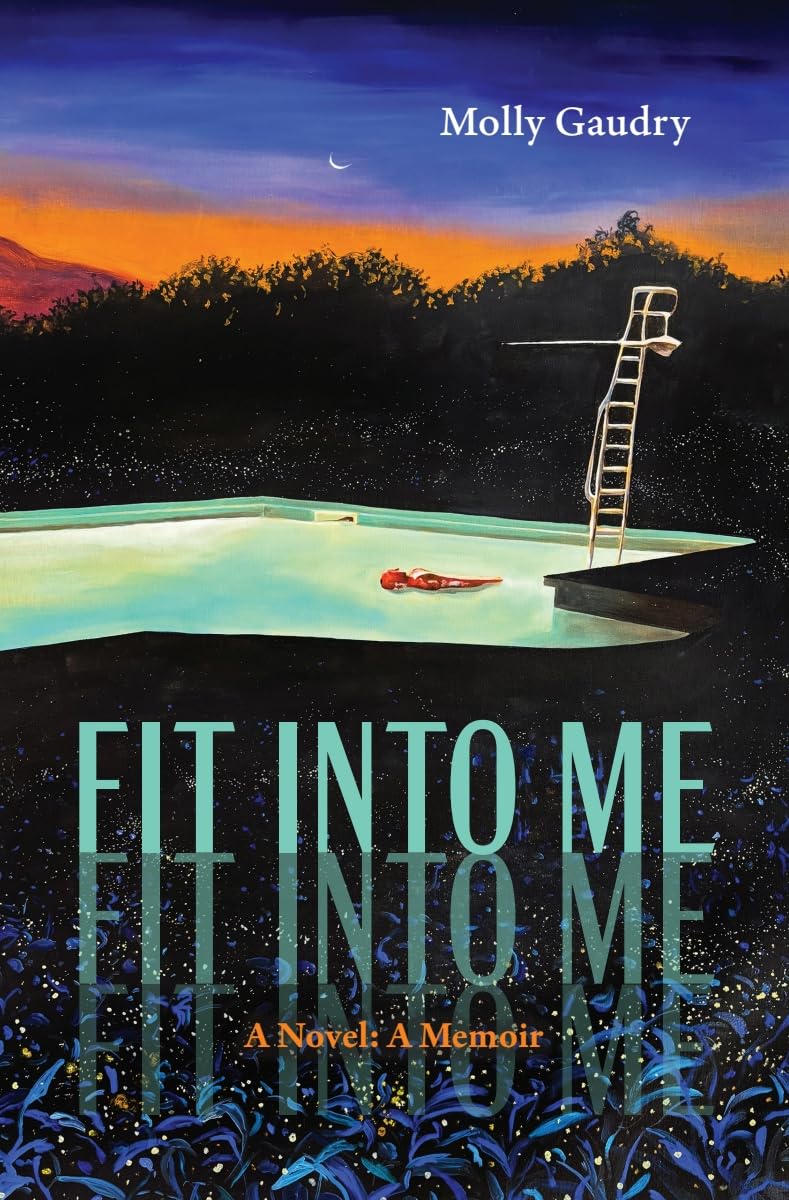
When writers’ lives inspire their fiction and their imaginations color their memoirs, where can a line be drawn between the two — or does no such line exist? Astute readers may point to “autofiction,” a mashup of autobiography and fiction, as the answer. But Molly Gaudry’s inventive Fit Into Me isn’t that. Rather, it is a true dual-genre work that is literally part memoir and part novel. The autofiction game of trying to guess what’s true and what isn’t vanishes as Gaudry demonstrates that the dichotomy itself is false:
“It wasn’t until the summer of 2015, a year later, that I had a breakthrough. Can my fiction fit into my nonfiction? Can my fiction get closer to the truth than my nonfiction? Can my fiction reveal and expose vulnerability, where my nonfiction might withhold?
“Writing toward these riddles became an obsession.”
The result is a delight because good writing isn’t mechanized, predictive output from an AI text-generating machine. Good writing is astonishing, vulnerable, original, and authentically human.
As the novel portion of Fit Into Me takes shape, Gaudry shows her writing process with notes, ideas, word lists, multiple drafts, and polished versions. What’s on the page is the real work of writing, a creative, messy, associative, hesitant, and painstaking process of seeking, finding, keeping, and discarding until only the necessary words remain.
The main character is the fifth-generation owner of a tea house and a spinoff from Gaudry’s earlier works, We Take Me Apart and Desire: A Haunting. She calls her character “the tea house woman” until the story reaches a point at which her name — Connie — is revealed through a friend’s memory of their childhood friendship.
The events take place from Christmastime through New Year’s Day and concern Connie’s stressful relationships with her lover, Giovanni; her friends Nell and Birdie; her elderly father, Sam; and Sam’s caregiver, Travis. As Gaudry advances the story, she shows, in ALL CAPS, how she used a word list she created from If Not, Winter: Fragments of Sappho translated by Anne Carson:
“Terrified he would go to SLEEP and not wake up, she treated her father like a Christmas ORNAMENT — fragile, afraid to shatter him. His SKIN was WHITER than the whites of his eyes.”
The memoir portion of Fit Into Me dips into Gaudry’s childhood, including an emotionally jarring trip to Korea during which she (maybe) met her biological father, his wife, and her half-brother. Should she — can she — relate the events of that visit as objective truth, or is memoir always a subjective re-creation of the past?
After a heartwarming scene in which she’s reunited with her sibling 20 years later in Salt Lake City, she revises what she wrote:
“The last time I saw my biological father — or any family in Korea — my half-brother
JiwonSiwon, was six years old and unwilling to release my leg, which he had wrapped himself around like a baby panda. He sobbed, in Korean, I don’t want you to go to California, which sounded like Cali-por-nee-ah. I recognized bogoshipo, I miss you, and my Korean nameSun-YeongSun-Hee, followed by noona, sister.“The truth is, Siwon has never come to find me.”
The memoir also explores Gaudry’s recovery from post-concussion syndrome, which caused her to experience such debilitating symptoms as persistent double vision, migraines, and extreme sensitivity to artificial scents:
“Because I had trouble retaining information and, consequently, comprehending that information.
“Because when those December 2012 application deadlines closed in, I had only time and energy enough to complete and submit two.
“Because, like some twisted O. Henry tale, I still wanted to get into a PhD program to study fiction but I couldn’t read it anymore, at least not without pain.”
The condition might’ve ended her career; instead, it forced her to experiment with her treatment regime and in her writing. Like the competitive roller-skater she once was, when she fell, she didn’t stay down. Instead, she writes, “Let us re-begin.”
And then she does.
Along with the novel and memoir, Gaudry includes more than a hundred footnotes that reference ideas, facts, and literary images repurposed from other writers’ works. On one page, for example, she combines words from Stephen King, Azar Nafisi, A.S. Byatt, Kathy Acker, Carlos Ruiz Zafón, Jorge Luis Borges, and Alberto Manguel to create a fresh take on why she writes. Elsewhere, she places an entire chapter as a six-page footnote inside another chapter, except that, as she explains, the footnote is “Not Really a Chapter at All — Just a Piece of the Greater Puzzle.”
Experimental work can so easily go wrong, but the disparate parts of Fit Into Me somehow make sense together. The result is a surprising and fascinating book that just clicks. Because fiction is memoir. Because memoir is fiction. Because Gaudry proves blending the two can be brilliant.
Marcie Geffner is an award-winning journalist and book critic. Like Gaudry, she is a writer with aphantasia, an inability to “see” mental images in a mind’s eye.
.png)