From Life Itself: Turkey, Istanbul, and a Neighborhood in the Age of Erdoğan
- By Suzy Hansen
- Farrar, Straus and Giroux
- 368 pp.
- Reviewed by Michael Bobelian
- May 7, 2026
What causes a pro-democracy society to embrace authoritarianism?
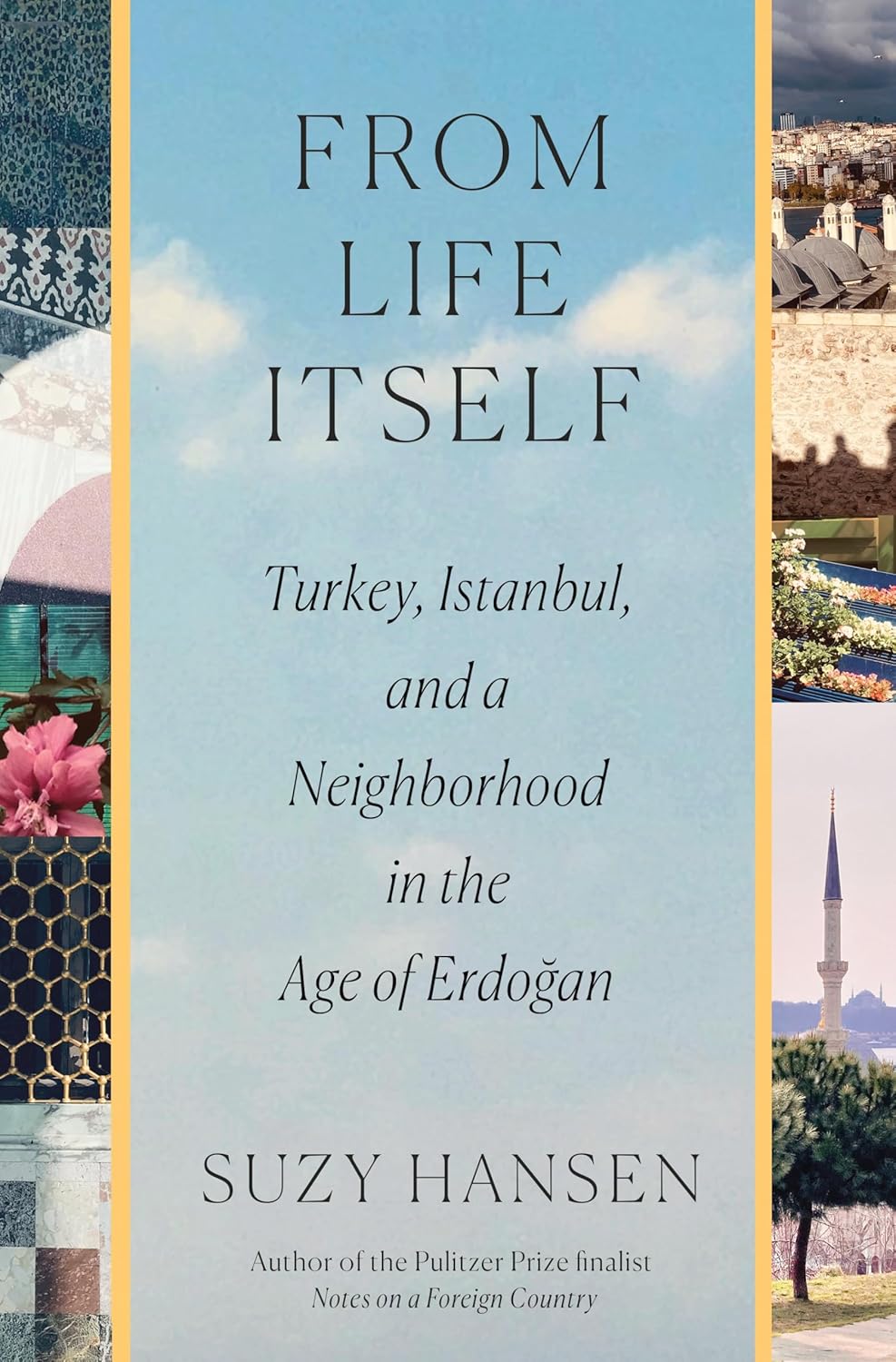
In a chaotic, war-torn region, Turkey has long stood out as a moderate and stabilizing force. Its membership in NATO and the G20 are testament to this status. It’s also why Turkey ranks among the world’s most popular tourist destinations. But in From Life Itself: Turkey, Istanbul, and a Neighborhood in the Age of Erdoğan, Suzy Hansen shatters these widely held perceptions.
Through her exploration of Karagümrük, a historic neighborhood in Istanbul, Hansen provides an immersive experience of a rapidly evolving landscape. We meet Ismail, the longtime muhtar (“elected village elder”); Majed, a Syrian transplant; Murat, a barber resentful of secularism; Ebru, a “humanist” real-estate agent running for muhtar; and others as they navigate the changes wrought by the country’s strongman president, Recep Tayyip Erdoğan, as well as by an influx of migrants, over-development, and globalization. The mosaic painted by Hansen, a Pulitzer Prize finalist, captures “how ordinary people experience authoritarianism in the twenty-first century.”
Though the author provides readers with a nuanced and authentic depiction rarely found in the press, the vignette she produces lacks narrative drama. The primary source of tension in Karagümrük arises from the surge of Syrian refugees. While Turkey accepted far more Syrians than any other country, its anti-Arab racism is both deeply rooted and widespread. Turks, Hansen explains, considered themselves “white, not brown or…Middle Eastern.”
For the most part, the captivating sections of the book center on the larger forces rocking Turkey: Erdoğan’s authoritarian streak, rampant corruption, and questionable elections capped off by the 2016 coup that Erdoğan exploited to purge his opponents before dismantling “Turkey’s state institutions and the organs of its democracy.”
From Life Itself shines when contextualizing Erdoğan’s reign within the broader historical currents overshadowing Turkish society. When the Turkish Republic emerged from the ashes of the Ottoman Empire in the early 1920s, it had lost its status as a leading global power for the first time in five centuries. Under his leadership, Mustafa Kemal Atatürk, popularly seen as Turkey’s founding father, injected a new sense of honor and pride while refashioning his country into a Western-oriented, secular state.
Following Atatürk’s death in 1938, a flailing quasi-democracy — marked by four military coups between 1960 to 1997 — stumbled in his larger-than-life shadow. No matter who was in charge, autocracy remained the norm. “A deep current of fascism ran through the Turkish republic from the beginning,” Hansen notes.
After a brief interlude that saw a more open society emerging under Erdoğan, he too embraced authoritarianism. But unlike previous power grabs, Erdoğan transformed Turkey into a regional — often anti-Western — power that has embraced Islamism and abandoned Atatürk’s tenets. “He was fracturing and reinventing Turkey’s seemingly unassailable national identity,” the author writes.
He has done so through systemic corruption, unbridled development that has profited his corporate allies, a Tammany Hall-like machine doling out favors and goods, control of the media and judiciary, and the empowerment of working-class Turks, who’d been looked down upon by Atatürk’s cosmopolitan adherents. “Erdoğan was Turkey’s revolution,” Hansen explains.
“The question,” she poses in positioning Turkey’s slide into authoritarianism within a global continuum, “seemed less why democracy was failing, and more why twentieth-century nation-states weren’t surviving the twenty-first.” These international comparisons are par for the course these days. There’s some truth to how political movements can traverse borders: Fascism and communism, in particular, spread like wildfire in their heyday.
But one risks resorting to oversimplifications when comparing disparate populations with widely different histories. Hungary and Russia, two countries often cited for democratic backsliding, had few democratic foundations to build upon. India, as the largest and possibly most diverse nation in the world, has unique demographics that make it difficult to compare with other countries. Turkey, for its part, has never been a functional democracy. And the United States, despite its centuries of democratic governance and enviable constitutional guardrails, is a different matter altogether.
Hansen is on firmer ground when her focus remains on Turkey. By the end of her stay in Karagümrük, she reports, its residents were disoriented and unable to recognize their country. “In a blink, Erdoğan had ended Turkey’s century-old political system.”
Given the corruption, authoritarianism, and rampant inflation ravaging the nation, how does Erdoğan remain popular? To explain his success, Hansen points to his ability to tap into something deep within the Turkish psyche that emerged from the loss of empire. “Erdoğan’s Turkish Islamism was a civilizational movement, not a national project,” she writes, “and that made Turkey neither empire nor nation, but something else entirely, a whole new invention, an imperial fantasy through which one man could return to the Turkish people something they believed they lost: their dignity.”
Michael Bobelian has written about human rights, legal affairs, and politics for the Washington Post, Los Angeles Times, Forbes, and other publications. He’s the author of Children of Armenia: A Forgotten Genocide and the Century-Long Struggle for Justice.