Funny Business: The Old-School Wedding Crashers and Knocked-Up Virgins Who Changed Comedy Forever
- By Matt Singer
- G.P. Putnam’s Sons
- 336 pp.
- Reviewed by Chelsey Stone
- November 3, 2026
A serious look at R-rated comedies of the early aughts.
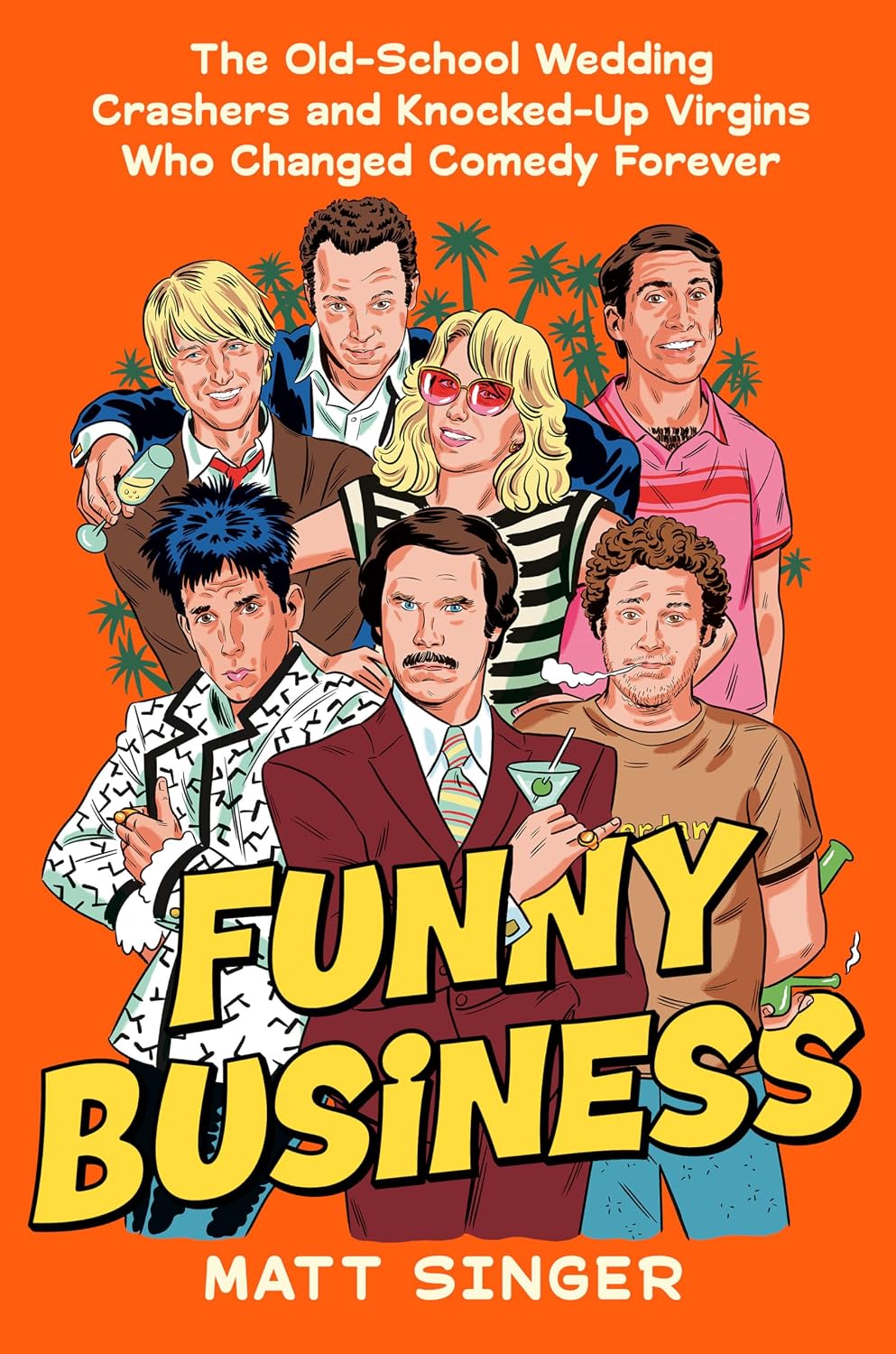
Though Funny Business is by a dude, about dudes, and — for all intents and purposes — for dudes, anyone who enjoys a good story about persistence in the face of rejection will take something away from it.
In this film history, author and critic Matt Singer details the rise, boom, and bust of R-rated comedies through the actors, producers, and directors who became synonymous with the genre in the early aughts. Through his well-researched account, moviegoers of this era will gain a new appreciation for the seriously hard work behind goofy films like “Zoolander,” “Anchorman,” “Wedding Crashers,” “Pineapple Express,” and many more.
Each chapter has a leading movie or man (as the author points out, “they were pretty much all dudes”). Singer provides a brief biography and the tumultuous career trajectories of our stars: Ben Stiller, Judd Apatow, Will Ferrell, Vince Vaughn, Owen Wilson, Steve Carell, Seth Rogen, and others.
In explaining his own career trajectory, Rogen recounts going from the worst kid in karate class to the best in three years, simply because everyone else quit — a lesson in persistence. This anecdote epitomizes a theme Singer repeatedly touches on as he recounts these guys’ careers: They never quit, no matter how much failure or rejection they met with. Even Stiller struggled to break into television and film, and his famous parents, who were in show business themselves, got him his first Broadway role. But perhaps none struggled more than Stiller’s longtime friend and collaborator Apatow. From “The Ben Stiller Show” to “The Cable Guy” and “Freaks and Geeks,” many of his projects suffered from early cancellations or box-office underperformance.
Maybe this was at least in part because, according to Singer, Apatow and Stiller kept “indulging in their weirdest impulses.” “The Cable Guy,” for example, was a dark thriller in which an unhinged cable-company employee (Jim Carrey) crosses innumerable boundaries with a client. But they weren’t just after the bizarre; Singer explains that Apatow and others were adamant about portraying real life (such as when Apatow put his own kids in “Knocked Up” and let them interact organically with the adults) and what felt true to them (like Rogen writing “Superbad,” a screenplay about sexually repressed teenagers, while he still was one).
Every step of the way, Hollywood resisted. At least at first.
Fans may be surprised by the struggle behind the boom, given that these guys seemed capable of making films about anything they wanted (remember the adult-sized bunkbeds in “Step Brothers”?). You wouldn’t be mistaken for feeling this way; Singer did the math:
“From 2006 to 2016, Judd Apatow alone produced twenty-one movies.”
But as Apatow and many of our other leading men became hot commodities, their very success turned against them. Their blockbusters made ensemble casts (like in “Anchorman”) increasingly expensive, as Hollywood couldn’t afford the higher and higher salaries driven by Ferrell, Vaughn, Wilson, and the like. Their individual success disrupted the playfulness of riffing off each other, as they got too busy working on their own projects. And the sheer proliferation of R-rated comedies made their once novel and edgy humor feel overplayed.
The only chapter to break up the boys’ club centers on “Bridesmaids,” the rare female-driven R-rated comedy of the era. The film follows many of the same creative patterns Singer identifies in the male-driven movies that came before it: assembling a cast of funny performers, encouraging a collaborative environment, and leaning into “cringe-inducing laughs.” Yet even in a chapter about women, two dudes — Apatow and Paul Feig (co-executive producer of “Freaks and Geeks”) — retain a central role.
Singer explains how Apatow, its producer, fostered the collaborative spirit and pushed one of the movie’s funniest scenes (the food-poisoning sequence) into its famously outrageous final form, while Feig, who directed “Bridesmaids,” assembled the team that executed it. The two clearly had a positive impact on the movie, but this only reinforces how pervasive the male creative network was during this comedy era. Singer couldn’t tell the story of a female-driven breakthrough without returning to that same network.
Though the author takes a serious look at R-rated comedies of the early aughts, this book, with its titillating subject matter and Singer’s own zingers, is a fun read, one that earns its laughs without skimping on the reporting. But it’s not just a romp through raunchy movies and cringey scenes; it’s the story of a unique moment in film history, one shaped by a band of persistent weirdos all trying to do the same thing: make movies true to their experiences.
Chelsey Stone is a freelance writer and editor. Her travel, literature, and health and fitness coverage has appeared in BBC Travel, National Geographic, Runner’s World, and Outside.

