G.I. Jive: A Dictionary of Words at War: The Vernacular of Victory (1939-1946)
- By Paul Dickson
- Bloomsbury Academic
- 448 pp.
- Reviewed by Lawrence De Maria
- March 5, 2026
A comprehensive, entertaining compendium of military lingo.
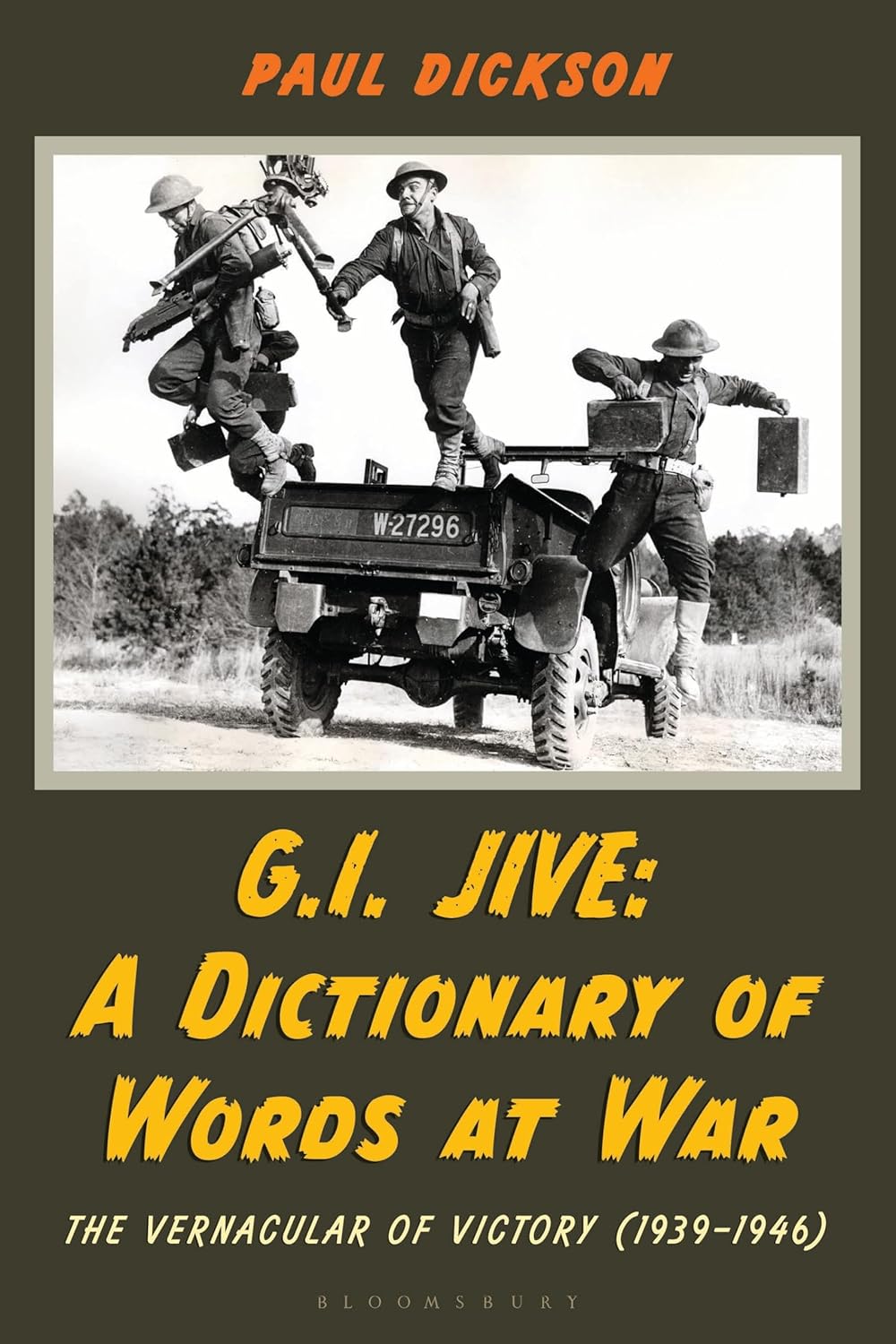
I’ll be the first to admit that I’ve never reviewed a dictionary before. So, I didn’t know where to begin when covering Paul Dickson’s encyclopedic G.I. Jive: A Dictionary of Words at War: The Vernacular of Victory (1939-1946). Going from A to Z seemed stupid since I wasn’t sure if there’d even be any soldier-slang Z words other than “Zero,” the Japanese plane that gave American pilots fits during the early years of World War II.
As it turns out, there are 13 more Z words here, including “zoot suit,” which has two meanings: It’s the overalls worn by aircraft-carrier signal officers when landing the planes that, later in the war, shot down many Zeroes. And it also refers to the uniforms worn by petty officers.
Thank God for the book’s introduction and its Reader’s Notes section. They are so extensive that they make this a delightful read.
Soldiers have been bitching about the military since long before Alexander the Great. There are probably some ancient cave scribblings, now lost to history, that say, “Gronk Was Here” (surely written moments before Gronk was eaten by a saber-toothed tiger).
Some particular American military grumblings date from World War I (known as “the War to End All Wars”; what a crock). But slang really took off when WWII started. A few Britishisms from its early days survive, but it wasn’t until 1940, when Americans were drafted for the fight, that things truly got going.
Soldiers have always cursed, but home-front sensibilities (and censors) in WWII cleaned up their act. Thus, SNAFU became Situation Normal All “Fouled” Up (only recently has the F-word been restored to its rightful spot). Then there was “S.O.S.,” shit on a shingle. I don’t know why “shit” was so proscribed. Creamed beef on toast was the only decent meal I got in my college days, when lunch in the Villanova cafeteria was often Spam on white bread with a dollop of ketchup.
(There was a food riot later, and the college eventually went co-ed. Both happened just after I graduated, when the chow and the view got much better. I’m not complaining, mind you. The food in the Marines was fine. I even put on weight.)
I suspect that S.O.S. occupies an honored place in many of the author’s similar books, which include War Slang: American Fighting Words & Phrases Since the Civil War and Chow: A Cook’s Tour of Military Food. But Dickson is no one-trick pony. His work ranges far from warfare to touch on subjects as disparate as Sputnik and the Civil Rights Movement.
There are thousands of edifying entries in G.I. Jive. Among the many things I learned:
- “Sam’s punk” was a Navy mail clerk.
- “Owl” was a nickname for pickets (since they often asked, “Who goes there?”).
- “Fightin tools” referred to eating utensils.
- A “doughpuncher” was a baker.
- “Irish grapes” were potatoes.
These are among the more esoteric offerings, however. The book is also packed with common words like Spam (whose mention brought back horrible Villanova memories for me, although the canned meat is apparently a delicacy in South Korea — go figure).
Many of the featured words’ origins are described at length in this exhaustive, informative work. For example, I never knew that “Kilroy Was Here,” which G.I.s once wrote on walls and buildings all over Europe and Asia, was anathema to the United States Marine Corps.
So, I’ll end by saying, “Kilroy Was Here.” Of course, I’m probably FUBAR.
Since 2005, Lawrence De Maria has written 40 thrillers and mysteries on Amazon.