Gator!: The Making of America’s Iconic Reptile from First Encounters to Florida Man
- By Mark V. Barrow Jr.
- University of Chicago Press
- 456 pp.
- Reviewed by Justin H. Thompson
- November 23, 2026
A fact-packed, frustrating study of the swamp-going beasts.
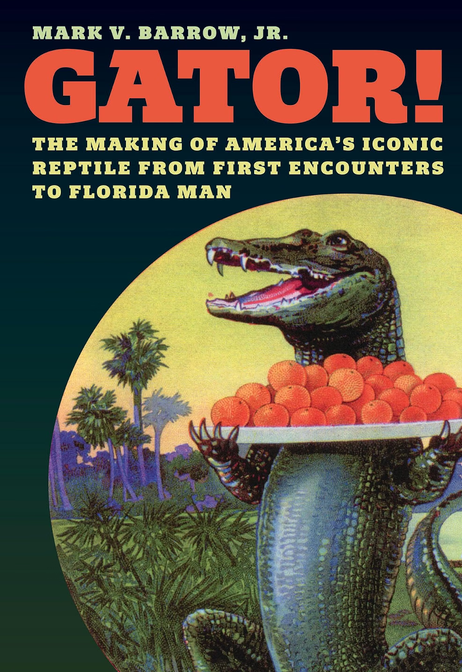
Why we are fascinated with alligators is, perhaps, an easy question to answer: They are ancient, massive, and occasionally dangerous. How that fascination manifests is the subject of Gator! The Making of America’s Iconic Reptile from First Encounters to Florida Man by Mark V. Barrow Jr. It is an expansive if disjointed work that can feel less like the elaboration of a thesis and more like a tour of someone’s personal collection of memorabilia: a bit scattered, loosely connected, and more meaningful to the collector than to us as readers.
While promising to tell the story of the alligator, the text so often wanders into tales about individual biologists or conservationists that the wondrous creatures themselves get lost. The book is both at its most urgent and its most frustrating when Barrow examines the history of “alligator bait” as an anti-Black slur. He exhaustively shows the insult’s reach: Born from a joke caption on a photograph of Black children in 1897, the term made its way into advertisements, cartoons, postcards, song lyrics, and even the campaign literature of a 1912 Ohio Republican congressional candidate.
Before the Civil War, Barrow argues (logically, I think), legends about alligators’ race-specific dietary preferences might’ve been leveraged to dampen enslaved people’s enthusiasm for escaping into the swamps that often surrounded plantations. He is less convincing when arguing why this particular instance of dehumanization became so prevalent in the ensuing decades. And while he concludes that the post-Civil War images “were part of a wide-ranging campaign to fortify racial boundaries in the decades after emancipation,” the odd specificity of the term “alligator bait” gets lost. By the end of the chapter, I was left wondering, why alligators?
In the rest of the book, Barrow’s treatment of race is inconsistent, sometimes worryingly so. He reproduces, for example, an 1893 Florida steamship brochure aimed at luring Northerners to a new Southern holiday hotspot but makes no mention of the illustration — a Jim Crow figure astride an alligator — adorning it. Likewise, in a section about the over-enthusiastic hunting of the reptiles in the late 19th century, Barrow notes:
“Newspaper accounts from the period often maintained that African Americans dominated commercial alligator hunting in the South, but the Census Office data contradicted those claims.”
Again, the fact that prevailing attitudes were so racially charged — and wrong — exactly at the time the alligator began to be perceived as threatened seems remarkable and worthy of further scrutiny. Alas, the author moves on without additional conversation.
Barrow similarly discusses but does not give enough attention to Florida’s native Seminole people. He retells the story of a man calling himself “White Tiger” and claiming Seminole ancestry who opened an alligator tourist spot in 1903. Others derided his Indigenous affiliation and, Barrow writes simply, he then disappeared.
The author does devote a chapter to alligator wrestling and the use of the animals in sideshows and the role both played in Seminole cultural and economic identity, but he stops before fruitfully interrogating further. And when he discusses “Alligator Joe,” a Jacksonville resident who owned an alligator park and who traveled the country in the off-season wrangling and roping gators, Barrow notes that the man’s part-Seminole identity “became a hallmark of his performances.” Where he stops is in addressing the why of it all.
The book ultimately suffers from Barrow’s decision to squeeze discussions of race and indigeneity into single chapters, rather than weave a richer tapestry connecting, say, race with consumerism or unpacking why Northerners were drawn to Indigenous alligator wrestlers in a time of increasing social pressure on Indigenous people to conform to white cultural standards. By failing to ask such questions, Barrow never manages to make Gator! more than a catalog of tidbits and trivia.
The intersections among the conspicuous consumption of alligators, race, indigeneity, and authenticity all point to a complicated matrix that could use the animal as an entry point into a wider exploration of the societies that feared and fetishized them. Yet, page after page, Barrow seems unwilling to take up the challenge.
Justin H. Thompson studied English literature. He lives and works in Washington, DC.
