Ghosted: A History of Ghost Hunting, and Why We Keep Looking
- By Alice Vernon
- Bloomsbury Sigma
- 304 pp.
- Reviewed by Chris Rutledge
- October 10, 2025
A sympathetic look at our endless search for the dearly departed.
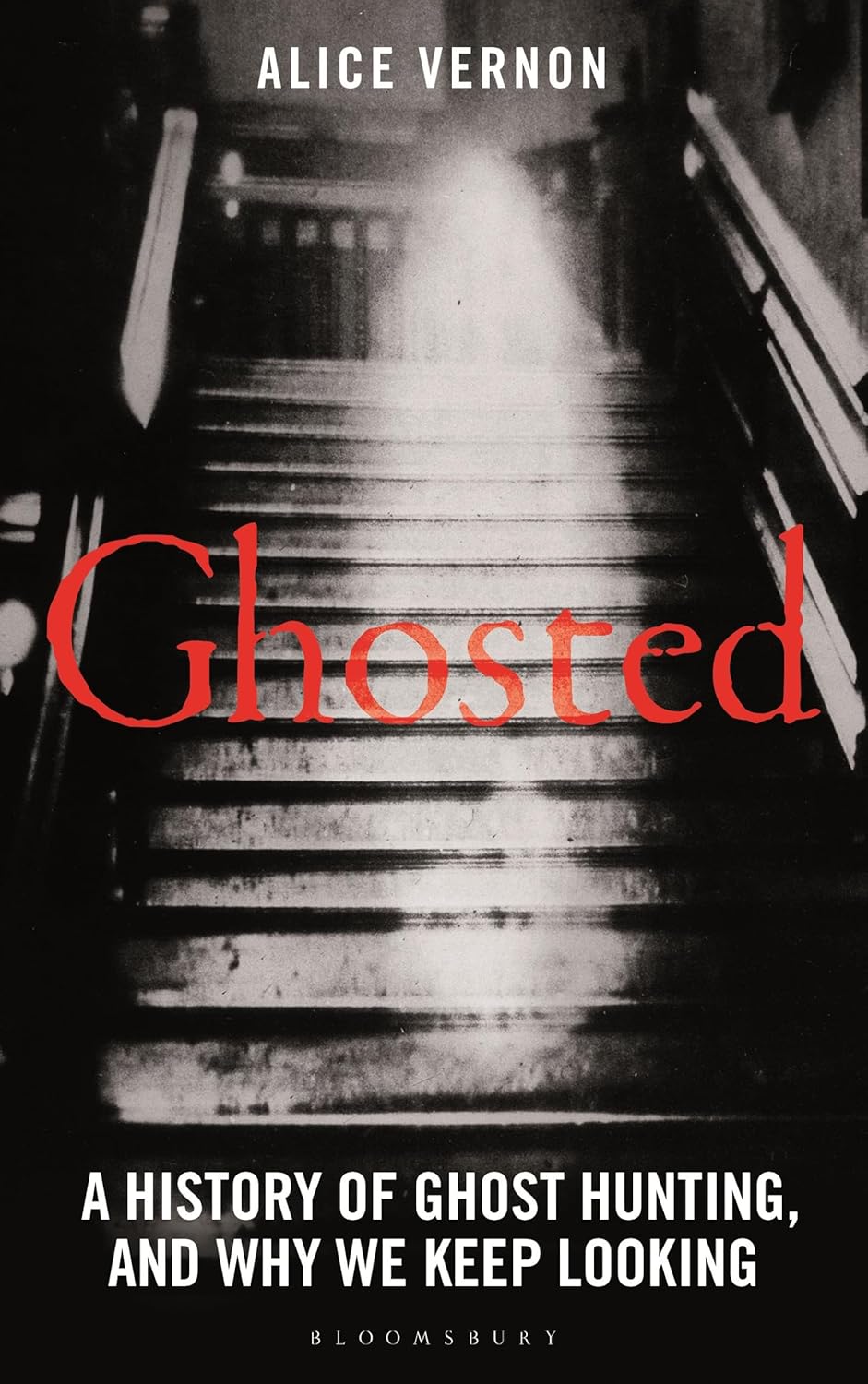
Ghosted explores how we’ve approached the paranormal during the last hundred years and how the search for supernatural life has evolved during that time. Author Alice Vernon, a professor at Aberystwyth University in Wales, has built a career on parapsychology. She clearly loves her work, and she brings this love to the table (even if it’s a séance table).
In the book, Vernon balances the competing views of spiritualists, who purport to communicate with ghosts, and skeptics, who find such efforts laughable at best and abusive at worst. She’s blunt in critiquing those who would “exploit…their paying customers’ grief and hope in an afterlife” but recognizes that we all want to “lessen the gap between the living and the dead.”
Where there’s a desire to speak to the deceased, a market for such services arises. Inevitably, the more unscrupulous among us will seek to supply the demand. But there’s also quite a history of skeptics who worked to expose sham spiritualists. Most often, the debunkers included magicians, who harbored a professional curiosity as to the “how” charlatans seemingly made ghosts appear (Houdini himself was one such investigator). As Vernon writes, magicians were uniquely suited for this work:
“A scientist may be able to record…chemical residue found in a medium’s cabinet, but they’re not trained to detect sleights of hand, camouflaged prosthetics and planted accomplices.”
The tricks were quite varied and surprising. For example, the use of the then-new art of photography played a large role in deceiving séance-goers. Stereoscopes, generally used to create three-dimensional images, were instead used to superimpose onto existing pictures such scary sights as spirits, whose presence allegedly couldn’t be captured by the naked eye. When handed a doctored photo snapped at a séance — one depicting an apparent specter staring back at the camera — duped victims could be led to believe their loved one’s aura had been in the room with them.
And once the lights were off, simpler devices, such as glow-in-the-dark cloth hidden in a closet, could easily be mistaken for ghostly emanations. One medium took it a step further, hiding cheesecloth in her mouth and regurgitating it at just the right moment. As Vernon reports, “the ethereal stuff — allegedly the very material of the spirits themselves,” would seem to appear in the room out of nowhere.
Despite the obviousness of the fraud, Vernon is incredibly sympathetic to believers in parapsychology, which includes most of us. She cites a 2005 Gallup poll which stated that “73 percent [of Americans] believed in at least one kind of paranormal phenomenon.” Quite an impressive number, that.
Why do we believe? For a variety of reasons. Sometimes, a loved one dies under less-than-honorable circumstances that leave a “blemish on the family,” as Vernon puts it, which might be repaired by speaking with the dead to get clarity. In other instances, survivors may simply feel there’s more to be said to the deceased. In those cases, they could believe the “spirits of the dead remained to give a message.”
World War I saw a particular boom in the belief in ghosts. Husbands, sons, and fathers “who had died so far away” on European battlefields left gaping holes in households and hearts back home. Vernon reminds us that sometimes “death is [a] painful…grisly…affair…[and] the secular concept of a utopian afterlife…an important comfort.” We conjure ghosts “from the things about a person — their voice, their scent…that linger most in our minds.”
The popular depiction of ghosts evolved in the 20th century in tandem with geopolitical realities. After World War II and the devastation wrought by the atomic bomb, ghosts began to be portrayed as wicked and dangerous. Hence the popularity of movies like “The Amityville Horror” and, later, “The Conjuring” series. During this period, even such seemingly safe things as children’s toys became a source of terror. The author, in an example of immersive reporting, addressed this firsthand by purchasing on eBay a “haunted” doll purported to contain evil spirits. As the reader might imagine, this did not endear her to her officemates.
Such hands-on work is one of the strengths of Ghosted. Besides buying the aforementioned doll, Vernon also joined the Association for the Scientific Study of Anomalous Phenomena, becoming an ASSAP Accredited Investigator. She sat in on séances and participated in paranormal investigations so she could bring her own experience to bear in writing this book.
She layers the text with witty asides, betraying her amusement at the topic. One might wonder, then, why she’s ultimately not more cynical about the true believers she encounters. She offers a moving defense of herself, stating, “my ability to criticize wavered in the face of empathizing [over]...how genuinely soothed people have been by the thought of speaking with their deceased loved ones.”
Not only that, but it’s the rejectors of the supernatural who are more likely to be isolated by their dismissal of the otherworldly. “Belief is communal,” the author reminds us, “whereas scepticism is personal.”
Chris Rutledge is a husband, father, writer, nonprofit professional, and community member living in Silver Spring, MD. Besides the Independent, his work has appeared in Kirkus Reviews, American Book Review, and countless intemperate Facebook posts, which will surely get him into trouble one day.
.png)
.png)