Given No Choice: A History of Abortion Rights
- By Cody McDevitt
- Independently Published
- 416 pp.
- Reviewed by Chris Rutledge
- June 5, 2026
An edifying look at the fight for bodily autonomy.
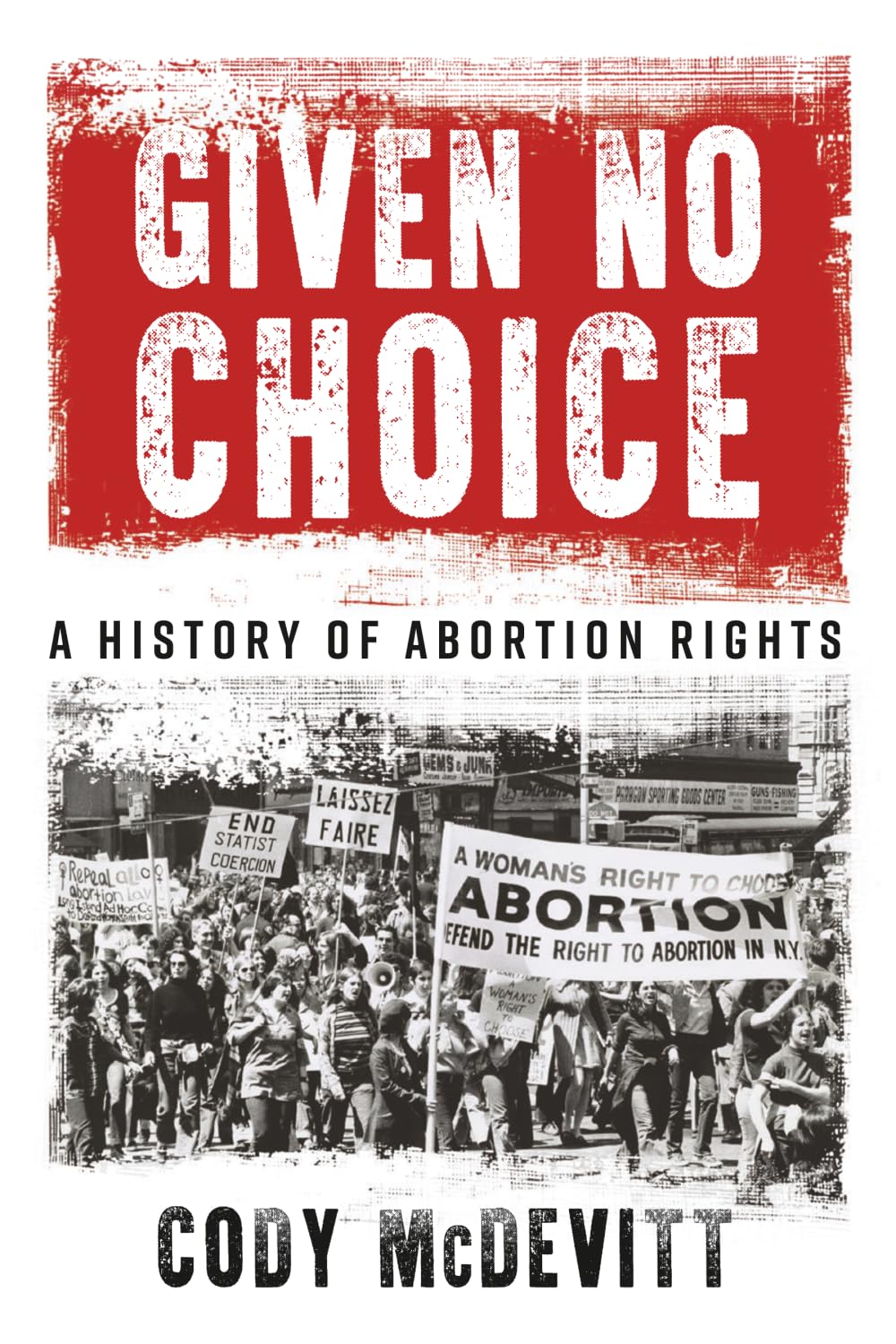
Given No Choice is a comprehensive history of abortion jurisprudence in the United States. Cody McDevitt’s deep dive examines the strictures that have been put in place to control women’s reproductive health and the work of those who would secure women’s freedom over their own bodies.
McDevitt is long experienced in covering this topic. He’s the host of the Substack “Repro Rights Now,” which addresses abortion as seen through the eyes of the law and the media. He is also an experienced investigative journalist and thus is able to speak to both the facts and their broader context. He makes it clear from the outset where his sympathies lie.
The book is laden with both newsy nuggets and painful personal anecdotes. It begins with the story of Sherri Chessen, Phoenix’s host of the locally franchised children’s show “Romper Room,” whose fifth pregnancy in 1962 was upended by fetal defects caused by thalidomide. Despite a doctor’s recommendation that she terminate the pregnancy (advice she heeded), her employers determined “she was no longer competent to work with children because she planned to have an abortion.”
Given the sweep of the book — which reaches as far back as ancient China, when mythical emperor Shen Nung was alleged to have prescribed mercury as an abortifacient — it’s hard to say which element is most interesting. One aspect of note is religion’s ongoing role in abortion law. It’s easy to forget that organized religion wasn’t always so closely affiliated with the anti-abortion movement. Indeed, in 1967, “a group of ministers…[created] the Clergy Consultation Service on Abortion…a referral network that sought to destigmatize” the procedure. As late as 1968, the American Baptist Church, albeit a liberal offshoot of the Southern Baptists, “adopted a policy statement…that abortion was a personal decision.”
But, today, McDevitt reports, organized religion has emerged as the most dangerous threat to both legal abortion and its providers. He notes that “the Christian Right first took shape through the influence of television preachers…Hundreds of thousands of new voters…motivated by resentment over the perceived advances of feminism” picked up the mantle of abortion abolition.
These new recruits didn’t limit their actions to the ballot box, however. Instead, they took it upon themselves to commit violence against those who would oppose them. Reports the author, “50.2% of clinics experienced severe anti-abortion violence in just the first seven months of 1993.” This included physical altercations, blockades, and, on several occasions — such as with the shootings of Dr. David Gunn and Dr. George Tiller — premeditated murder.
Spurred on by generations of religious leaders like Archbishop Fulton Sheen, who called pro-choice Americans “lovers of death,” these terrorists went so far as to bomb abortion clinics, finding “a scriptural justification for using lethal force [to protect] innocent lives from murder.” A group calling itself the Army of God even developed a manual with “detailed instructions for sabotaging clinics.”
We all know the outcome of the 1973 Roe v. Wade decision, which the author covers aptly. More interesting is McDevitt’s exploration of the efforts to overturn it, which involved deceptive messaging from the anti-choice movement. He writes:
“Anti-abortion activists continued to distort the debate by exaggerating the prevalence of third-trimester abortions...public reaction...to graphic imagery could be wielded to sway public opinion.”
In other words, by focusing on rare and tragic but medically necessary late-term abortions, opposition forces successfully created a wedge issue that resonates even today. They then leveraged that wedge by “advancing restrictions in small, seemingly technical steps, [so that] lawmakers could gauge public reaction.” Parental-notification laws, calls for reproductive-health providers to maintain hospital privileges, etc., all seem reasonable but chip away at women’s bodily autonomy nonetheless.
The result of abortion bans, of course, is illegal abortions (between 100,000 and 250,000 of which occurred in New York City in 1935 alone). We visit the pre-Roe, Third World-like wards in Chicago filled with women victimized by back-alley abortions. “At Cook County Hospital,” writes McDevitt, “an entire 40-bed ward…was dedicated to septic abortion cases.” But when the procedure was legalized, “maternal mortality dropped by 40-50%. Within a year…[that ward] closed permanently.”
Naturally, the loudest voices calling for abortion’s ban in early and mid-20th-century America were male. One New York hearing to discuss the issue “featured 15 legal, medical, and religious leaders. Only one woman, a nun, spoke.”
The strength of Given No Choice lies in its spotlighting of those on the front lines of the fight for reproductive freedom, from activists to victims. If the stories of young women like Becky Bell — a 17-year-old Indiana girl who died after an illegal abortion — make you angry, that’s the point. It’s impossible to read the extensive history laid out here and not wonder how strangers could deign to tell women what to do with their own bodies. McDevitt does a good job stoking this anger and, perhaps, stirring the reader to action.
Chris Rutledge is a husband, father, writer, nonprofit professional, and community member living in Silver Spring, MD. Besides the Independent, his work has appeared in Kirkus Reviews, American Book Review, and countless intemperate Facebook posts, which will surely get him into trouble one day.