Glorious Country: How the Artist Frederic Church Brought the World to America and America to the World
- By Victoria Johnson
- Scribner
- 448 pp.
- Reviewed by Dennis Drabelle
- June 1, 2026
The 19th-century master excelled at capturing nature on canvas.
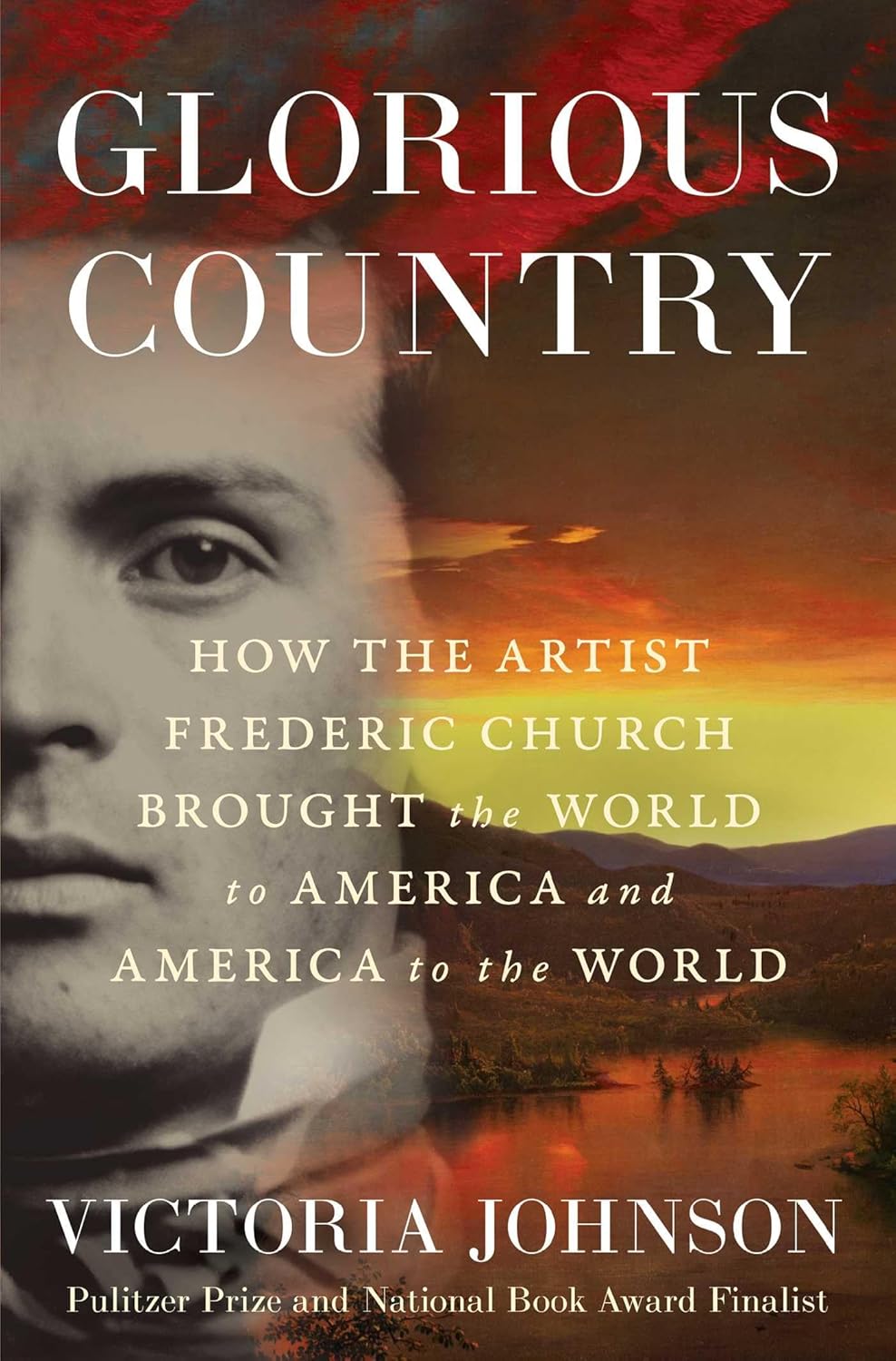
The American artist Frederic Church (1826-1900) loved the Hudson, built his dream house on land with a grand view of it, and qualified as a standard-bearer for the Hudson River School of painters. As Victoria Johnson points out, however, Church was too cosmopolitan to be pigeonholed as a regionalist. In the prologue to Glorious Country, her astute biography of Church, Johnson asserts that, by age 33, he had become “the greatest landscape painter in the western hemisphere.”
Before that, Church had been a golden boy and an equally gilded young man. Later on, changing tastes in art, illness, and the burden of a profligate son weighed the artist down, but he found solace in what he, as a painter, and Washington Irving, as a writer, had accomplished: serving notice that American culture was coming of age.
Born in Hartford, Connecticut, where his father was a prosperous watchmaker and jeweler, Church was a compulsive sketcher from a young age — a quirk that his parents found “vaguely disreputable.” They wouldn’t have minded if he’d gone into portraiture, which was “both lucrative and respectable” but were appalled to learn that a drawing class he took as a teenager featured nude models.
In the end, Mr. and Mrs. Church came around. With their support, Frederic moved to the Hudson River town of Catskill, New York, to study with Thomas Cole, an English immigrant widely hailed as the foremost living painter of American landscapes. Church came to share his mentor’s passion for the sky — “the soul of all scenery,” in Cole’s words — and graduated from sketching with pencils to working in oils. So gratifying was his 19-year-old pupil’s progress that Cole arranged for two of his paintings to go on display in the National Academy of Design in Manhattan.
Water soon joined sky as a dominant element in Church’s work, and in a bravura passage, Johnson describes his approach to a seascape at Mount Desert Island in Maine:
“He studied the water carefully. It wasn’t one thing only, he saw…He used fluid, swirling strokes to create the foam of the breaking waves. Mixing a blue-green to match the calmer expanse of ocean beyond the rocky shore, he painted a large patch toward the top third of his paper, making it opaque enough to keep a schooner afloat. With a greener tint laid down in alternating thin and thick strokes, he captured the wash of the water as it neared the rocks. The fogbank in the far distance was a pale violet shroud unfurling over land and sea.”
Inspired by the example of German geographer, naturalist, and writer Alexander von Humboldt, Church traveled to South America, where he made drawings that came to fruition in his oil “The Andes of Ecuador,” lauded by the Philadelphia eminence grise Rembrandt Peale as “the best landscape ever painted.” Church’s paintings sold well, too, often bringing in four or five figures apiece.
In 1857, Church parlayed his affinity for water into one of his masterpieces, “Niagara, from the American side,” a painting of the falls that, as Johnson notes, “[threatened] to sweep viewers over the precipices along with a log that bobbed in the waves.” The falls themselves, however, were ailing. Landowners on both sides of the U.S.-Canadian border had transformed the banks below Niagara Falls into carnival midways patrolled by touts pressuring visitors to patronize their employers’ hotels, restaurants, gift shops, and excursion boats.
In the 1870s and 80s, the peerless landscape architect Frederick Law Olmsted led a successful binational campaign to buy out those entrepreneurs, remove their “attractions,” and establish a state park on the American side of the border and a provincial park on the Canadian side. The whole effort had started with Olmsted’s distant cousin Frederic (with a c), who had alerted Frederick (with a k) to the Niagara problem in the first place.
The main thing missing from Church’s life was a spouse, and he took care of that at the age of 34 by marrying Isabel Carnes from Dayton, Ohio — they’d met at an exhibition of his much-praised painting “The Heart of the Andes.” The first great sorrow of Church’s life came in 1865, when their two young children died from diphtheria. The couple went on to have four more kids, the eldest of whom, Fred, grew up to be such an intractable ne’er-do-well that his father threatened to disown him.
Church had the wherewithal to take the whole family on a two-year trip through Europe and the Middle East, at the end of which he was primed for a foray into architecture. The result was Olana, his beguiling place on the Hudson. Although Church referred to it as a “Persian House,” the eclectic design also has French, Ottoman, Moorish, and Armenian touches. (Now preserved as a state historic site, Olana is well worth a visit.)
In his later years, Church was flummoxed by the rise of Impressionism. Calling the style “rank in color” and “crude in effect,” he dismissed it as a fad, but it was his own work that went out of favor. Meanwhile, his once astonishingly supple right hand was stiffened by rheumatism, and his productivity fell off sharply. He died in 1900 at age 73.
Early in the new century, Church’s poetic evocations of nature seemed passé, but his reputation has since recovered: The 1979 sale of his “Iceberg” for $2.5 million set a record for an American painting. Church once wrote to a fellow artist, “See for yourself this glorious country, where we reside. I cannot do it justice either with pen or pencil.” Victoria Johnson’s sharp-eyed biography proves he was wrong on that score.
Dennis Drabelle’s most recent book, The Power of Scenery: Frederick Law Olmsted and the Origin of National Parks, has just been reissued in a paperback edition.