Goliath’s Curse: The History and Future of Societal Collapse
- By Luke Kemp
- Knopf
- 592 pp.
- Reviewed by Linda Nemec
- January 15, 2026
Are we hurtling toward an inevitable cliff?
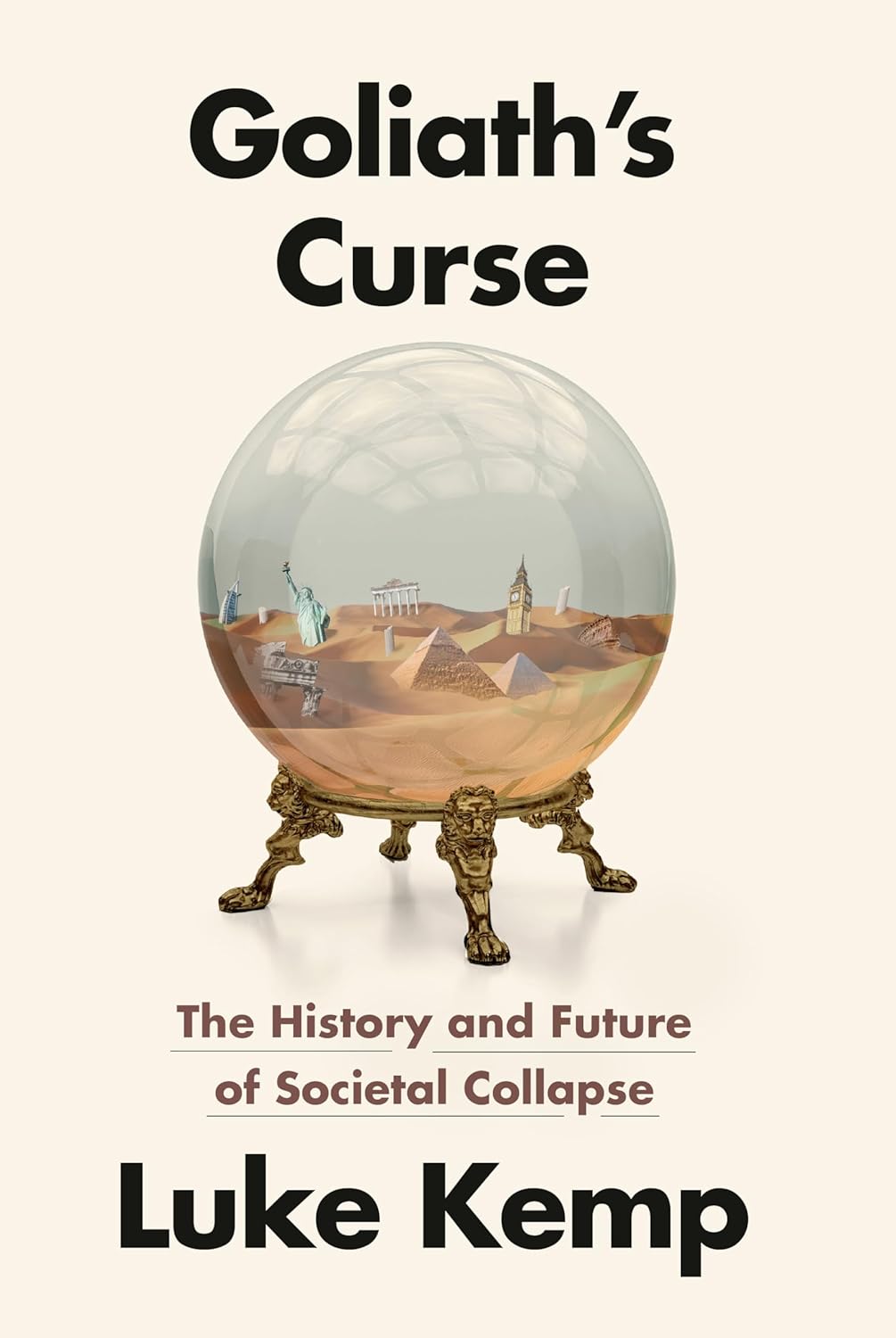
Like its title, Goliath’s Curse is provocative, ambitious, and timely in light of the changes we saw in 2025 — more authoritarian leaders, the rapid expansion of AI, renewed nuclear-arms competition, and the worsening effects of climate change. Author Luke Kemp opens by challenging a long-held view of human history: that chaos would inevitably result from societies without rulers given humanity’s supposed predisposition toward violence.
He lays out compelling evidence that our understanding of the past is biased toward dominating leaders rather than ordinary people, and he makes persuasive arguments — backed by detailed research — that challenge accepted explanations for why civilizations disappeared and what happened afterward. Kemp’s strong political views, however, surface in his contemporary examples, including in several references to Donald Trump and Elon Musk, and may turn off some readers.
He argues that early human survival depended on egalitarian societies in which people hunted together, shared knowledge, formed far-reaching trade networks, and actively resisted dominant leaders. He makes a striking case that this social organization helps explain why Homo sapiens survived the Ice Age while Neanderthals did not. This claim stopped me in my tracks, and I found myself repeating it to friends and family during conversations about the resurgence of authoritarian leaders.
Status competition, Kemp argues, is the central driver of societal collapse, and he uses this theme effectively to traverse thousands of years of human history while drawing parallels to the present. As food became more abundant, the urge to dominate — more common among individuals ranking high in psychopathy, narcissism, and Machiavellianism (the so-called “dark triad”) — became more consequential. Small groups seized control of increasingly “lootable” resources, wars followed, and societies began to adopt dominance hierarchies — what the author calls “Goliaths.”
Those who controlled resources accumulated power over information, politics, and economic systems, often through threat or force. As Kemp notes, “frequently the most violent and overconfident were selected” as rulers, many of whom were corrupt. Goliaths, especially those exhibiting dark-triad traits, tend to be “more intent on growth, status, and aggression than the average human.”
This framework inevitably calls to mind contemporary political rhetoric, including a recent statement from Deputy White House Chief of Staff Stephen Miller:
“You can talk all you want to about international niceties and everything else, but we live in a world — in the real world — that is governed by strength, that is governed by force, that is governed by power. These are the iron laws of the world since the beginning of time.”
Kemp’s research on early Goliath societies is impressive. Drawing on archaeological and historical evidence, he compares indicators of human health from post-Ice Age societies through the Industrial Revolution, showing how growing wealth and power inequalities harmed populations. As Goliaths fought wars with one another, they became increasingly extractive in their demands on citizens. While there were often strong incentives to remain within large empires — such as the Roman Empire — many people, including slaves, were unable to leave anyway.
These societies were marked by corruption, overexpansion, environmental degradation, and the immiseration of the masses. Minor shocks — droughts, floods, wars, and disease — were often enough to trigger collapse. Kemp argues that civilizations contain the seeds of their own demise: As costs to citizens rise through taxes, inflation, and warfare, benefits decline, producing what he calls “Goliath’s curse.”
In the first half of the book, Kemp repeatedly challenges conventional historical narratives using evidence drawn from multiple disciplines. One of his most unexpected claims is that “collapse has usually been a good thing for most citizens.” He argues that, after collapse, rulers are weaker and more fragmented, allowing space for more democratic arrangements at the village and city level, as well as renewed knowledge-sharing and technological development, including advances in agriculture and animal husbandry.
The most difficult chapter to read shifts from historical analysis to the present. Here, Kemp focuses on today’s so-called Global Goliaths (particularly the United States), which he argues face a different kind of curse: the creation of humanity-ending risks. These include environmental breakdown, nuclear war, unregulated artificial intelligence, and pandemics. He identifies the fossil-fuel industry, big tech, and the military-industrial complex as the principal “agents of doom.” Some of these arguments are speculative and verge on overreach, but they don’t undermine his central claim that current global systems are pushing us toward large-scale societal collapse unless major changes occur.
Kemp is an engaging storyteller, and the first two parts of the book — covering the Paleolithic era through modern history — are surprisingly readable given their scope. The final section, which turns to future risks and solutions, will be more challenging for readers already overwhelmed by daily news.
Some of his proposals are familiar and broadly persuasive, including tackling environmental degradation, reducing extreme wealth inequality, and expanding inclusive governance. Others — such as imposing wealth caps and rapidly decarbonizing the global economy — will strike many as extreme. Still, by offering concrete solutions, Kemp brings his argument full circle — a move this reader appreciated, even when some recommendations seemed unattainable.
Linda Nemec spent most of her career as a USAID contractor. She recently retired and now focuses on community organizing, reading, and tackling home projects while listening to audiobooks.