Great American Presidents: The Twelve Who Transformed the Nation
- By Allan J. Lichtman
- Bancroft Press
- 598 pp.
- Reviewed by Kitty Kelley
- October 12, 2026
A convincing scorecard for the Oval Office’s key inhabitants.
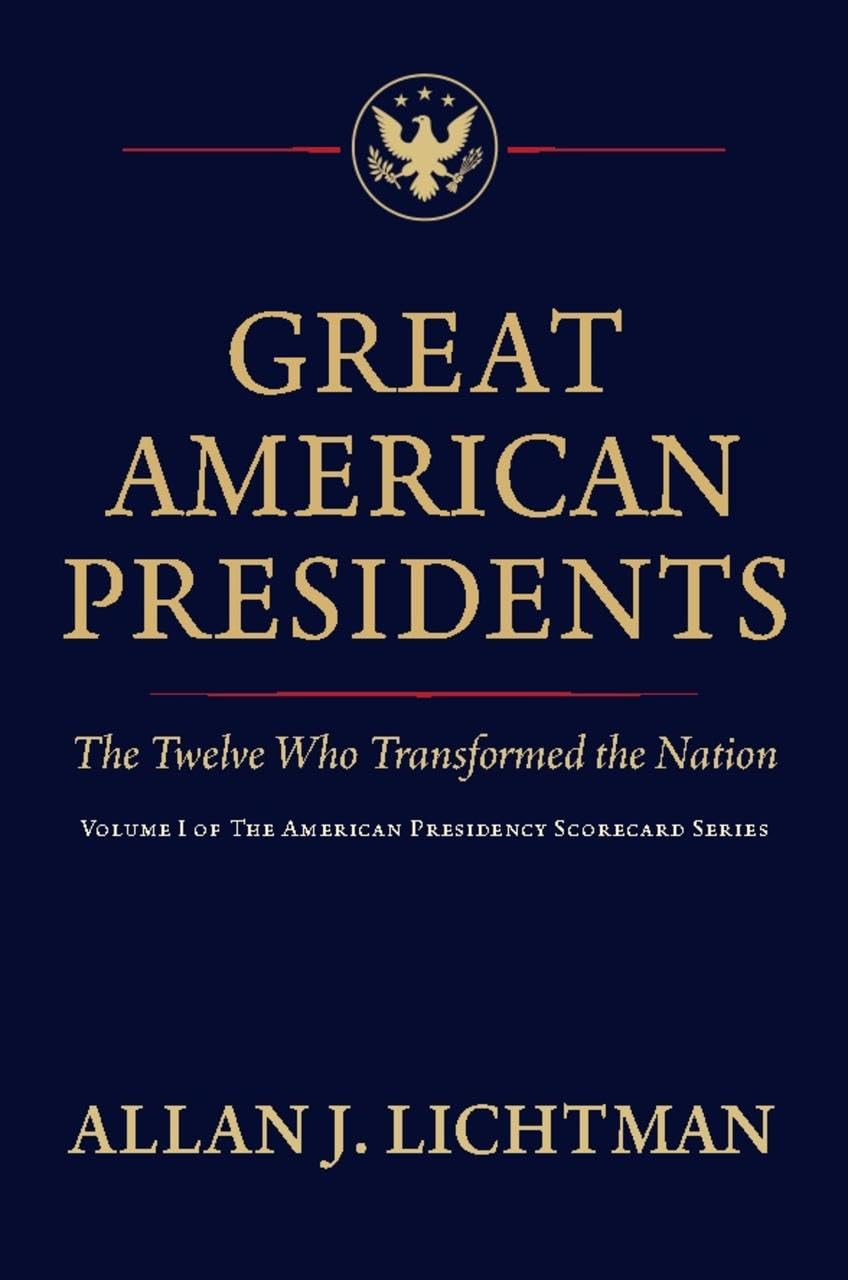
What an ingenious book Allan J. Lichtman has written! And that exclamation point is appropriate because his scholarly tract is immensely readable, with smart sentences and pithy paragraphs. He provides “Ten Keys to Presidential Greatness” and a scorecard for evaluating Great American Presidents: The Twelve Who Transformed the Nation. Before handing out the grades, though, the author, a Distinguished Professor of History at American University in Washington, DC, presents — via his chapter names — the dozen commanders-in-chief he considers transformative:
George Washington: An Indispensable Leader
Thomas Jefferson: Inspiration and Contradictions
Andrew Jackson: The People’s President
James K. Polk: Manifest Destiny Unleashed
Abraham Lincoln: The Great Emancipator
Theodore Roosevelt: Big Stick, Bigger Vision
Woodrow Wilson: Idealism Meets Reality
Franklin D. Roosevelt: Patrician as Liberal
Harry S. Truman: The Buck Stops Here
John F. Kennedy: The Adaptable President
Lyndon Johnson: Rushing to Triumph and Tragedy
Ronald Reagan: Conservative Icon
In the pages that follow, Lichtman captures the humanity of each man — their faults and foibles, coupled with their titanic strengths. He then grades them on what he calls the Crisis Key, the Transformation Key, the Moral Vision Key, the Hidden Hand Key, the Stewardship Key, the Realignment Key, the Institution Builder Key, the Narrative Key, the Diplomatic Pivot Key, and the Adaptability Key. The only president to turn all 10 keys of greatness, “the architect of the modern American state and its place in the world,” is Franklin D. Roosevelt. “His legacy lives on not only through policies and precedents but also in the very fabric of American political life.”
(Some readers might object in favor of Lincoln, whom Lichtman awards 9.5 keys for “his willingness to sacrifice legal and political norms for the sake of the nation’s survival, proving that a republic’s leader must sometimes embrace controversy and contradiction to defend its foundational ideals.”)
While celebrating FDR, the professor does not spare the man his faults, two of the most tragic being the interning of 100,000+ Japanese Americans in 1942 and the 1939 turning away of the SS St. Louis, which was carrying 937 Jewish refugees fleeing Nazi Germany. Still, Lichtman maintains, Roosevelt did more for the Jews than any other world leader, “including Churchill, who talked big but acted small.”
Following his chapter on the patrician FDR, the author captures the plainspoken common sense of Truman, particularly abundant in 1948, when he was running for re-election against Thomas E. Dewey, the Republican governor of New York. Fifty pollsters predicted a win for Dewey, but Truman simply laughed it off. “I know every one of those 50 fellows,” he said. “There isn’t one of them has enough sense to pound sand in a rat hole.”
On Lichtman’s scorecard, Truman merits a 6. His shortcomings appeared to be his inability to transform governance beyond the New Deal framework or to exercise the subtle political manipulation necessary to produce a lasting electoral realignment. Despite decisive leadership, Truman struggled to sustain a hold over the public.
The unexpected name on the roster is Polk, whom Lichtman deems “the most consequential one-term president in American history.” As a candidate, he promised to serve only a single term and scrupulously honored his pledge (unlike Joe Biden in 2024). That unprecedented vow allowed Polk to focus entirely on tangible results, “ultimately doubling the size of the nation in just four years,” earning him the title of a Manifest Destiny visionary but a score of 5. “He was a great president in that he bent the arc of history and forged the continental nation we know today,” writes Lichtman, “but he did so by unleashing the very forces of sectionalism and violence that would nearly destroy it.”
Throughout his book, the author inserts small grey squares of text he terms “Lichtman’s Lens,” which introduce his personal point of view based on his research. In the chapter on JFK — whom the author gives a 6.5 — the lens states:
“Kennedy’s early term was marked by trusting ‘experts’ into the Bay of Pigs disaster. However, his true greatness lay in his ability to adapt. During the Cuban Missile Crisis, he rejected military calls for immediate air strikes, choosing a ‘quarantine’ that gave the Soviets room to retreat without triggering a nuclear holocaust.”
The saddest chapter may be the one on Johnson, whose triumphs as chief executive included the creation of Medicare and Medicaid; aid to education; the War on Poverty; the Civil Rights Act of 1964; and the Voting Rights Act of 1965. Johnson passed over 1,000 bills, enabling his Great Society achievements to surpass FDR’s New Deal accomplishments. But then came Vietnam, during which he “squandered his political capital and tarnished his legacy by fighting the worst losing war in American history, at a tragic cost of lives, resources, and credibility for the president and his party. Eight years of Republican presidencies would follow Johnson’s time in office.”
Lichtman blames LBJ as the architect of his own political ruin. Still, he awards the man a score of 8, while faulting him for not changing his Vietnam policy and for allowing the escalating war to overwhelm his presidency.
In the Republican years that followed Johnson’s sole term, the most successful president was Reagan (1981-1989), who won the Cold War and shifted the political center of gravity for decades. He tilted the Supreme Court to the right with his appointments of Anthony Kennedy, William Rehnquist, and Antonin Scalia. He ignored the AIDS epidemic and faced his biggest crisis with the Iran-Contra scandal, in which his administration sold arms to the terrorist state of Iran in exchange for hostages. Reagan denied doing so, but in March 1987, he addressed the nation, saying:
“A few months ago I told the American people I did not trade arms for hostages. My heart and my best intentions still tell me this is true, but the facts and the evidence tell me it is not.”
Reagan survived that scandal and, through his tax cuts and deregulation, became a hero to the wealthy. With Soviet leader Mikhail Gorbachev, he negotiated the first-ever treaty to reduce nuclear arsenals. On Lichtman’s Greatness scorecard, Reagan, who “successfully shifted the country’s political center of gravity for forty years,” garners a 6.5.
In Great American Presidents, Lichtman has written a masterful study of the U.S. presidency, one that should be required reading for anyone interested in political science — or hoping to take up residence at 1600 Pennsylvania Avenue.
Kitty Kelley is the author of seven number-one New York Times bestseller biographies, including Nancy Reagan, Jackie Oh!, and Elizabeth Taylor: The Last Star. She is on the board of the Independent and is a recipient of the PEN Oakland/Gary Webb Anti-Censorship Award. In 2023, she was honored with the Biographers International Organization’s BIO Award, which is given annually to a writer who has made major contributions to the advancement of the art and craft of biography.