Happy People Don’t Live Here: A Novel
- By Amber Sparks
- Liveright
- 256 pp.
- Reviewed by Keith Donohue
- November 11, 2025
The bighearted ghost story you didn’t know you needed.
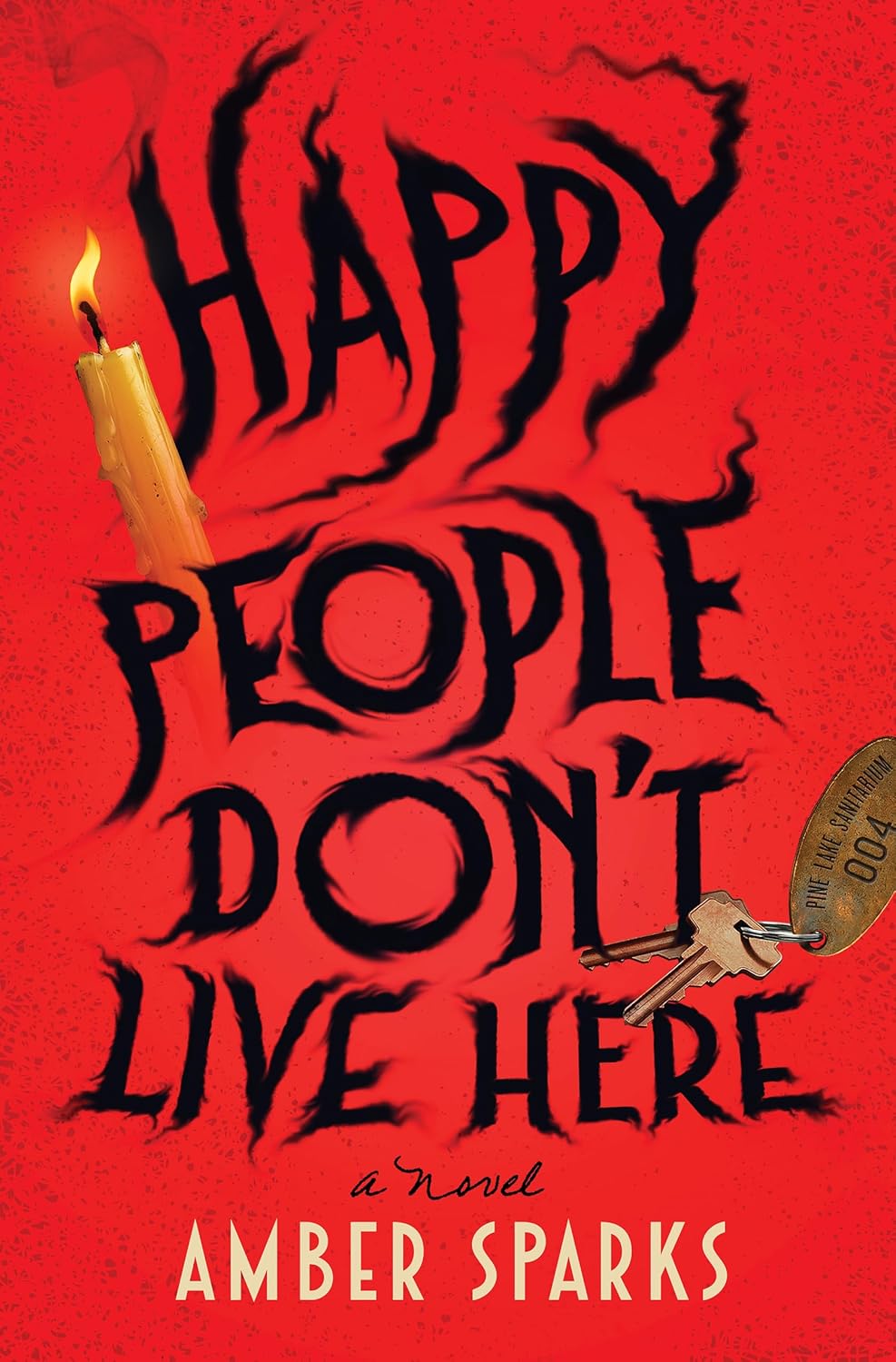
Amber Sparks conjures a perfectly charming ghost story in Happy People Don’t Live Here. The author of two short-story collections and a volume of essays, Sparks has written in her debut novel a funny and quirky tale ideal for the long, sometimes spooky nights of autumn.
A decade before the story begins, Alice took her baby, Fern, and ran away from her controlling and abusive husband. Every few years, they move from one anonymous town to another, arriving finally in Pine Lake, Minnesota, and a run-down apartment in a converted sanitorium. A handful of zany tenants occupies the other flats: a woman who earns a living as a mermaid and likes to bathe in her tailed costume; a divorced professor of medieval history; the Glass Girl, a woman with fragile bones; the Cursed Lady; an Old Soldier who may have been a writer; and a disgraced taxidermist.
Hanging around the adjacent graveyard are the ghosts of sanitorium patients who died from consumption. Fern, now 10, is the only one who can see them among the headstones:
“sad and formless, and drift[ing] about the complex like soap bubbles, popping every now and then and heading back to the spirit realm or wherever ghosts went when they were tired of haunting places.”
Fair enough, until things get weird. Almost immediately after settling in, Alice begins to receive threatening notes spelled out in letters cut and pasted from magazines and newspapers. “I KNOW WHO YOU ARE” reads the first, enough to give anyone goose bumps. Then, Fern discovers what appears to be a dead, naked woman in the dumpster, only to have the corpse vanish before she can fetch anyone to help.
Guided by her beloved Golden Age girl-detective stories, Fern launches an earnest investigation into the dead woman’s whereabouts and identity, quizzing her fellow tenants. Discovering that the building’s handyperson dabbles as a medium, she contrives to hold a séance to contact the spirit of the body from the dumpster.
Unfortunately, wrong number: The séance-goers instead reach a woman who died at the sanitorium a hundred years ago and end up holding a rather extended conversation with her. In the spirit of the novel, nobody flips out or runs screaming with fright. Nor do they seem particularly concerned when a lady dressed in 1920s fashion shows up later that night and announces to Alice:
“I’m Zillah. I think your daughter brought me back from the dead.”
Turns out, Zillah is looking for her sister, Ada, who once ran con games for a living.
The plot unspools in three strands. What links them is their sadness: Happy people really don’t live here. Sorrow floats above them like the cemetery ghosts, unmoored and occasionally angry, everything framed within a madcap murder mystery complete with a denouement that brings the suspects together in one room, where all is revealed. (“Plot twist,” one minor character proclaims.)
The ending — which shamelessly relies on one coincidence after another — provides for a wholly satisfying resolution since we suspended disbelief ages ago. Even unhappy people deserve moments of joy once in a while, perhaps most of all Alice, who earns her keep by building commissioned miniatures and dioramas or selling her own creations to collectors via the internet. I almost googled her to buy my own little world, till I realized there’s no such thing as ghosts, or if there are, they reside (quite properly) in stories.
Sparks is a clever writer who has, by melding conventions from several genres, created a perfect hybrid here, with brief and punchy “chapters” that honor her roots as a short-story writer. Or maybe they’re simply a winning strategy for our attention-addled times.
Keith Donohue is the author of six novels, including, most recently, The Girl in the Bog.
.png)