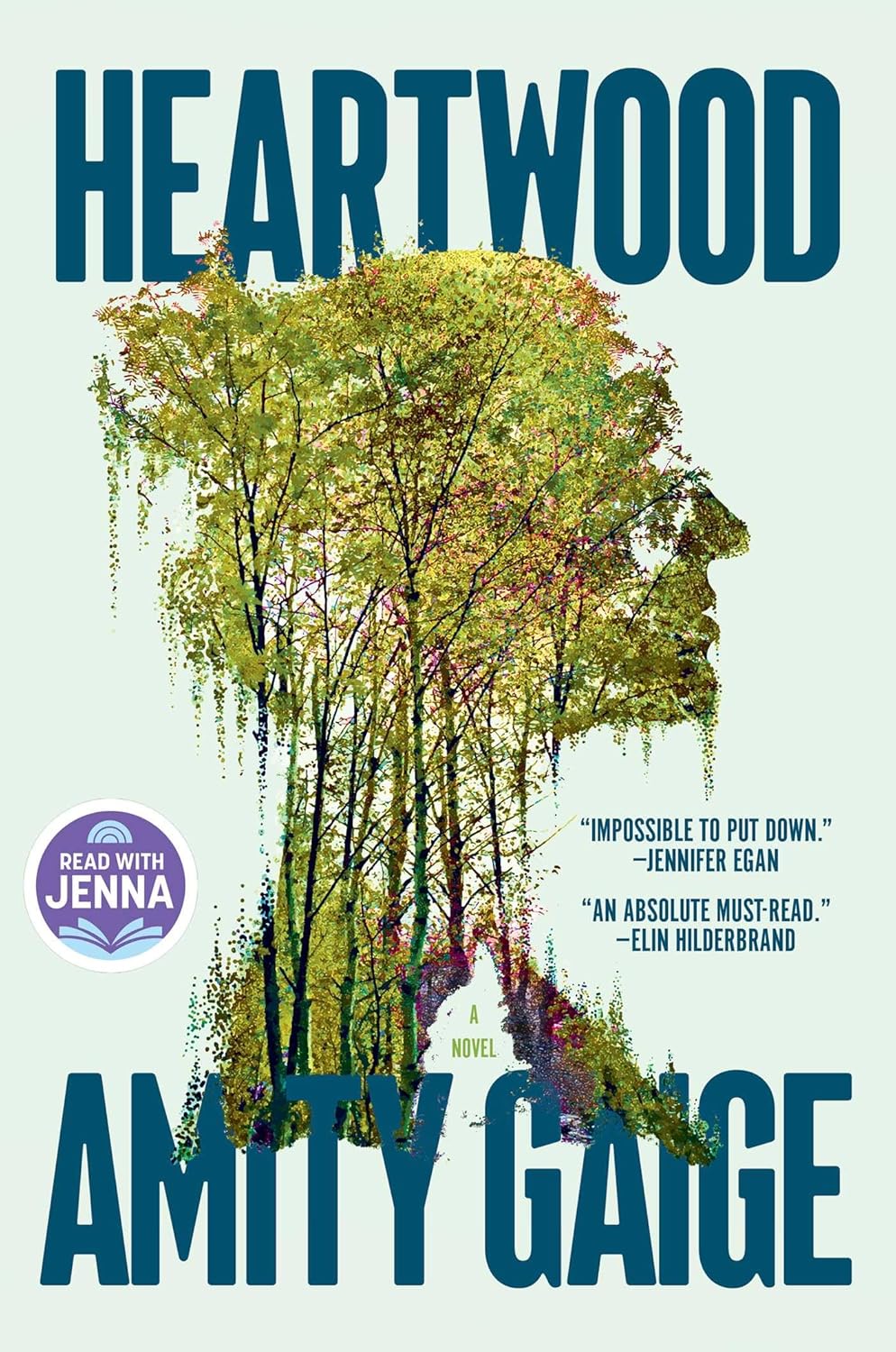
Heartwood: A Novel
- By Amity Gaige
- Simon & Schuster
- 320 pp.
- Reviewed by Jennifer Bort Yacovissi
- April 30, 2025
Powerful characters and propulsive adventure make this a page-turner you won’t want to end.
I remember learning from a friend that the northern terminus of the Appalachian Trail (AT) is the summit of Mount Katahdin, a steep 5,300 feet. I was incredulous. “That’s just mean. You’ve slogged 2,000 miles already, and they force you to climb a mountain?”
She rolled her eyes. “Well, it’s not supposed to be easy!”
Indeed, it is not, and Amity Gaige’s latest adventure, Heartwood, immerses readers in the wrenching difficulty of the challenge, as well as in the demons that might drive a person to undertake it.
Readers familiar with Gaige’s earlier novels, especially Sea Wife — a tale of a suburban family taking a year out of normal life to sail their boat around the top of South America — already know her willingness to get her characters outside in the harsh and bracing elements, testing their limits and often those of their closest relations. Her stories foreground troubled marriages and fraught parent/child dynamics.
Heartwood offers another take on thrusting suburban humans into the grip/awe of nature. At the tail end of the pandemic, 42-year-old nurse Valerie Gillis decides to remove herself from that endless, soul-killing heartache by undertaking a hike of the AT. Her husband, Gregory Bouras, is her loyal supporter, meeting her at pre-arranged trailheads with fresh supplies, often waiting through unexpected delays for her to appear. And then, 200 miles from the trail’s end, she fails to arrive at the meeting point.
In such cases, Maine game wardens are responsible for the search and rescue. (Many readers will hear echoes of the real-life incident from 2013 in which 66-year-old nurse Gerry Largay became lost hiking the AT, and the country was gripped by stories of the search for her.)
As soon as Gregory reports Valerie missing, the wardens start the search. Lieutenant Beverly Miller, 30 years on the job and one of the very first women to be hired into the service, leads the effort. Her team has a high success rate and almost always finds lost hikers within 24 hours. After that, things get dicey. As Lt. Bev explains:
“Maine is the worst place on the AT to get lost. It’s a whole new kind of hiking, more remote than anything that’s come before. Not much farther north than where Valerie Gillis was last seen lies the Hundred-Mile Wilderness. At the trailhead looms a sign that reads, verbatim: Do not attempt this section unless you have a minimum of 10 days supplies and are fully equipped. This is the longest wilderness section of the entire A.T. and its difficulty should not be underestimated.”
One of the many delights of Heartwood is getting steeped in trail culture, especially for those of us who’ve never contemplated tackling a long through-hike. (I was completely hooked when, early on, Lt. Bev says, “I had read, along with every friendless kid of my generation, My Side of the Mountain, a book about a boy named Sam who leaves home to live in a hollowed-out tree in the Catskills with his falcon and his weasel. I read that book so many times I could recite entire passages.” Me, too, Lt. Bev. Me, too. Still, that book, written by Jean Craighead George, never propelled me to want to hike the AT.)
There’s also the window into what it takes to conduct a wilderness search, especially one that isn’t resolved quickly. Lt. Bev is our able guide through the ins and outs of leading teams of professional and volunteer searchers while simultaneously conducting an investigation into whether there has been foul play (there are reasons for suspicion on several fronts).
As in Sea Wife, because one of the main characters isn’t available, we hear their voice through their writing. Here, Valerie is writing letters to her mother as a way of keeping herself collected and focused during the expanding days and nights. Slowly, we come to understand her situation and what has precipitated it.
Valerie’s trail name is Sparrow, her mother’s childhood nickname for her. Her ride-or-die trail partner, whom she met and bonded with on the way, is Santo — real name Rueben Serrano, from the Bronx — whose interviews with one of the wardens provide much of the trail intel, up until he had to leave the hike in Vermont to help his ailing father. Santo is not only a novice hiker, like Sparrow, but also a rarity on the trail:
“Man, do you have to be friendly when you are a Black man hiking. You have to start waving, like, a mile away. ‘Hey, y’all! Beautiful morning, innit?’”
The final main thread of narrative is supplied by Lena Kucharski, 76, a wheelchair-bound misanthrope in a retirement home who eats primarily what she’s able to forage in the gardens around the facility. Lena has an online friendship with TerribleSilence, an expert forager based in Maine. They discuss how TerribleSilence might help in searching for the lost hiker, but Lena becomes alarmed as her correspondent’s communications swerve into conspiracy and paranoia.
Gaige ratchets up the suspense, making the pages fly without ever sacrificing the emotional center of the story, which is the exploration of how our relationships shape us. Santo’s belligerent, belittling father made him determined to prove his mettle, while Lt. Bev’s fragile, faltering mother forged her into the one responsible for the family and, later, for a large chunk of the Warden Service. Lena, meanwhile, has managed to fully alienate her own daughter by tamping down a love so powerful, she feared it would overwhelm her.
For Sparrow, utterly alone in an uncaring wilderness, her enduring connection to her mother sustains her:
“Sometimes, in your lap, I would press my hand against your chest so that I could feel the center of you — your heartwood, your innermost substance, like the core of a tree that keeps it standing.”
I’m still not interested in hiking the Appalachian Trail, but I’m all in on this book that puts me there, and in good company, too.
Jennifer Bort Yacovissi’s debut novel, Up the Hill to Home, tells the story of four generations of a family in Washington, DC, from the Civil War to the Great Depression. Her short fiction has appeared in Gargoyle and Pen-in-Hand. Jenny reviews regularly for the Independent and serves on its board of directors as president. She has served as chair or program director of the Washington Writers Conference since 2017, and for several years was president of the Annapolis chapter of the Maryland Writers’ Association. Stop by Jenny’s website for a collection of her reviews and columns, and follow her on Bluesky at @jbywrites.bsky.social.