Hidden Terrors: The Scourge of Cholera in Jackson’s America
- By Paul Kelton
- Oxford University Press
- 360 pp.
- Reviewed by Peggy Kurkowski
- November 24, 2026
An 1830s pandemic reveals how disease can be politically weaponized. Sound familiar?
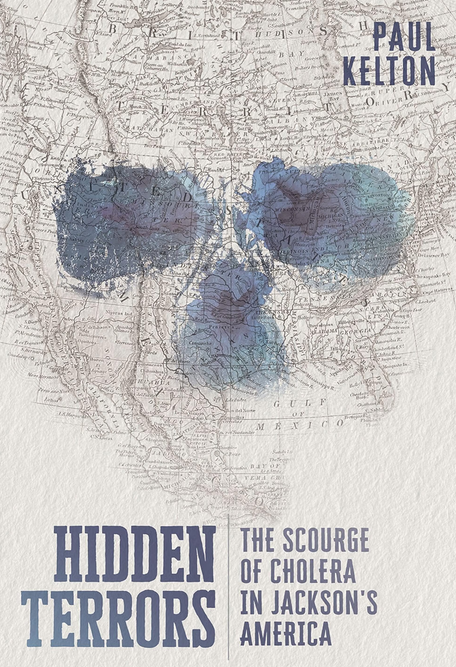
The unprecedented cholera pandemic that swept across a young United States receives a thorough examination in historian Paul Kelton’s fascinating and rigorously researched study, Hidden Terrors. Billed as the first comprehensive history of the 19th-century epidemic, the work aims to redress the historical silence surrounding this devastating event through a blend of social, medical, and political analysis supported by extensive primary-source material.
Arriving in waves between 1832 and 1836 and causing mass mortality wherever it struck, cholera followed the expanding territories of the young nation, exposing the public anxieties, political divisions, and medical misconceptions surrounding the deadly bacterium Vibrio cholerae.
By early 1832, news of cholera’s march across Russia, Europe, and the United Kingdom prompted calls in the U.S. for a national quarantine law and the creation of a sanitary commission by state officials in New York. But these warnings from a concerned citizenry fell on the deaf ears of President Andrew Jackson’s states’ rights Democrats, who dominated Congress at the time.
Meanwhile, newspapers and journals across the country vigorously debated how to respond when the illness inevitably reached American shores, with most counseling against panic. Yet the symptoms and manner of death from cholera were terrifying: In the disease’s most virulent cases, otherwise healthy adults could collapse within 15 minutes of feeling ill, with time until death measured in hours rather than days.
Kelton draws liberally from the accounts of those entrusted with protecting public health — the medical establishment and government officials — while incorporating firsthand reports from people whose lives were touched by suffering as cholera rampaged across the Eastern Seaboard. The debates between the “contagionists” and “noncontagionists” offer a window into an era when the origins and transmission of cholera remained unknown. During the pandemic’s early years, public discourse largely favored the noncontagionist position, even as contagion theory found a more receptive audience among local civic leaders and native-born residents who witnessed the disease’s devastation in their communities.
As cholera took hold of a fearful populace, the “skeptical press” found reasons to dismiss reports of mass mortality. The press was abetted in this deliberate obfuscation by a medical establishment blinkered by noncontagionist theories and business leaders unwilling to see quarantines disrupt the flow of commerce. Political and social ideology also played a calamitous role in the epidemic’s spread, as politicians, doctors, and other respected officials clung to an unscientific notion of “selective predation” among cholera’s victims.
Despite five widespread outbreaks in four years, editors and officials insisted that cholera targeted only the intemperate and “filthy, debauched” classes of Americans: poor whites, Irish immigrants, enslaved African Americans, and Indigenous peoples. Even when sober, wealthy, and respected citizens succumbed to the disease, the official “script” remain unchanged.
Synthesizing the medical and social implications of this victim-blaming, Kelton examines how the pandemic affected free Blacks, the enslaved, Irish immigrants, and the Choctaw Nation. He reserves particular disdain for the moral reformers of the Temperance Movement, whose nonsensical insistence that alcohol abuse predisposed certain populations to cholera reinforced the notion that the disease had its own “intended victims.” Temperance societies proliferated in the wake of the pandemic, cynically promoting membership as a means of increasing one’s chances of survival.
Kelton’s empathy for human suffering — cholera struck people at all levels of society — is one of the book’s greatest strengths. Through gripping firsthand accounts, he brings the scourge up close and personal, giving names and stories to the statistics. Readers will shake their heads at the appalling indifference and callousness with which the nation responded to the disease (and may have flashbacks to a far more recent pandemic).
Ultimately, the epidemic exposed far more than the limitations of 19th-century medicine; it laid bare the nation’s prejudices, political priorities, institutional failures, and willingness — or unwillingness — to recognize the humanity of its most vulnerable citizens.
Peggy Kurkowski is a professional copywriter for a higher-education IT nonprofit association by day and major history nerd at night. She writes for multiple book-review publications, including Publishers Weekly, Library Journal, BookBrowse Review, Historical Novels Review, Foreword, Shelf Awareness, and the Independent. She hosts her own YouTube channel, “The History Shelf,” where she features and reviews history books (new and old), as well as a variety of fiction. She lives in Colorado with her partner and four adorable, ridiculous dogs.

