Honeysuckle: A Novel
- By Bar Fridman-Tell
- Bloomsbury Publishing
- 336 pp.
- Reviewed by Marcie Geffner
- April 13, 2026
Is a girl made of flowers free to refuse her creator?
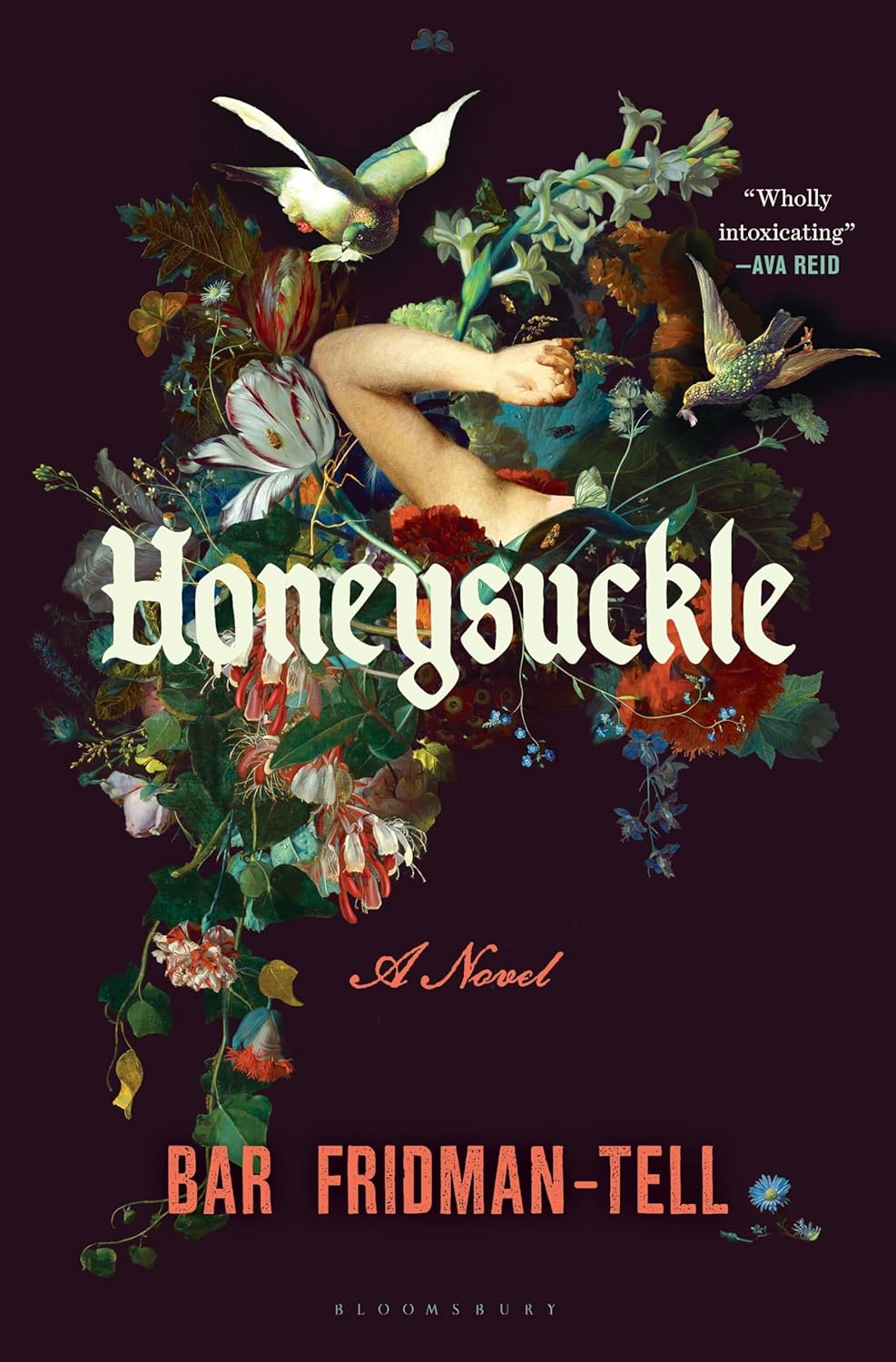
In exchange for a promise to stop following her around, 14-year-old Wynne creates a living girl from flowers to be a playmate for her 8-year-old brother, Rory. All is well until that playmate, Daye, begins to disintegrate as the flowers rot.
Can she be fixed?
Wynne agrees to try, though against her own better judgment and only to calm Rory’s devastated, uncontrollable sobs. Her magic succeeds season after season, and all again remains well until Wynne heads off to college, and Rory matures into a randy teen obsessed with keeping his captive and cooperative friend alive. At that point, Rory’s needs and Daye’s come into conflict.
Does Daye want to be refreshed for longer periods of time or even, as Rory hopes, permanently, like a “real” girl? Does she want to be transformed from a child into a young woman with physical attributes that make her even more desirable to him? She’s not sure what she wants or even what she is, and whether she has the ability to refuse Rory (when she was created for him) is an awkward question that neither of them wishes to consider too closely.
In a moment of loneliness, Daye wonders:
“What would happen to her if Rory didn’t come back? What would she be if she didn’t fall apart? What was she now, without Rory? What was she, what was she, what was she?”
Clearly, this situation can’t continue. But how bad will it get for Rory and Daye, and how will they resolve it?
Those questions are at the heart of Bar Fridman-Tell’s gorgeous debut novel, Honeysuckle, which combines fantasy with coming-of-age, horror, romance, and nature writing. The last emerges from the landscape around Rory’s home, where bunnies, frogs, swans, multiple types of birds, and myriad other creatures thrive in the meadow, forest, and sometimes snow-covered lake. The area is also rich with the seasonal materials used in Daye’s gruesome reconstruction sessions: “sharp and astringent herbs” in autumn, berries and evergreens in winter, “wreaths of lavender and bluebells” in spring, and hydrangeas and sweet-pea blossoms in summer. No wonder Rory likes how nice Daye smells…when she isn’t rotting.
The girl made of flowers comes from a traditional Welsh folktale about a woman named Blodeuwedd (“blo-DAY-weth”), but the novel mirrors the tale only in part and is decidedly modern. Other literary characters that seem to be human but aren’t also echo through the story. Pinocchio, Frankenstein’s monster, Dorothy’s Tin Man, various golems, Winnie-the-Pooh and his pals in the Hundred Acre Wood, and even Twilight’s vampires, among others, could arguably be considered kin to Daye.
Yet another of the book’s strengths is the delicate balance the author sustains between Rory’s story and Daye’s. Both are fully realized and have their own habits, needs, desires, dreams, and fears, and though they’re intensely intertwined and deeply dependent on each other, neither dominates the narrative.
The theme that consent must be given freely rather than compelled becomes heavy-handed at times as Rory repeatedly proves himself to be a selfish jerk whose professed concerns about Daye track more with his needs than hers. For him, Daye’s steadfast agreement with his schemes — while he controls her very existence — is merely convenient, not nonconsensual. The notion that even Blodeuwedds should have a right to say no just Does Not Sink In, no matter how many times others, including Daye herself, point out the problem:
[Daye’s] voice cracked. “Rory, you don’t get to choose only the me that’s most comfortable for you and call it love.”
“How can you say that?” His expression seemed to crumble. “You know I love you. I love you so much. Do you have any idea what’s it’s like to watch you fall apart again and again?”
Although Rory suffers from terrifying nightmares about Daye’s deterioration, when awake, he’s so consistently awful that readers may find him one-note and his point-of-view rough sledding to stomach. An intriguing subplot in which a village boy’s curiosity about Daye hints at the possibility of something worse than Rory’s obsession might’ve made Rory more tolerable by comparison, but it’s left unexplored.
The novel’s dramatic conclusion is signaled early and is easy to guess, yet that may be for the best because the fantastical resolution of Rory’s and Daye’s dilemma might otherwise prove too out-of-the-blue for readers to accept. As it is, the ending — and, indeed, the entire story — fits together well and proves both thrilling and satisfying.
Marcie Geffner is a journalist, essayist, and book reviewer in Ventura, California.