Hot Desk: A Novel
- By Laura Dickerman
- Gallery Books
- 368 pp.
- Reviewed by Kristin H. Macomber
- September 29, 2025
This debut’s rom-com wrapper belies its surprising depth.
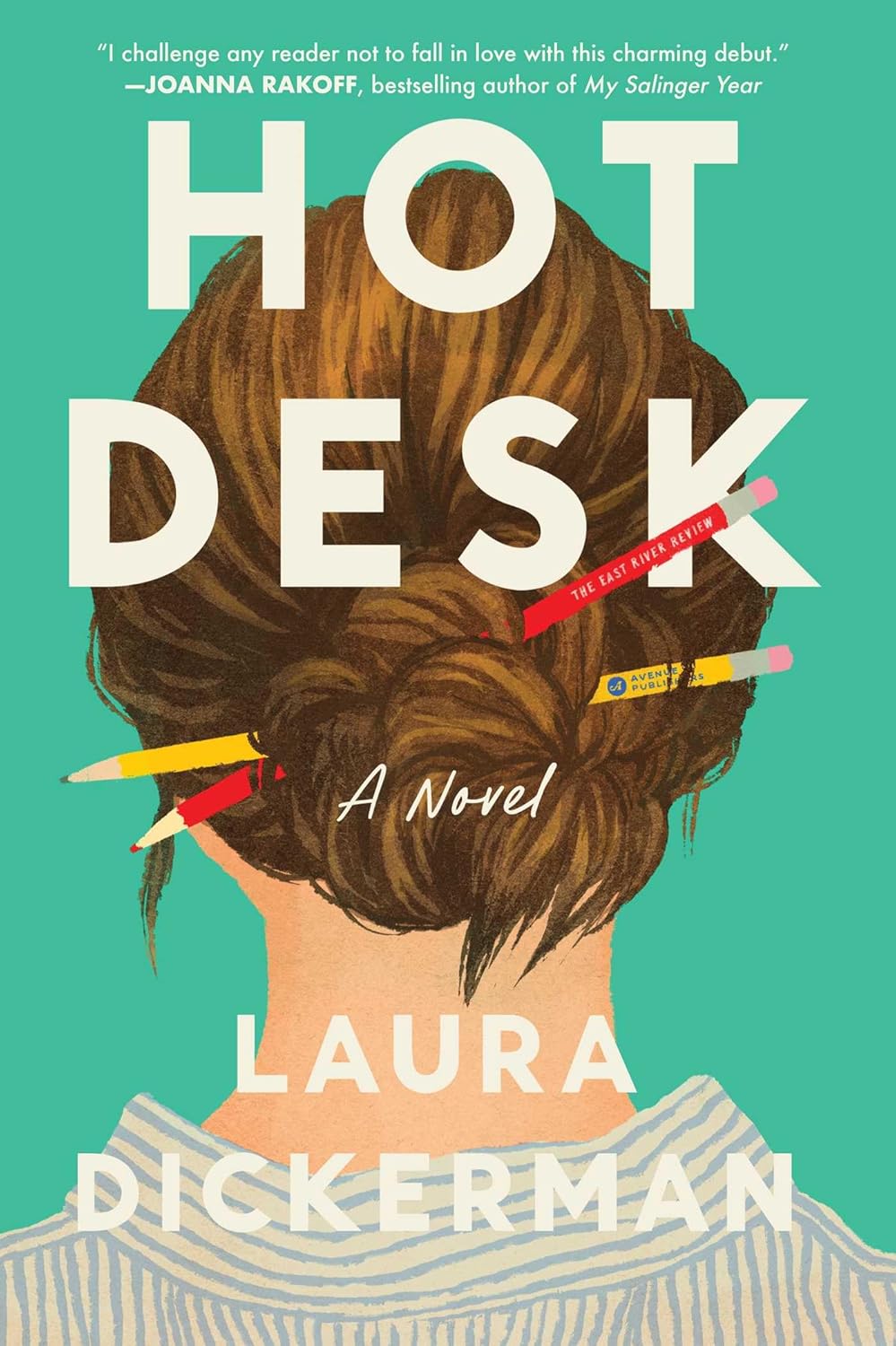
Hot desking: A strategy accelerated during the covid pandemic, when efficiency experts declared that workspaces could be tag-teamed by a part-time, in-office workforce. So begins Hot Desk, Laura Dickerman’s debut novel, as the titular work scheme has been launched to accommodate two divisions of a downsizing Manhattan publishing conglomerate.
Let the petty intra-office blowback begin!
The first character we encounter is Rebecca Blume, a successful young editor on the rise at Avenue Publishing. We meet her just as she’s gotten a first look at her Tuesday/Wednesday bullpen desk — a sight that leaves her feeling demoted, given that she’d had an actual office (or, more accurately, a repurposed file closet) before this new shared-seating plan was hatched.
All she knows about her workplace’s Thursday/Friday occupant is that he’s a new hire for Hawk Mills, one of Avenue’s competing divisions, and that he seems to think a runty little cactus should permanently adorn their co-desk. Who would want such a pathetic plant?
Later, we meet the new guy, Ben Heath, who’s delighted just to have gotten a foot in the door of a legitimate literary imprint. He’s all in on the rotating-workspace concept, despite his confusion over the message on the Post-It note — “WHAT IS THIS ABOUT?” — stuck to his cactus, which was left there, he can only assume, by the desk-mate he has yet to encounter.
Dickerman sets her novel in motion with this not-quite-meet-cute-waiting-to-happen scenario. So, yes, Hot Desk checks the rom-com box. But truth be told, the author’s opening chapters only scratch the surface of the multilayered narrative to come. For starters, what begins in the post-pandemic era takes a turn back to the New York publishing world of the 1980s, when your Rolodex was your social-media hub, literary lions ruled both the bestseller lists and Page Six scandal columns, and publishers hired scads of English majors to scour their slush piles in search of the next Joan Didion — in other words, during a (largely but not entirely) golden age of the written word.
Hot Desk’s multiple datelines converge with the death of a long-revered writer, a man often referred to simply by his monogram (EDA) or, even more simply, as “The Lion.” In addition to being a Nobel laureate, EDA founded and financed a literary publication whose offices have been housed in the lower levels of his family’s brownstone since the 1960s. For the throngs of aspiring writers and editors who worked at his East River Review, EDA was the resident celebrity and editor-in-chief whose prose they worshiped and (occasionally) the alleged grownup who’d drop in and turn their late-night editing sessions into billiards contests, often with alcohol-infused make-a-wish wagers that wouldn’t pass HR behavior standards today.
Much to Rebecca’s puzzlement, EDA’s death in the present day triggers a request for her to meet with his widow, Rose Adams, to discuss her plans for her husband’s estate. It’s an opportunity Rebecca is at a loss to justify, beyond one slim thread of connectivity — her mother was an intern at the East River Review four decades earlier.
The crisscrossing of timelines provides space for multiple story threads and incorporates a multitude of characters who might be hard to keep tabs on if their dialogue — spoken, Zoomed, written, texted, DM’d, and, yes, Post-It-noted — were less plausible and engaging. And fun! I say this as a reader who’s ditched many a novel for having put words in characters’ mouths that just didn’t ring true. Thankfully, Dickerman not only gives each chatty morsel its due, she’s even willing to let her characters prattle on in nervous-blather mode, then catch themselves giving a speech they didn’t mean to give, and finally willing themselves to stop immediately, before they make total fools of themselves.
Bottom line: Don’t judge this book by its title or its cover or its amusing plot. Stick with it for the good stuff, which includes a reckoning of generational wrongs; a battle to keep those in power from having the last word; an affirmation of the right to tell one’s own story; and, best of all, a chance for a woman to renew a broken bond with the dearest friend she ever had.
As for that poor cactus and its seat-sharing duo? Well, you’ll have to read the book to see how their story ends. Or just wait for the movie, which could become the greatest rom-com of them all.
Kristin H. Macomber is a writer who lives in Cambridge, MA. The last romance novel she read before this one was Jane Austen’s Persuasion.
.png)