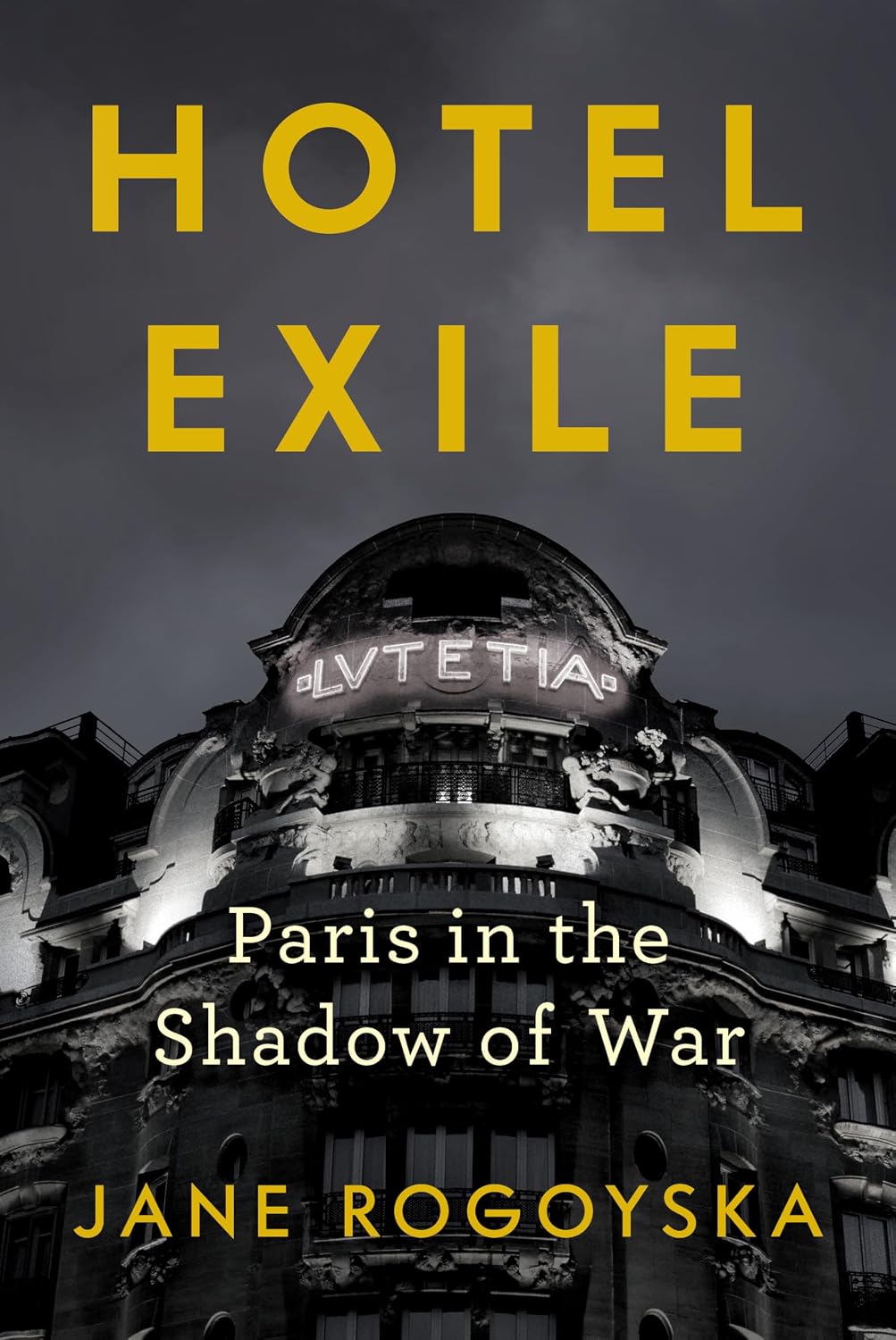
Hotel Exile: Paris in the Shadow of War
- By Jane Rogoyska
- W.W. Norton & Company
- 352 pp.
- Reviewed by Jethro K. Lieberman
- October 15, 2026
An epic account of the City of Light’s descent into darkness.
It’s daunting to write about World War II as if there’s something new to say. The literature on the fighting and the years surrounding it is immense, from sweeping narrative histories to more focused stories and examinations of its devastation in particular cities and countries; its innumerable leading actors, battles, technologies, and strategies; its ideologies and cruelties; and its depravity and slaughter.
But that’s the task that Jane Rogoyska, a British writer and filmmaker, set for herself in Hotel Exile: Paris in the Shadow of War. Though it may take a while for readers to catch on, she ultimately succeeds by depicting the war’s drama and horror in a novel way. Neither conventional biography nor chronological history, this eminently readable book is, instead, a collection of moments, her technique a form of literary pointillism: Brief encounters, snippets of thoughts, laconic summaries, and connections form a canvas of global insanity (and occasional heroism) reflected in the sighs, cries, fears, and boasts of victims and perpetrators. It’s all centered on a Parisian hotel, the Lutetia, that still stands today.
Rogoyska chronicles a slew of relationships, betrayals, shifting political alliances, tensions, policy debates, and personal minutiae. Most of these stories consume but a page or two, sometimes just a sentence or a paragraph, though she frequently returns to larger story arcs. Many of the anecdotes are poignant, sardonic, and eye-opening but largely unconnected.
Founded in 1910 and described as “a Paris institution,” the Lutetia is “the only ‘grand’ hotel on the city’s bohemian Left Bank.” It has boasted more than a handful of famous patrons: “Andre Gide took his lunch here…Picasso and Matisse were regular guests.” Charles de Gaulle and his bride stayed in the Lutetia on the way to their Italian honeymoon. It was a meeting place for all sorts of groups and many prominent speakers. It is also where Parisians of a certain class came to celebrate birthdays and anniversaries.
Not every refugee from the crushing evil that grew day by day in their respective homelands spent time at the Lutetia, but enough did that Rogoyska can stitch together numerous yarns about those who stopped by daily, lunched there once a week, or had enough funds to live there while waiting — vainly, as it turned out — for all the ugliness to melt away.
Despite her book’s title, Rogoyska’s account of the war is only fleetingly about the Lutetia itself; the subtitle does almost all the work. The hotel is not so much an actor in a drama as it is the stage on which the story of three disparate groups plays out: emigres, mostly from Germany, who escaped to Paris throughout the 1930s; officers of the Abwehr, the German military-intelligence service, which took over the hotel in late 1939; and, after the liberation of the city in August 1944, the deportees and POWs for whom the Lutetia served as a repatriation center. As Rogoyska tells it:
“The roll call of those forced out of Nazi Germany in those early days [1933] reads like the guest list for a particularly distinguished university conference. Among them are names both familiar and forgotten, the stars of Weimar’s intellectual and political firmament: Bertolt Brecht, Lion Feuchtwanger, Heinrich Mann, Thomas Mann, Golo Mann, Walter Benjamin, Alfred Kerr, Anna Seghers, Alfred Döblin, Bodo Uhse, Gustav Regler, Hannah Arendt, Walter Fabian, Ernst Erich Noth, Ludwig Marcuse, Annette Kolb, René Schickele, Hermann Kesten, Alfred Kantorowicz…[and Hungarians] including Joseph Roth, Manès Sperber, Franz Werfel, Alma Mahler-Werfel, Stefan Zweig.”
The first wave of emigres was warmly welcomed, but the hearty greetings soon chilled. Right-wing publications began sounding a familiar theme: Let them in, and they will take our jobs. Xenophobia and antisemitism swept the country. The French government erected hurdles making it difficult to survive. When passports expired, refugees became stateless. When the Nazi regime marched into Paris in 1940, emigres became “enemy aliens.” The City of Light was no longer a refuge but a prison for exiles. Large numbers were whisked away to internment camps; others fled, or tried to. Rogoyska recounts many stories of escape-planning and the journeys themselves.
Days after France capitulated, the Abwehr requisitioned the Lutetia as its local headquarters. The staff was kept on and remained professional. The Nazis and Parisians alike tried to maintain the façade of normalcy. It didn’t always work, partly because of the Germans’ insecurities about their own ignorance of high culture. One evening at dinner in the hotel’s main dining hall, an Abwehr staffer choked on — what else? — an artichoke, not knowing what it was or how to eat it. His table companions had to be talked down from arresting the chef.
As the Nazis faced a two-front war, they began to move troops and personnel to the front lines. In 1940, roughly 40,000 German military personnel were stationed in Paris. By 1943, the number was down to 15,000. In 1944, the Germans packed up and fled. In the aftermath of the war, the French repatriated concentration-camp survivors. (Over half of France’s 90,000 political deportees were repatriated; by contrast, only 2,500 of its 75,000 deported Jews returned.) Rogoyska devotes many pages to arrival scenes at the Lutetia:
“They are walking skeletons, their skulls covered with skin so thin it is almost transparent. Their heads are shaven, men and women almost indistinguishable. Most wear filthy clothes resembling striped pyjamas.”
For the victims, their immediate return was psychologically and physically unsettling. They seemed barely alive, barely human; they were profoundly disoriented and remained so for some time. For many, the reaction to their presence was silence:
“Those who have not experienced concentration camps cannot imagine it. Those who have survived soon learn that others are not willing to hear what they have to say. What people want to do, more than anything else, is forget…To survive deportation is to find oneself in a particular kind of exile: separated from the rest of society by experiences that others cannot begin to understand.”
Remembrance of the full horror did not come until decades later, when the survivors, in old age, determined to tell the next generation what had happened. So the story ends. Yet there’s something more — unstated but available to anyone who has now glimpsed the whole. Somehow, Rogoyska projects this sepia-toned saga onto our own times, as we recognize that this is our tale, too. We again live in a world of deportation, fugitives, refugees, and political exiles, only now there’s no idyllic hotel through which to consolidate the tales of flight and despair — tales over which our own descendants will surely shake their heads in disbelief.
Jethro K. Lieberman is the author of Liberalism Undressed, a study of the principles and policies that constitute a modern understanding of liberalism.