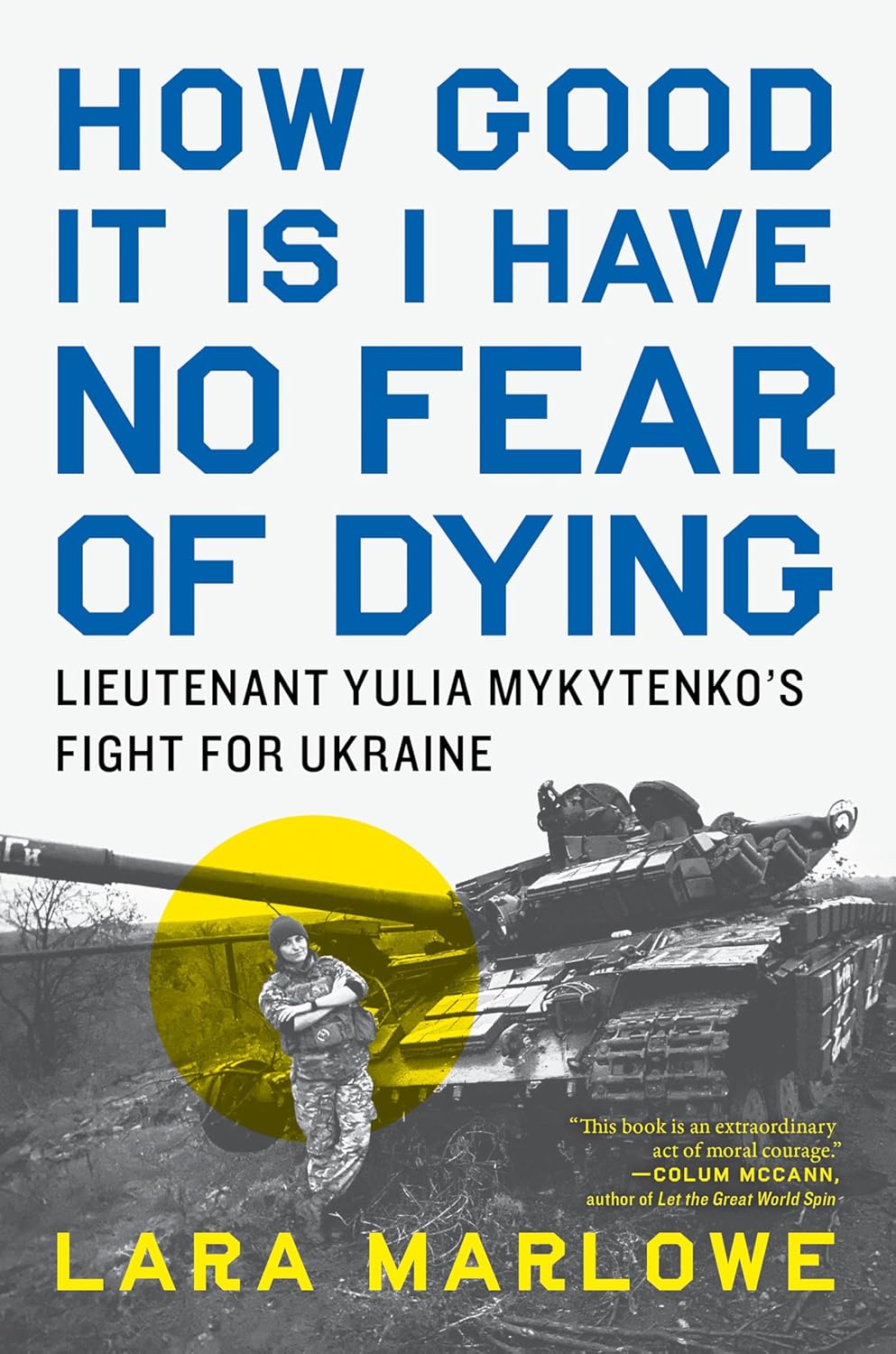
How Good It Is I Have No Fear of Dying: Lieutenant Yulia Mykytenko’s Fight for Ukraine
- By Lara Marlowe
- Melville House
- 312 pp.
- Reviewed by Larry Matthews
- February 6, 2025
A young officer refuses to be ground down while battling the Russians.
Ukraine has taken on outsized importance in the West in the years since Vladimir Putin began his attacks on the country, first in Crimea and Donbas in 2014, and then via a full-scale invasion in 2022. The United States and its NATO allies have poured billions of dollars in equipment and weapons into the fight, reasoning that if Putin is successful in Ukraine, he’ll look for other prizes in Eastern Europe.
Ukrainians of all ages and backgrounds volunteered to fight the Russians and have managed to battle them to a stalemate despite being grossly outnumbered. One of them is the author of How Good It Is I Have No Fear of Dying, who introduces herself like this:
“I am First Lieutenant Yulia Mykytenko, a Ukrainian woman, age 28. This is my life now.”
But it is not her first time in combat. She fought the Russians a decade ago in Donbas, a resource-rich area on the border between the two countries. Russia wants those resources; Ukraine refuses to give them up.
Mykytenko’s story — originally published in Ukrainian and translated into English by the author, Lara Marlowe, an American journalist working as a foreign correspondent — brings us into the daily existence of Ukrainians fighting the Russians while trying to maintain something resembling normal lives. Mykytenko describes her happy days as a university student and then takes us to the front, where misery and horror reign. In the weeks following Russia’s invasion, she joins the long lines of volunteers eager to face the enemy. “There are hundreds of men packed inside” the recruiting station, she recalls, “and hundreds more outside.” They are issued weapons onsite.
The war turns out to be a strange combination of old-school trench fighting and modern technology. (“We follow the war news on our smartphones.”) Mykytenko commands a drone unit — from her laptop — that both surveils the Russians and attacks them with explosives dropped from makeshift drones purchased for a few-hundred dollars in Western Europe. Mykytenko reflects on how similar it all feels to World War I:
“A century later, life in trenches and dugouts had not changed much. The cold, dirt, danger, rats and lack of sleep are the same.”
In the Ukrainian military, every soldier donates part of his or her salary to help buy equipment — Mykytenko used her Facebook page to raise funds — while civilians back home send money and supplies. But victory, if it eventually comes, won’t be the result of these small, private efforts. It will be because of the equipment donated by NATO: billions of dollars’ worth of artillery, missiles, and state-of-the-art tanks provided by the U.S. and its European allies.
“The T-90, the Russians’ best tank, doesn’t hold a candle to the Abrams, Challengers and Leopards we finally obtained from the West,” Mykytenko writes. “Unfortunately, the quality of these tanks is not matched by quantity.” There is never enough materiel to meet demand at the front, where the Ukrainians are locked in a death struggle with Russian soldiers, convicts, mercenaries, and North Koreans, all of whom are being sacrificed in appalling mass attacks:
“Ukrainian infantrymen are mowing down Russians with machine guns. It is worse than killing. It is slaughter, elimination, annihilation, death on the assembly line. The Russians are shredded by our machine guns, but they just keep coming.”
The drones she commands show her the battlefield and its destruction. From her computer, she sees men shot, blown up, lying in agony with horrible wounds. Yet she feels nothing for them if they are Russian. “I try not to dwell on blood and torn bodies,” Mykytenko admits, “because if I let myself think about what I have seen it will sap my strength and energy. It will engulf me.”
Neither does she have sympathy for the people she imagines sitting in comfortable offices in Washington, DC, calculating the risks of providing better weapons to Ukraine and deciding how many deaths are acceptable. In a passage that might well define her entire country, she writes:
“I am not so much demoralized as tired. Fatigue has burrowed into me, and I know I am not as effective as I once was. Our war of attrition has turned into a war of exhaustion, not just for me but for the country and for our Western partners.”
How Good It Is I Have No Fear of Dying is an important book that goes far beyond the nightly news updates on how the war in Ukraine is impacting American politics. It shows us what war can do to the human soul. We are constantly being told by the pundits that the world is dangerous and unstable. Lieutenant Yulia Mykytenko, not yet 30, embodies what we are facing.
Larry Matthews is the author of Take a Rifle from a Dead Man.