How to Disappear and Why: Essays
- By Kyle Minor
- Sarabande Books
- 260 pp.
- Reviewed by Yelizaveta P. Renfro
- March 19, 2026
This ruminative collection may especially appeal to writers.
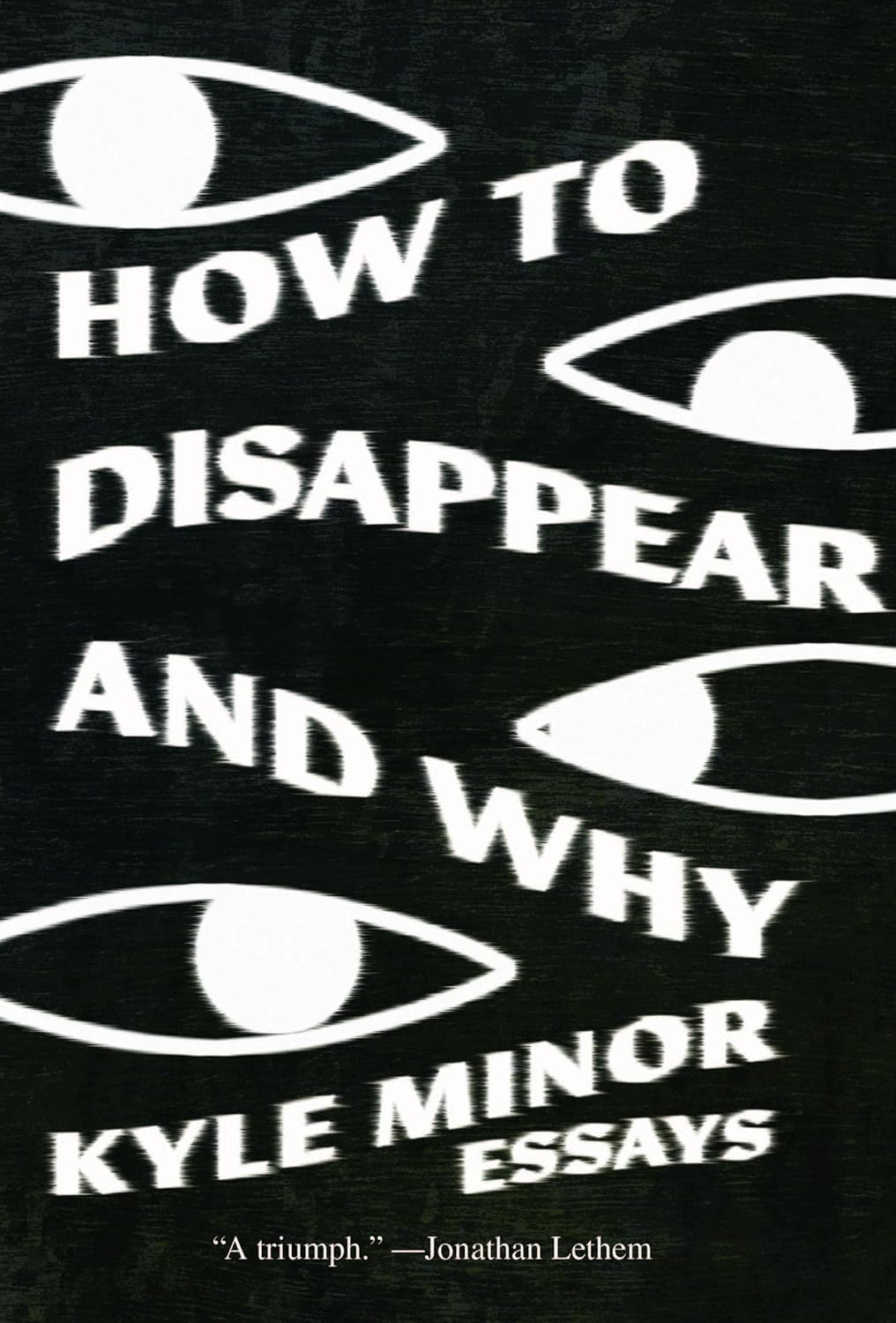
The opening title essay of Kyle Minor’s new collection, How to Disappear and Why, offers a series of 11 lists, beginning with “Reasons to Disappear,” which includes nearly three dozen wide-ranging possibilities, such as, “Perhaps you are ashamed,” “Perhaps your reasons for wanting to be known or seen have been satiated,” and “Perhaps you wanted no one to remember you had been.”
The subsequent 10 sections on “Ways to Disappear” — including “People Who Famously Disappeared,” “Of All the Reasons to Disappear, the Best Reasons to Disappear,” and others — encapsulate the frenetic anxieties driving Minor’s cerebral, existential collection.
In his essays, Minor explores different forms of disappearing in more depth. “A Theory of Ghosts,” for example, is written as an address to a friend who has died and is still haunting Minor, speaking to him in “two voices”: “the voice of the man, alive, carrying the shabby coffee cup, asking for rides to the grocery store, getting in fights at the bar” and “the voice of the ghost, no less alive for speaking outside time.”
The essay, Minor reveals, is an intimate letter that he’s been working on for five years, and he foregrounds his struggles in expressing himself by leaving in his false starts, striking through rejected phrases rather than omitting them, thereby making his strained efforts at communication apparent on the page.
In “The Uber Diaries,” he is the one who disappears, taking a summer job as an Uber driver in order to supplement his income and, more significantly, to bury his own desires and disappointments beneath the stories of those whom he chauffeurs around Indianapolis. The essay features a cast of colorful characters — strippers, students, drunks, a cancer patient on her way to chemo, a series of passengers who believe it’s their duty to offer their driver life advice — with occasional glimpses into the circumstances that brought Minor to this point.
“This time two years ago, I was finishing a thirty-city book tour,” he thinks as he’s driving one night; elsewhere, he mentions his failed movie deals. By the end of the essay, Minor’s own desires have been subsumed into the stories of his passengers. “I used to be so pretty,” he writes in the final lines of the essay, echoing what the cancer patient said to him. “I wish you could’ve seen me. You would have loved me.”
In the essay that immediately follows, “On the Desire to Reject Narcissism: Notes Toward a Follow-Up Essay to ‘The Uber Diaries,’” Minor offers additional insight in a series of potential openings to a new essay. In Opening #2, he writes, “But why does one need to be pretty? Why does one need to be seen? Why would one write an ending that equated the cry of the pink-hooded cancer patient with the cry of the failed screenwriter driving the Uber Toyota?”
In Opening #14, Minor takes a different tack:
“When one has primarily (and for a long time) been mostly keeping the company of fiction writers, poets, journalists, university professors, visual artists, and filmmakers, and then one suddenly finds oneself moving briskly through the city nightly in the company of bankers, lawyers, nurses, construction workers, food-service workers, sex workers, and bartenders, one begins to believe that one’s engagement with the world has become…”
Other openings explore similar preoccupations. “Are all writers of essays, stories, screenplays, songs, poems, tweets, letters narcissists?” he asks in #43, and, “What is the responsibility of the narrative artist when his or her material traffics in the lives of others?” (#52). Other openings (#75a, #78, #87) have been rejected by the author, as evidenced by more strike-throughs.
The collection is rife with meta-commentary, with Minor addressing us directly (“If you are reading this essay, you probably hold at least a bachelor’s degree. It’s not unlikely that you have a master’s degree or PhD”) and describing the process of completing the book (“The book you are right now reading — How to Disappear and Why — was once the manuscript I am still self-defeatingly withholding from my publisher in this unpleasant moment that will become the past. Typing and deleting, typing and deleting”).
Toward the end of his final essay, “The Sickness and the Song,” he describes visiting his old writing teacher in New Mexico shortly before the man’s death. In talking about his writing career, the teacher says, “It wasn’t until the end that I stopped singing the song of myself,” paraphrasing Whitman. “I got interested in the public story.”
Minor takes this lesson to heart, concluding with a rejection of narcissism, an embrace of the public story. “There is a time to sing the song of oneself, but that time is not forever,” he writes. In the final lines of the book, he offers one more reason to disappear. “For the song to grow the self must recede,” he writes. “I see a path forward.”
In his rather exhaustive “Notes, Sources, and Suggestions for Further Reading,” Minor makes one more gesture toward his rejection of narcissism and his embrace of other stories — and other storytellers. “The written essays in this book are intended to live among the unwritten essays on the subject of How to Disappear and Why,” he explains, continuing with an invitation to his readers (who might be fellow writers):
“I hope it’s understood that most if not all of these currently unwritten essays will not be nurtured into the light by the author of this book. If there was anything here for you, one great reciprocal honor you could bestow would be to nurture one or two of them into the light yourself. If you did, you’d be doing so with my encouragement and blessing, because I’d like to read them in magazines and literary journals and websites and a book bearing your name.”
If the collection has a fault, it’s just that: His primary audience seems to be the very “writers of essays, stories, screenplays, songs, poems, tweets, letters” whom he suspects of narcissism, the holders of graduate degrees, the small cadre of readers who appreciate clever meta-moves and excruciating self-awareness. That’s not to say there isn’t anything here for others but rather that they’ll need to look past Minor’s writerly tics to enjoy this wide-ranging and capacious examination of disappearing in its many manifestations.
Yelizaveta P. Renfro is the author of the essay collections The Season of Birds and Stones and Xylotheque, and a collection of short stories, A Catalogue of Everything in the World. Her fiction and nonfiction have appeared in Glimmer Train Stories, Creative Nonfiction, North American Review, Colorado Review, Alaska Quarterly Review, South Dakota Review, Witness, Reader’s Digest, and elsewhere. She holds an MFA from George Mason University and a Ph.D. from the University of Nebraska.