How to Dodge a Cannonball: A Novel
- By Dennard Dayle
- Henry Holt and Co.
- 336 pp.
- Reviewed by Carr Harkrader
- July 11, 2025
This rollicking bildungsroman unfolds amid the Civil War.
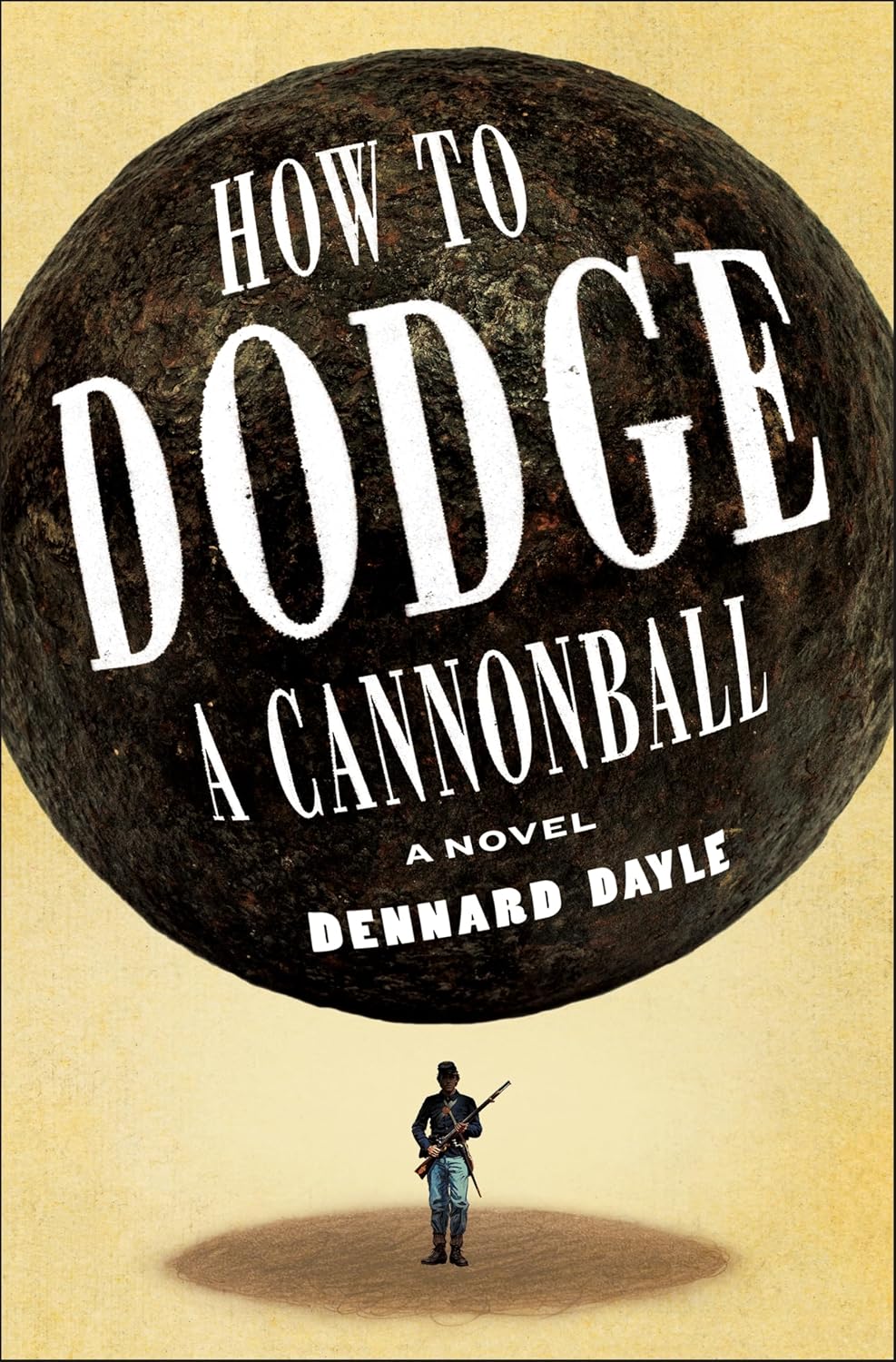
You could describe How to Dodge a Cannonball, Dennard Dayle’s debut novel, in any number of ways: a cockeyed look at the Civil War; a bonkers coming-of-age tale featuring a band of (mostly unwilling) brothers journeying across 19th-century America; and certainly a satire of our country’s many racial issues. But I like to think of it as the literary equivalent of its protagonist’s job in the army: It twirls whatever flag is placed in its hands in an impressive (and often tangled) display for the entertainment of its readers.
Anders, that protagonist, is a flag-twirler during the war. For which side? Well, it depends. As a very young man, he enlists with the Union Army near his home in Illinois. Soon (within a sentence), the Confederates capture his unit, and he promptly flips the Stars & Bars in a “Secession Twist.” He takes his flag-twirling quite seriously, you see, even if no one else seems to. After the disastrous Battle of Gettysburg, he defects to a Black Yankee unit. To cover up the obviousness of his own whiteness, Anders claims he is an octoroon.
All this happens in the first 20 pages, and the narrative — complete with arms dealers, trips to New York City and out West, multiple episodes of twirling-induced violence, and even a piece of “scientific theater” inserted in the middle — can sometimes feel like that messy kitchen drawer containing batteries, twine, random buttons, and the manual for two microwaves ago. However, this book might be the funniest, messiest drawer you’ll ever encounter.
It can be difficult in comic novels to develop — and maintain — a voice, but Dayle has the uncanny ability to offer subtly poignant moments that leaven the literary slapstick. Few topics are more rife with hypocrisy and absurdity than war and race, so the Civil War offers the author plenty of fertile ground to plow. Indeed, it’s so obvious a topic that even the novel’s characters write about it. Anders’ immediate superior in the Union Army, Tobias Gleason, for one, claims that “America is the home of the new human” and pens high-handed, pretentious plays about its possible racial future.
The novel generally follows the contours of the actual war, so its wild ending led me to look up whether a particular settlement that Dayle was describing was real. The clueless Anders guides us through this nation run amok, and his developing relationships with his all-Black unit offer a tether for the reader even as he seems to revel in the nonsense unfolding around him. Ironically, the obviousness (to everybody but him) of his racial deception helps him bond with his fellow soldiers, all of whom have their own reasons for joining the Union forces.
At one point, a compatriot asks Anders if he’s ready to execute what could be a dangerous mission (one that ends with the first “twirl off” I’ve ever read in literature). “Are you committed?” she queries, to which Anders replies, “I commit to everything. Life dangles everything out of reach. So I push, and push, until something comes loose.”
In How to Dodge a Cannonball, America itself is coming loose. If it occasionally feels like Dayle is moving his characters around the country like chess pieces, the book nonetheless highlights how the war happened everywhere. It wasn’t just open land that served as battlefields; riot-filled Manhattan or your own barracks could be just as contentious and deadly.
In our current moment, everything feels unhinged. Politics is intensely fractious, and any object or exchange can quickly become the scene of cultural trench warfare. But the Civil War was an actual war; states, frontiers, and racial lines were constantly being redrawn and fought over. Amid the vitriol, the “new human” that Gleason hoped to see arrives, but it’s not terribly new. The character Slade Jefferson, an amoral and wealthy arms merchant who pulls strings on both sides, is a reminder that venal rich men aren’t novel in 1865 or 2025. He embodies the corrupt forces long calling history’s shots. As young Anders slowly discovers, growing up ain’t easy — whether for a kid or a country.
Carr Harkrader is a writer and book critic in Chicago. You can follow him on X at @CarrHark.