How to Lose Your Mother: A Daughter’s Memoir
- By Molly Jong-Fast
- Viking
- 256 pp.
- Reviewed by Gretchen Lida
- July 14, 2025
Coming to terms with a famous, and famously flawed, parent.
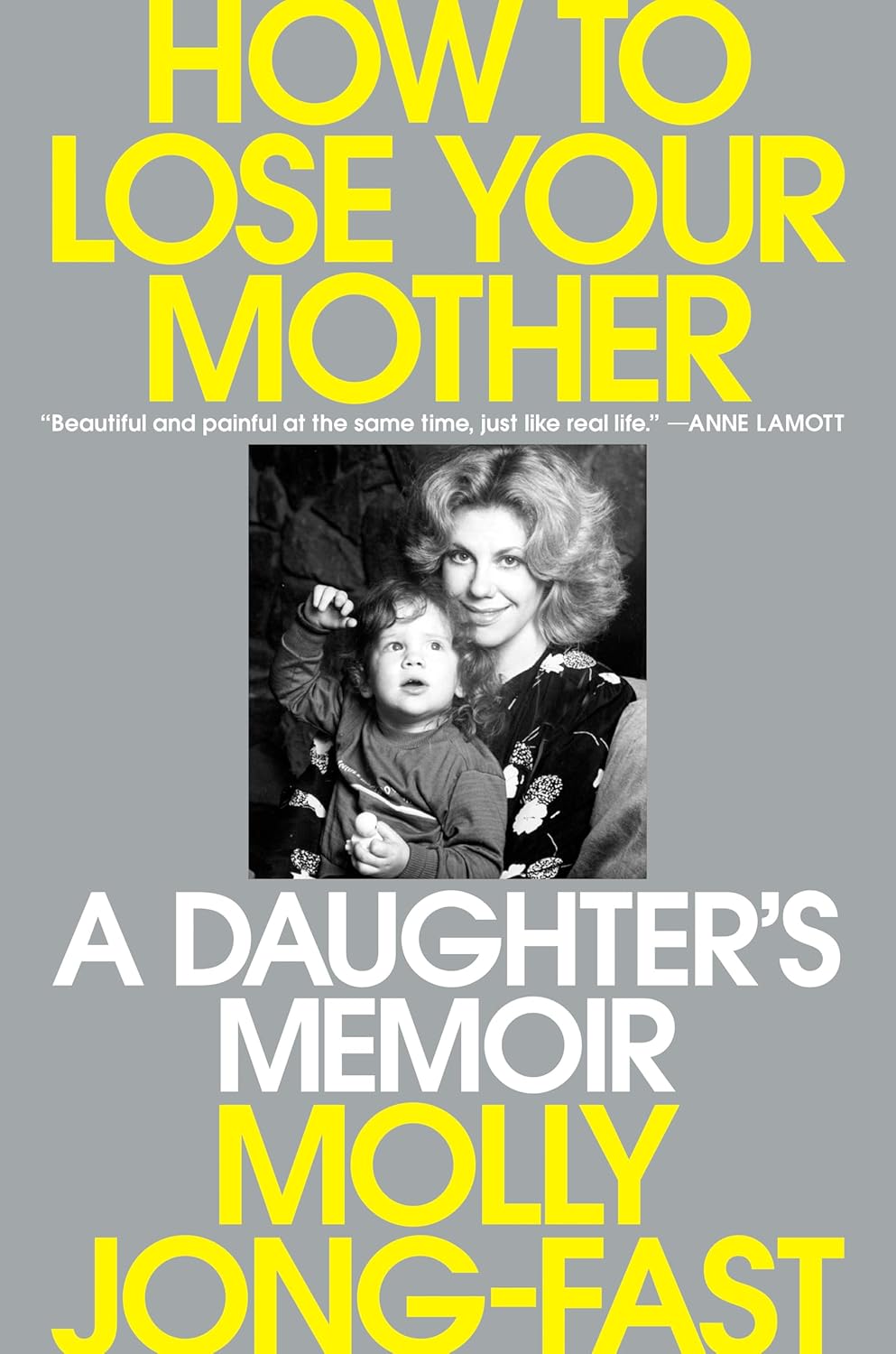
There’s something utterly delicious about a memoir that roars and crashes like a trainwreck. The kind of book where the author’s dirty laundry isn’t just airing out but smoldering atop the wreckage. Where not a single reputation escapes without a stain or two. Political commentator and author Molly Jong-Fast’s How to Lose Your Mother is just such a book.
The memoir chronicles 2023, which the author calls the “Annus Horribilis.” It was the year she moved her ailing elderly mother, the writer Erica Jong, and her stepfather into a care facility, and her husband was diagnosed with a rare and potentially deadly cancer.
While terrible, these kinds of ordinary calamities eventually happen to most of us. Even having a less-than-warm-and-fuzzy relationship with one’s parent is common. What isn’t pedestrian is Erica Jong’s fame, or her only child’s candor in examining it.
Jong-Fast’s book straddles three memoir subgenres; the first is the “mean mommy” book. In fact, perhaps my only real complaint about this work is its title; it’s hard to lose someone you never had in the first place. Jong-Fast describes how she was perpetually a peripheral character in both her mother’s books and her real life. For Jong, fame, alcohol, and the latest lover were always higher priorities than motherhood, an injustice that, like any child, Molly felt deeply.
In many instances, the author refers to herself as “a bad daughter,” all the while figuring out how to get her aging mother and stepfather the care they clearly need and tying up mountains of loose ends left by two people unable to look physical or fiscal reality in the eye. She notes that her mother long lived as if she was wealthy (she was not), and that after they move into what Jong-Fast christens “The World’s Most Expensive Nursing Home,” her stepfather constantly asks when they’ll be returning to their Manhattan apartment (never). While it wouldn’t have fit the tone of the book, I wish Jong-Fast had given herself more credit for hanging in there.
The second subgenre shelf for How to Lose Your Mother is the “celebrity-adjacent tell-all.” In these books, someone close to a famous person tells a good story, often reflecting on what fame and influence do to the human psyche. Examples include Ada Calhoun’s Also a Poet, about her father, the legendary art critic Peter Schjeldahl, and Care and Feeding by Laurie Woolever, who was an assistant to both Mario Batali and Anthony Bourdain. As in Jong-Fast’s book, these authors’ clear-eyed observations and self-discovery make their memoirs utterly readable.
Jong found celebrity following the publication of her scandalous-for-1973 novel, Fear of Flying, which is still considered an important text for second-wave feminism. She was, for several years, a household name (which didn’t keep her from always chasing after the next exciting man in hopes that, this time, he would save her). But her fame inevitably dimmed, a fact she never really accepted. When your identity was once inflated by the fact that Oprah called on the landline, what do you do when the calls stop? If you’re Erica Jong, you ignore it, you continue living as if you’re famous, and you drink.
Which brings us to this book’s third subtype: It’s an addiction memoir — both a story about Jong-Fast’s recovery from drugs and alcohol at 19, and a gloriously euphemism-free telling of Jong’s descent into alcohol-induced dementia. While Jong-Fast has now been sober for decades, her vulnerability is beautiful to encounter on the page. And she never falls into the AA morality trap when describing Jong’s addiction. Rather, she just lets the uncomfortable, chaotic scenes of her mother’s drinking play out in front of us. We get to decide whether or not there’s a lesson to be learned.
What these aforementioned subgenres don’t capture, though, is that this book is also often achingly funny, too. Zingers and jokes abound. In one section, Jong-Fast says that she’d expected to enter the “Old People in the Emergency Room” stage of life; in another, that, instead of Ozempic, she was on the “Surrounded by Death Diet.” Here, she poignantly (and wittily) reflects:
“We tell ourselves stories so that we may live, to quote Joan Didion, a serious writer who never took Mom seriously.”
Lastly, this is a pandemic book, the ghost of covid-19 floating through the pages. Jong-Fast notes that lockdown was the harbinger of her mother and stepfather’s rapid decline. They became well-practiced at isolating and no longer had to pretend to function. Quarantined in their apartment, she slipped further into the bottle, and he further into denial. While some parts of the book roar, this one whispers, but it’s persistent and hard not to notice. In the end, maybe this is how Jong-Fast loses her mother: all at once, and then very, very slowly.
Gretchen Lida is an essayist and an equestrian. She is a contributing writer to the Independent and Horse Network. Her work has appeared in the Washington Post, the Rumpus, the Lost Angeles Review of Books, and elsewhere. She is also recipient of the 2024 Paul Somers Prize for Creative Prose from the Society for the Study of Midwestern Literature.