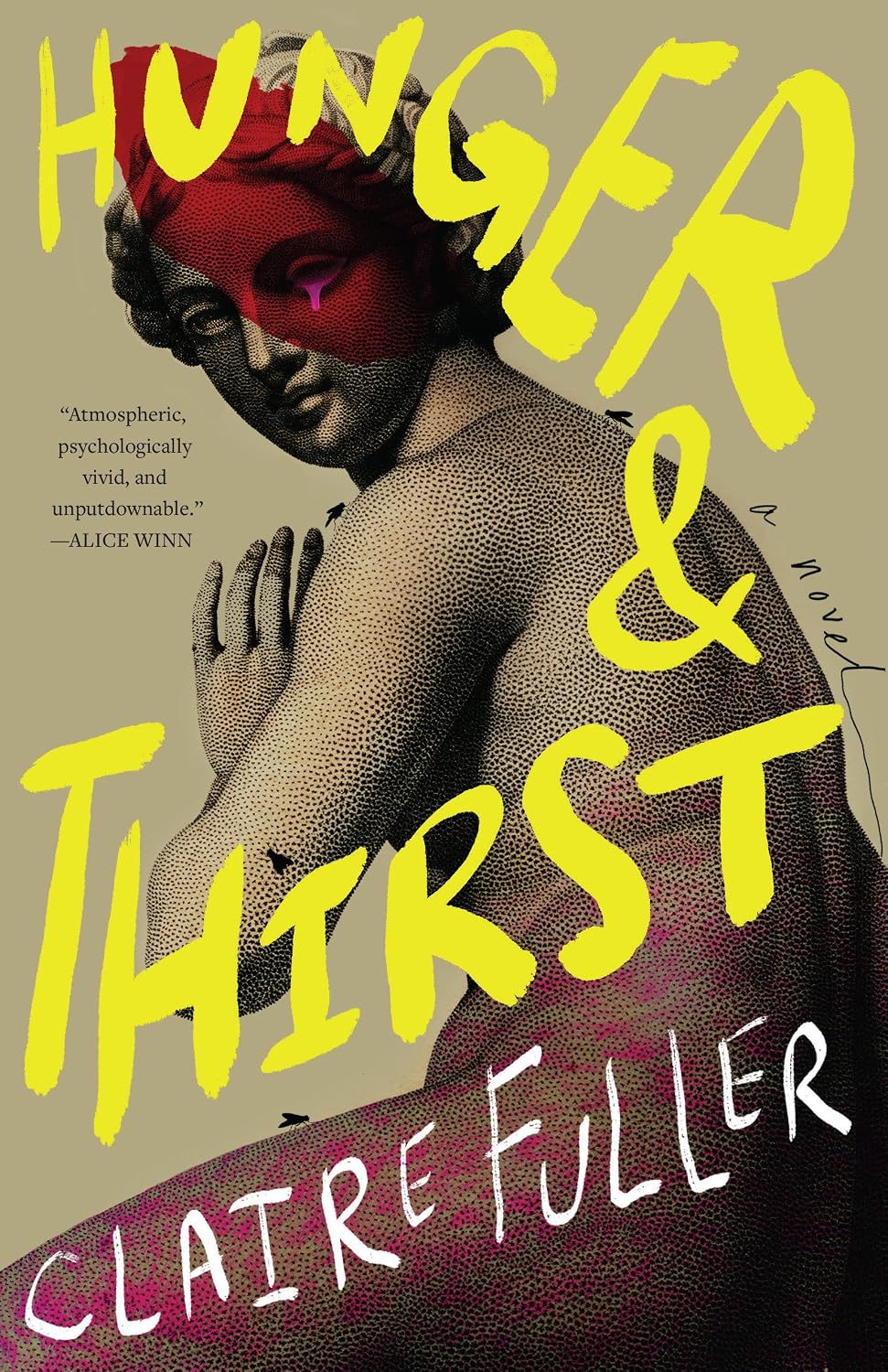
Hunger & Thirst: A Novel
- By Claire Fuller
- Tin House
- 320 pp.
- Reviewed by Carrie Callaghan
- August 18, 2026
A haunted house sparks horrifying appetites in this thoughtful, visceral tale.
Novelist Claire Fuller has a thing for dead bodies. In a previous novel, Unsettled Ground, two adult siblings illegally bury their dead mother and fight to preserve their access to the plot. In another, her prize-winning Bitter Orange, the narrator at the outset questions a visiting vicar about what they’ll do with the narrator’s soon-to-be-dead body, asking, “Where do they put us when we leave this place for the last time?”
Ursula, Fuller’s narrator in her dark and haunting Hunger & Thirst, likewise is preoccupied with bodies, even if she pretends otherwise. “All everyone wants to know about is the murder and what we did with the body,” she tells us in the first line, setting up a slow-burn mystery that shifts into horror.
That murder — of whom we don’t yet know — happened when Ursula was a 16-year-old orphan in the late 1980s, working as a mail clerk in an art school. There, she labors silently but full of yearning. Though lonely, she interacts only glancingly with her social worker, her adult roommates at her dingy halfway house, and her loutish colleagues as she tries to find a place for herself. The rest of the world may be convinced by Descartes’ mind-body dualism, but Ursula has trouble reconciling the split that society wants to impose on her, a supposed divide between her traumatic history of abandonment and her animal appetites.
Ursula’s appetites are both deep and metaphysical. Early in the book, one of the few female tutors at the school asks her what she thinks of the tutor’s sculpture-in-progress, a visceral chunk of ribs and intestines carved from wood. “It’s not hungry enough,” Ursula says, and, to her surprise, the tutor agrees. Not enough desire.
Ursula, though, has plenty of desire. She befriends Sue, a charming but troubled older girl eager to dare Ursula into greater and greater risks, and Ursula quickly falls in love with Sue’s earnest family. At her first dinner with the Gainsboroughs, Ursula is surprised to find herself satiated, “too full instead of family, inclusion, acceptance.”
They cannot provide for her material needs, however, and Ursula moves into an abandoned house with Vince, another worker from the art school who clearly lusts after Sue. The house is as creepy as a dilapidated movie set, which is, in fact, what Sue will turn it into, as she aspires to be a famous horror-movie director. The squat has been vacant since the previous occupants, a husband, wife, and baby, vanished. Died, died, and died, Vince tells them about the aptly named Bloodworths.
Then, Ursula, Sue, and Sue’s half-brother hold a séance, and it seems that maybe the Bloodworths aren’t dead. Their ghost, or something, has taken hold of Sue’s brother, saying through his mouth, “Thirsty.”
Thirst is a greedy master.
Ursula, Vince, and Sue are all thieves, we learn, taking possessions, maybe taking lives. Hunger & Thirst asks what it means to have a body that, through its appetites, takes pleasure, sustenance, and, yes, life from another. Letting food, or even love, into the body changes both the consumed and the consumer. Ursula knows she faces that choice:
“Now I have to prepare myself for what is coming, and must decide whether or not I let it in.”
This is a thoughtful novel steeped in the dark horror of a haunted house and populated by characters who are smart enough, good enough, to tell the truth about their misdeeds and yet still find themselves damned. There are echoes here of Bram Stoker’s Dracula, or more specifically, the mental patient, Renfield, who eats a fly and praises it as “life, strong life,” giving life to him. Flies follow Ursula, too.
Ursula’s hirsute body, a plague to a woman whose name means bear, ultimately demands an accounting of her animal urges, her thirst for love, and her hunger for life. Bodies are damnable things, inescapable so long as we’re living, and perhaps for some time after. What we do with them until then remains the question.
Carrie Callaghan is the author of the historical novels A Light of Her Own and Salt the Snow. She lives in Maryland with her family and four ridiculous cats.