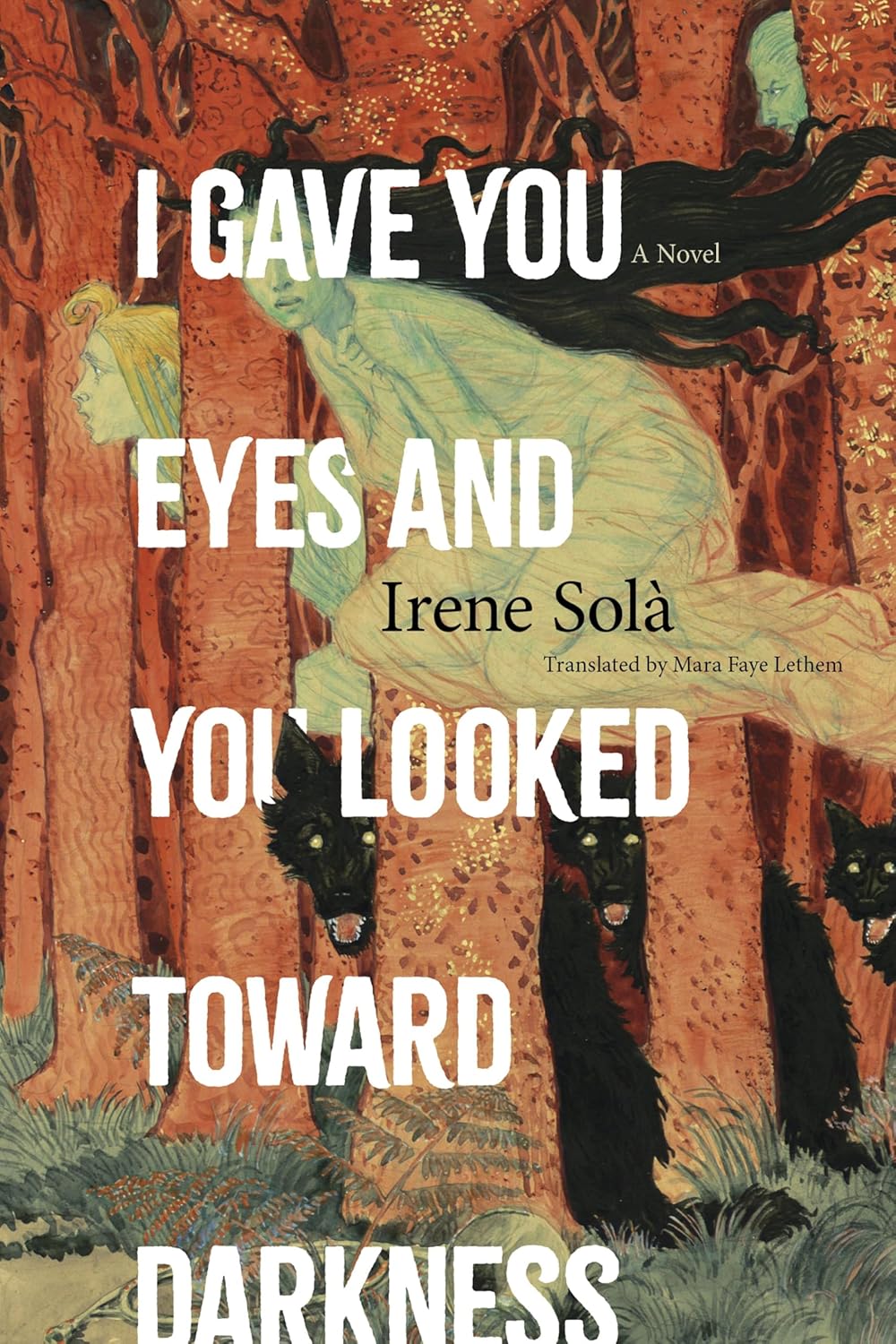
I Gave You Eyes and You Looked Toward Darkness: A Novel
- By Irene Solà; translated by Mara Faye Lethem
- Graywolf Press
- 176 pp.
- Reviewed by Mike Maggio
- July 29, 2025
Women confront the devil, the perversity of war, and their own capacity for malice.
Folklore and legends. They’re the cultural glue that binds generations from one to the other and connects the present to the past. Think of the English and Scottish Ballads like “Sir Patrick Spens” or “Lord Gregory.” Or the Italian folktales collected by Italo Calvino, replete with kings and queens and such characters as Olio d’Oliva or Fiorenza and her sisters. Tales of old, handed down (often orally), convey a sometimes-untold history and, like fairytales, create a magical sense of wonder while illuminating the human condition in all its frailties and virtues.
Irene Solà’s latest work, I Gave You Eyes and You Looked Toward Darkness, is, unlike Calvino’s folktales, an amalgamation of legends, a collage of age-old Spanish narratives patched together into a surreal work that, like a snake that has lost its way, meanders from page to page and leaves readers feeling as if they’re trapped in a troubling nightmare.
The story takes place in a farmhouse called Mas Clavell, where violence and squalor confront the reader. Here live several generations of women, each with her own story, each affected by war and brutality, each driven by a penchant for deceit, a propensity for vengeance, and a belief in dark forces.
The novel opens with Joana, the matriarch of the family, who makes a pact with the devil, bartering her soul in exchange for “a full man.” The devil delivers a husband to Joana, but Bernadí Clavell has one defect: He is missing his pinky toe. Joana, crafty as ever, outwits the devil for not delivering a “full” husband as she’d requested and revokes her demonic deal.
In fact, I Gave You Eyes is filled with characters who are missing one body part or another or who are just outright unattractive, often described as “ugly,” “hideous,” or “gawky”:
“Margarida [Joana’s daughter] understood. She knew that because of the pact Joana had made and broken with the devil, she was missing a quarter of her heart and Blanca was missing a tongue. That all-yellow sister of hers named Esperança had been born without a liver. The heir had been missing an asshole. Esteve, an ear; Guilla, a name; Àngela, the ability to feel pain; Martí the Lame, a small stretch of leg; and Bernadeta, eyelashes. Later on she would understand that Dolça was missing her goat tail, Marta had no memory, and Alexandra, goodness knows what Alexandra was missing!”
Against this backdrop of disfigured and unsightly characters, the Spanish Civil War rages, afflicting each of the inhabitants of Mas Clavell in one way or another. Scenes of violence and conflict abound, frequently mixed with superstition and mystery, illusion and hallucination, all delivered in a mélange of language and imagery that creates a confused narrative that continually loses focus. And yet, there’s something appealing about it all — something, like a curious dream, that keeps the reader coming back for more.
Solà has thoroughly researched the material she utilizes in I Gave You Eyes, and her sources are detailed in an author’s note at the end of the book. Into the traditional Spanish folktales she draws from, she injects the brutality of modern war in language that is poetic and opaque, grotesque and surreal, meandering and (at times) humorous. As a result of this strange mosaic, the story seems to get lost within itself. Perhaps this was Solà’s intent: to leave the reader bewildered in a way that illustrates the ambiguities of folklore and the oral tradition while also illuminating the perplexities of war.
I Gave You Eyes and You Looked Toward Darkness likely will not appeal to the average reader, but for those who want a novel that’s both challenging and inventive, it won’t disappoint.
Mike Maggio’s latest novel, Woman in the Abbey, was released in February and has been called “a magnificent blending of horror, fantasy, romance and suspense.”