I Want to Burn This Place Down: Essays
- By Maris Kreizman
- Ecco
- 176 pp.
- Reviewed by William Schwartz
- July 31, 2025
An understandable sense of frustration anchors these animated musings.
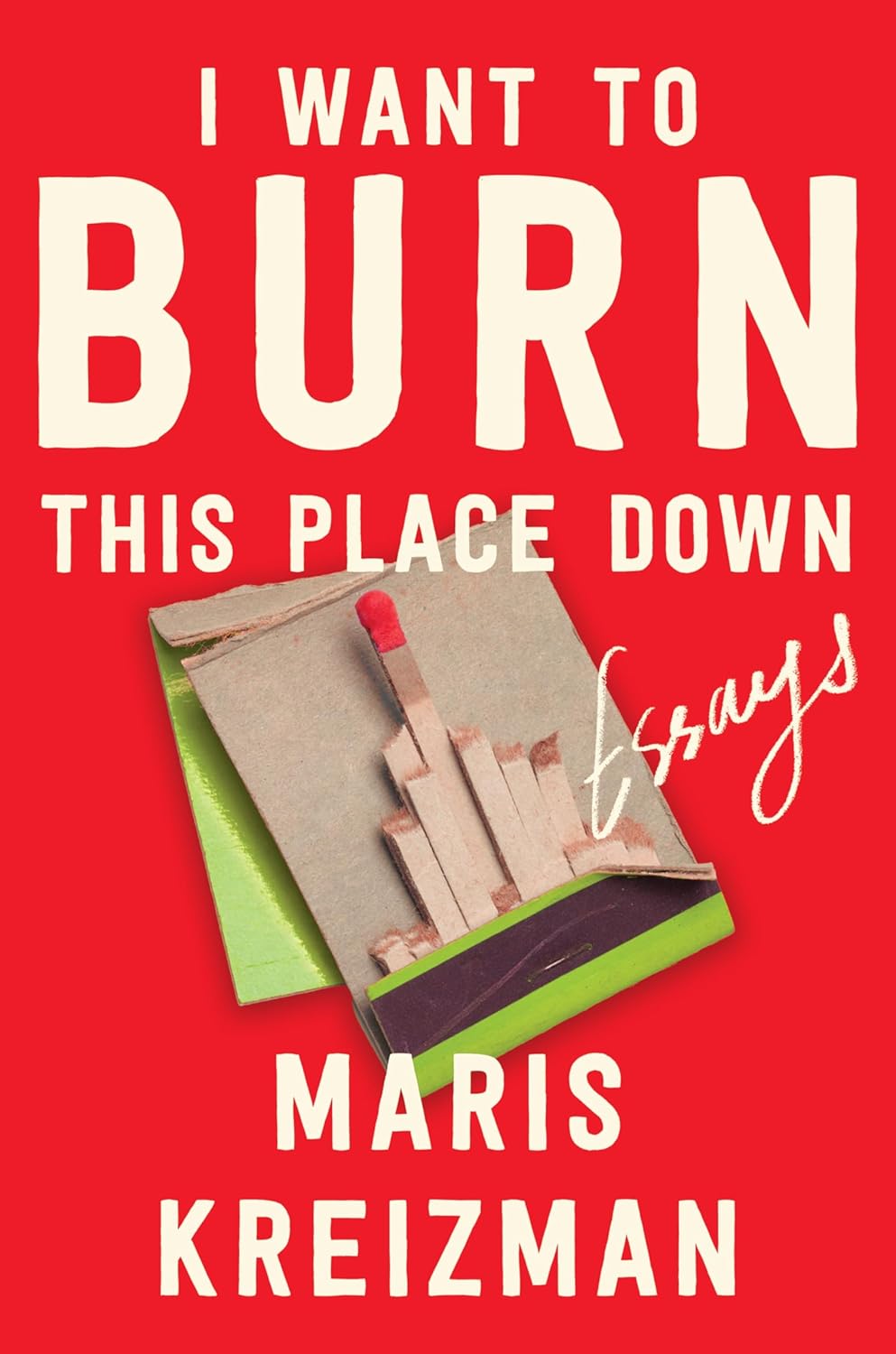
The title of Maris Kreizman’s I Want To Burn This Place Down derives from an episode of “Mad Men” in which one of the female leads, exhausted and infuriated by rampant workplace sexism, declares what she’d like to do to the office. There’s a certain irony to this, as Kreizman’s final essay in the collection is a rumination on how neither the girlboss-CEO dynamic nor the baby-making housewife one holds much appeal for her.
To be fair, the childless Kreizman does appreciate how seeing “Steel Magnolias” — a movie about a character with type 1 diabetes who dies after choosing to have a baby — might’ve put a damper on her nascent maternal instinct. The author, diagnosed with type 1 diabetes at age 9, is neither arrogant nor aloof about the pop culture she discusses in these essays.
In “Copaganda and Me,” she admits that shows like the sitcom “Brooklyn Nine-Nine” give an overly rosy impression of the police that’s subtly pernicious in a way that might be more dangerous than openly worshipful crime stories. Yet she also notes that the main reason shows like this appeal to her is because her elder twin brothers are themselves cops, and she wants to think the best of them (even if most of what they tell her about their job makes it sound very boring).
There’s a dull honesty in Kreizman’s writing that’s more appealing than the phrase “dull honesty” implies. I don’t have diabetes myself but can appreciate the nightmare Kreizman describes in “She’s Lost Control Again” of having to constantly monitor her sugar intake while also appreciating that (for her) this is just everyday life, and her neurosis about other people not understanding diabetes may be worse than the actual disease. “For an overthinker like me, the rise and fall of my blood sugar gives me endless fodder,” she writes. “I’m not sure if my diabetes was the cause of my diagnosis of OCD in later years, but it certainly didn’t help.”
Even granting that she could suddenly die at any time from the illness — she’s had many close calls — Kreizman admits that the risk feels almost mundane. Nonetheless, diabetes is a recurring presence in these pages.
The other recurring presence is Kreizman’s husband, writer/comedian Josh Gondelman. Somehow, he anchors the text while barely being in it. He’s simply a positive, supportive background influence in Kreizman’s life. Much like the intellectual process itself, she derives comfort from knowing that he’s there, while not necessarily needing to engage with him at all times. Actually, she discusses her grumpy little dog more than she does her husband, especially in the penultimate essay, “Panting Without Relief.” This exploration of an overheated world made increasingly dangerous for animals and humans alike is mainly about mortality and humility. “Bizzy is not so great at standing these days,” indeed.
But why does Kreizman want to burn everything down when she seems mostly satisfied as far as we can tell? Because she’s lucky, and she knows it. Despite the nonsense we’re all fed about ours being a bootstrap-pulling meritocracy, a lot of people (including her) get ahead by luck. The title of the essay “I Found My Life Partner (and My Health Insurance) Because I Got Lucky” reveals as much in plain English. Whether she thinks the majority of others’ success can, too, be chalked up to the whims of fate is ambiguous; she just knows she can’t attribute her own good fortune purely to superior ability and virtuous living.
In the final essay, “Having It All Without Having Kids,” Kreizman turns the aforementioned baby-making-housewife trope on its head, suggesting the stereotype is just one side of the coin, while the girlboss-CEO archetype is the other. Both roles represent an aspiration in an incendiary landscape where even having aspirations is increasingly difficult to rationalize. To some readers, this will sound like a bleak assessment of the world. To others, it will be an articulation of their own belief that the whole thing really should be torched.
William Schwartz is a freelance writer living in Southern Illinois. He has reviewed wide varieties of media, including South Korean dramas, upscale graphic novels, vintage videogame media, and much more.