In the Days of My Youth I Was Told What It Means to Be a Man: A Memoir
- By Tom Junod
- Doubleday
- 416 pp.
- Reviewed by Jennifer Bort Yacovissi
- May 5, 2026
Family. What can you do?
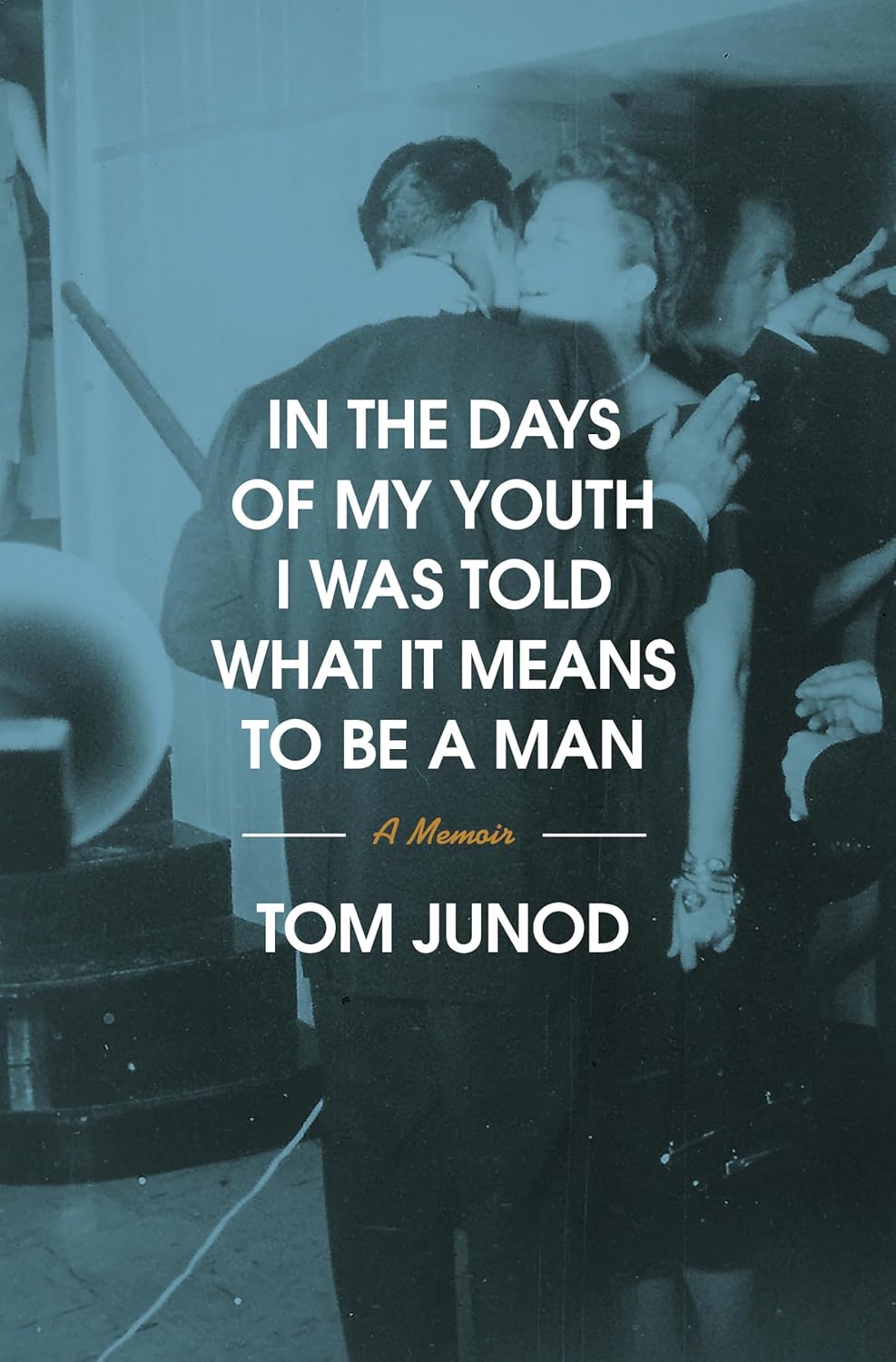
Tom Junod chose an unfortunate title for his memoir. Unfortunate because there are only so many times you can involuntarily sing the lyrics to Led Zeppelin’s “Good Times Bad Times” to yourself without going insane. On the plus side, though, you’ll get plenty of practice perfecting your air guitar, hitting that sweet bridge riff as often as you reach for the book. According to the acknowledgements, Junod’s Doubleday editor suggested the title, but is anyone paying royalties to Robert Plant?
Junod is a longtime magazine writer, perhaps most famous for an article about his friendship with Fred Rogers that was turned into the Tom Hanks movie “A Beautiful Day in the Neighborhood.” Given what Junod writes in his memoir, the movie bears little relation to his actual life. (I recommend you skip the Hollywoodification and instead watch the heartwarming Mister Rogers documentary “Won’t You Be My Neighbor?” in which Junod is one of the featured interviewees.)
Still, it’s hard to deny that the title In the Days of My Youth I Was Told What It Means to Be a Man serves as a coherent summary of Junod’s memoir of his love/fear/revulsion relationship with his profligate but oh-so-stylish father. Lou Junod, a disappointed singer, was a handbag salesman back when handbag salesmen pulled in more than stockbrokers. Indeed, he was a salesman to the core — movie-star attractive, charming, and unwilling to take no for an answer.
Here was a man who preened in his black bikini underwear in front of a full-length mirror, needed his own bathroom to store all the unguents he slathered on each day, and spent hours lying out in the sun with a reflector to keep his perpetual tan. “He was a scrupulously superficial man,” writes Junod, “believing so fervently in the magic of surfaces that his fervor almost passed for profundity and he was able to wear his soul quite literally on his sleeve, like cuff links.” He pursued women, women threw themselves at him, men sometimes threw their women at him (cue the still-repressed homosexuality of the 1970s), and his arms were open to receive them all.
Lou was undoubtedly charismatic, capturing the attention of every eye in any room he entered, but on the page, he comes across not only as cruel to his wife, Fran, and entirely self-involved but as thoroughly irritating. In replicating his father’s speech pattern, Junod uses ellipses to indicate the constant dramatic pauses. “Are you ready for…a hot fudge sundae?” (Said after Lou has used Tom to cover for an assignation with one of his conquests.) “She had quite a little thing…for your father.” (Said of a woman who’d committed suicide.) “Why don’t we take it out…in trade.” (No explanation needed.)
He employs the device liberally throughout. It’s really…annoying.
Junod was his parents’ “love child,” purposefully conceived when his twin siblings, Michael and Cathy, were already 10 years old. That means he was becoming self-aware around the time they were older teenagers and spending much less time at home. Thus, Little Tommy had a very different experience of childhood at home with Fran and Lou, with no filter between him and his increasingly unhappy mother and increasingly philandering father. He saw himself as his mother’s protector, while his father saw him as a project. The challenge: to build this scrawny, weepy little boy into an ideal, real man.
At its heart, though, Youth is something of an advertisement for 23andMe-like testing, or perhaps an argument against it, depending upon one’s tolerance for facing unsavory truths. Junod portrays himself as an inveterate questioner from the start, a spy within his family, taping dinner conversations, nosing into every private corner of the house to discover its occupants’ secrets, trying to understand his parents. As an adult who put that investigative impulse to professional use, he started to delve more deeply into stories he’d heard as a child about his father’s family.
It turns out that Lou is a chip off the old block, but in this case, the block is his mother, a woman who was a major figure in a nationally notorious murder, was married to two men at the same time — though neither of them, including Lou Junod Sr., was the father of Lou Junod Jr. — and was apparently pimping out her eldest daughter and herself to make rent. The author susses out several heretofore-unknown relatives across two generations, including at least one half-sibling. Still, we’ve been reading stories about the exposing of ugly family secrets since genetic testing became widely available to the general public; it’s hardly earth-shaking news (unless, of course, it’s your family).
More problematic is Junod’s insistence on sharing his discoveries with people who might not be thrilled — might, in fact, be traumatized — by the unsought revelations. That things seem to have turned out mostly okay in this respect doesn’t erase the Lou-like sense of entitlement that drives the author to press his information where it may not be welcome. I wonder how all this lands with his brother, Michael, who had a much different experience of Lou, revering him as a wonderful man and father to the day Lou died. Is it helpful to him to be forced to stare into this sun?
Junod has written about his father twice before: in the Mister Rogers story and in a profile in which Lou gives sage fashion advice to men. That all the major players in those pieces have now passed gives him the freedom to write the truth, as he understands it, in unvarnished detail. Youth may draw readers in because Junod is a known name and tells a good story. Perhaps readers will feel a sense of relief in thinking, “Wow, at least my family isn’t as effed up as this one!”
To which the author might reply, “Are you sure?”
Jennifer Bort Yacovissi’s novel, Up the Hill to Home, tells the story of four generations of a family in Washington, DC, from the Civil War to the Great Depression. She reviews regularly for the Independent and serves on its board of directors as president. Follow Jenny on Bluesky at @jbywrites.bsky.social.