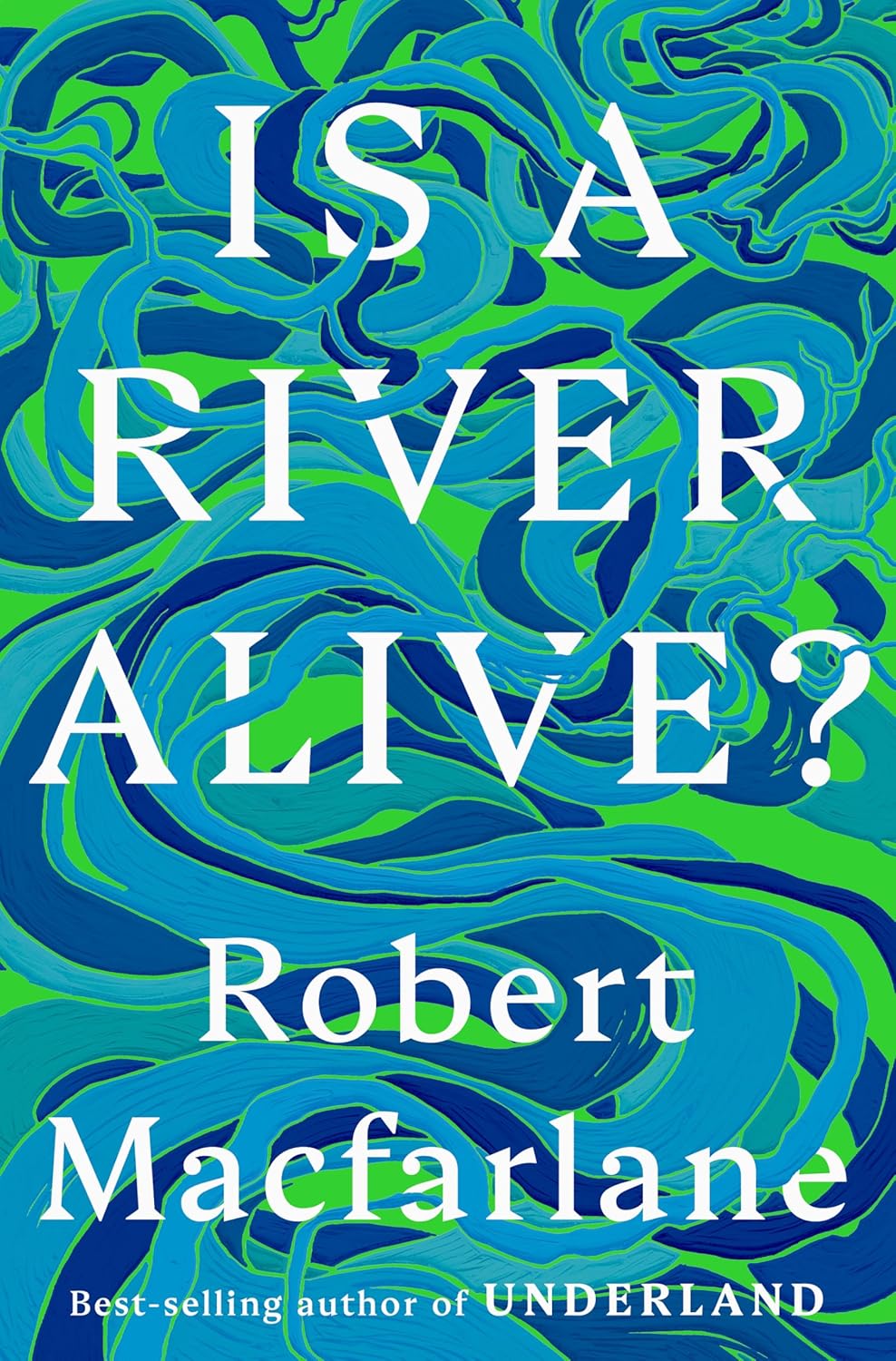
Is a River Alive?
- By Robert Macfarlane
- W.W. Norton & Company
- 384 pp.
- Reviewed by Anne Cassidy
- June 3, 2025
A poetic yet serious consideration of waterways and us.
It was September, a late-season frolic, one last adventure before work and school took each of us in different directions. It had been raining, and the Potomac was full and barreling toward the Chesapeake Bay. I remember staring down into that churning water as my family and I stepped into it, flimsy innertubes around our waists. My heart was pounding. What was I thinking when I planned this excursion?
Is a River Alive? is the title — and central question — of Robert Macfarlane’s new book. I know how I would’ve answered this question as we began our tubing trip, and my “Yes!” would be even more emphatic now, having just read Macfarlane’s lyrical call to action.
In the early pages, the author tells his 10-year-old son the book’s title. “Well, duh, that’s going to be a short book then, Dad…because the answer is yes!” The point is not the answer, though, but how Macfarlane arrives at it — with the pen of a poet, the derring-do of an adventurer, and a willingness to immerse himself in any landscape, even if it’s crawling with fire ants.
“I wish to say plainly and early that this book was written with the rivers who run through its pages,” he announces in his introduction. And he does just that, seeking always the souls of the waterways he traverses, speaking in their names, opening our eyes to a richer and more embodied world.
Macfarlane explores three river systems — Los Cedros, the River of the Cedars, in Ecuador; the Kosasthalaiyar, Cooum, and Adyar, three rivers that merge in Chennai, India; and the Mutehekau Shipu in Quebec. Sandwiched between their stories are palate-cleansing glimpses of an endangered chalk spring near Macfarlane’s home in Cambridge, England.
Britain, like many countries, has done a poor job of protecting its rivers and streams, but Ecuador has enshrined the rights of nature in its constitution. This has safeguarded the Los Cedros from mining interests that would otherwise have destroyed it. Macfarlane and his traveling companions — in each chapter, he introduces us to people who know and protect these unique environments — climb through a cloud forest and bathe under a waterfall. “All around us, we can see the forest extending in ridges and valleys,” he writes. “Mist hangs in scarves. The forest froths with sound...”
Chennai’s three dying rivers stand in stark contrast. Although a high court has recognized the rights of nature across Tamil Nadu, the Indian state in which Chennai lies, its rivers are open sewers with dangerously high levels of heavy metals and fecal matter. Those who fight for these rivers, writes Macfarlane, “want to counter-map life back into this landscape; to re-render the presence of palluyir — the web of being.”
As he did in an earlier book, Underland (2019), Macfarlane muses on the geological era in which we find ourselves. Should we call it the Anthropocene, the Eremocene (the Age of Loneliness), or the Ecozoic, a term coined by ecologist Thomas Berry to describe an era in which humans recognize themselves as part of the web of life?
That last one is a hopeful term, and there is plenty of hope in this book. A “floating city of birds — an avian Venice” teeming with ibises, spoonbills, cormorants, and herons, for example, exists only miles from a factory spilling toxins into Chennai’s water. But good news aside, dams, mines, and pollutants threaten these three rivers. “Across ten previous books and more than twenty years of writing, I have never before known a subject with the urgency of this one,” Macfarlane writes.
He saves the most adventurous tale for last, as he plunges through the whitewater of Canada’s Mutehekau Shipu. He learns how to paddle through eddies and float downstream if thrown from his kayak. He doesn’t just run the river, he is run through by it:
“Days on the water have produced in me the intensifying feeling of somehow growing together with the river: not thinking about it but being thought by it.”
This is more than personification. It is an attempt to push the boundaries of language and imagination. “We are all bodies of water,” he insists, “receiving, circulating, giving onwards; all participants in the hydrosphere, with the flow of the wet world running through us.”
I can’t think of another author who writes so unflinchingly about our responsibility to the environment or who speaks so honestly of pain and fear. Though the book ripples with lyricism, however, it has some suspenseful moments. Macfarlane isn’t afraid to admit when he’s frightened, a revelation that makes us trust him all the more. “It seems absurd that I’m about to paddle this, unthinkable that the river will not flip me, spin me, drown me...” Even though I held proof of Macfarlane’s survival in my hands, I still found myself wondering if he’d make it out alive. And maybe that’s the point. If rivers are threatened, then we are, too.
Anne Cassidy has been published in many national magazines and newspapers, including the Washington Post, the New York Times, and the Christian Science Monitor. She blogs daily at “A Walker in the Suburbs.”