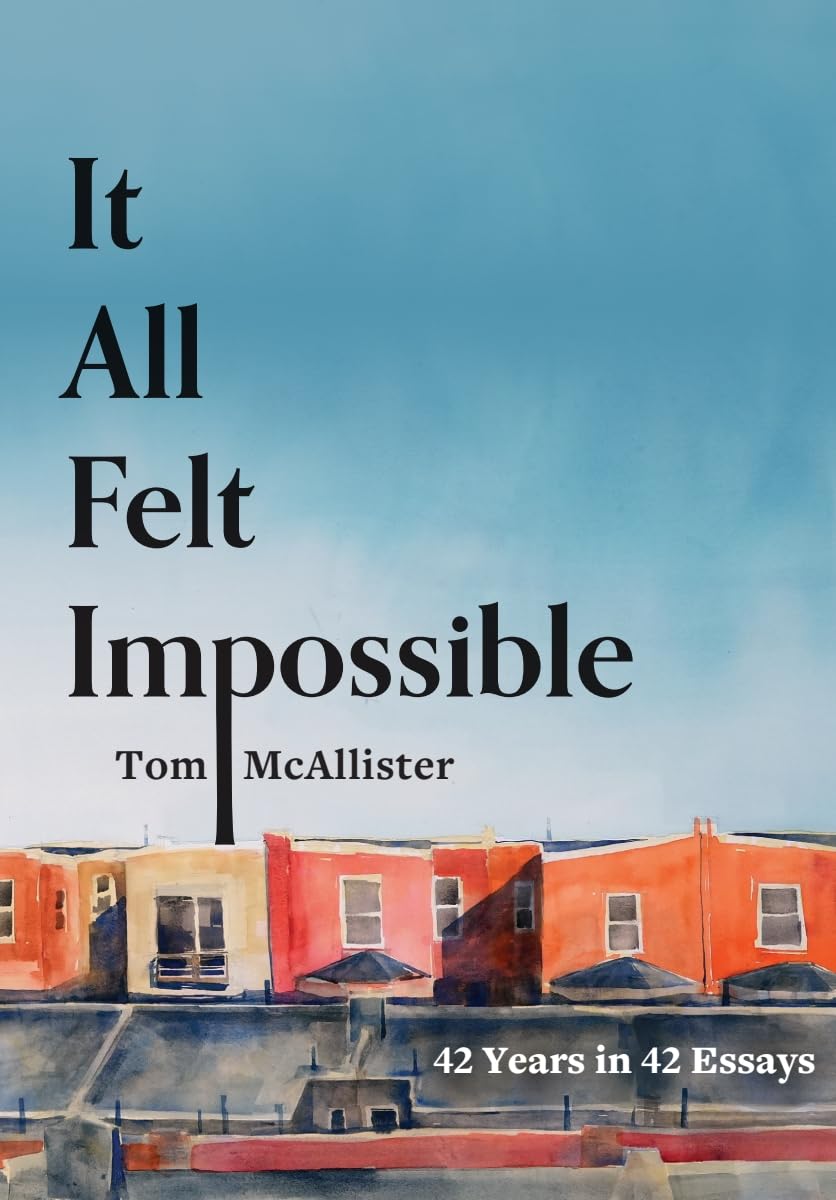
It All Felt Impossible: 42 Years in 42 Essays
- By Tom McAllister
- Rose Metal Press
- 184 pp.
- Reviewed by Yelizaveta P. Renfro
- June 16, 2025
A man takes annual stock of his life in this unique collection.
In the author’s note at the beginning of his new book, Tom McAllister explains how the quirky project came to be: After having two novels come out within 13 months of each other — and then attending to the requisite promotional activities and events — he found himself tired and writing very little. When a former student happened to email him, asking how to get over writer’s block, he responded with “the usual advice,” then added, “sometimes it helps to give yourself arbitrary restraints. Simplify the task by eliminating some of the variables.”
McAllister then decided to take his own advice, imposing a set of rules on himself: He would write an essay of no more than 1,500 words for each year that he’s been alive. The result is an unconventional memoir, It All Felt Impossible: 42 Years in 42 Essays. Beginning in 1982, when he was born, and ending in 2024, McAllister’s book provides us with a fragmented, idiosyncratic portrait of his life to date.
Since McAllister has no memories of his earliest days, he dedicates the first essays to discussing the world into which he was born. The Commodore 64 computer was launched in 1982, “Hawaii Five-O” and “Three’s Company” were on TV, and in photos, he writes, “the ashtrays are ubiquitous and ornate, and everyone is smoking.”
By 1989, McAllister has started forming memories, and at his seventh birthday party, held at a Pizza Hut, he describes a moment of panic in a bathroom when he tries unsuccessfully to open the door with soapy hands. “I became frantic, first kicking the door and then pounding on it with my fists, and then trying the slippery nob again, and then screaming. I was convinced they would forget about me and leave me in the bathroom.” McAllister is freed seconds later when another customer opens the door, but the moment stays with him, even as the other details of the party have faded. He interrogates what this early episode reveals about his persistent dark outlook:
“My personal history is littered with these moments — of intense despair, certainty regarding my doom — that turned out to be harmless, exaggerated. The more time I spend writing about my youth, the more I realize how much my story is one of irrational panics. Moments of self-inflicted hysterics that dictate choices I make for the rest of my life. The gradual boxing in of my possibilities due to fears I have invented whole cloth.”
Another episode in 1992, when McAllister puts a straw in his uncle’s coffee at McDonald’s, making his uncle laugh at him, leads to weeks of torment. “Some mornings, before I was even fully awake, it was the first image to appear in my mind,” he writes. “When I saw my father drinking coffee, I remembered my mistake and wondered how everybody else knew everything and I knew nothing.” Again, the author finds deep significance in what appears to be a minor childhood incident, connecting it to his adult internet habits:
“There was so much information in the world and I would never even know a fraction of it, and not knowing made me hate myself. This anxiety manifests now in the way I spend all day online, clicking and digging and scrolling, in a futile quest to consume as much content as possible, regardless of its importance or relevance to my life, regardless of how learning it may damage me.”
Indeed, many of McAllister’s essays make these leaps, drawing out the larger significance of isolated incidents. Sometimes, rather than examining his own abiding character traits, he scrutinizes the larger cultural or political implications of his experiences. For example, in an essay on youth sports that describes the soccer coaches he once had, McAllister builds to a sober realization:
“Unqualified youth sports coaches are the gatekeepers to all kinds of trauma. When you meet an asshole out in the wild, you can safely assume he had an asshole coaching him in baseball when he was nine. Because so many people spend their lives being belittled by authority figures, they learn to believe it’s okay for their boss to be like that too. They learn not to value themselves at all. They make excuses for even the worst men. They vote those kinds of men into office because the cruelty is so familiar.”
McAllister’s style is guileless and plainspoken; his essays give the impression of having been quickly dashed off, but on closer inspection, their carefully wrought structure becomes apparent. In his author’s note, he names two influences, Denis Johnson and Alejandro Zamba, “two very different writers from me, and from each other, but also two writers with the confidence and audacity to tell stories that appear at first glance to be meandering and plotless, while in fact being precisely and beautifully structured.” This is, indeed, what McAllister accomplishes in the best pieces here.
In the essay on 2003, McAllister, at that time a student at La Salle University, describes watching the invasion of Iraq on TV, the political awakening he experienced in classes that required he “engage critically with systemic injustice,” and the death of his father from esophageal cancer. Unable to reconcile all that happened during this dark year in his life, McAllister ends with a stubborn refusal to manufacture meaning:
“There’s this writing move I feel like I’m expected to do here, at the end of an essay, where I add some flourishes and assign meaning or reveal hidden beauty in the events I’m describing, but sometimes there is no meaning, and the only beauty or ugliness is what’s on the surface. What am I supposed to tell you? That everything got better? Come on.”
That’s not to say all of his offerings are dark. McAllister’s love for his spouse comes through from the very first essay. “There’s one more fact here that I have to mention,” he writes near its conclusion. “1982 is the year LauraBeth, my wife, was born. We didn’t know each other then. She was a baby too, and babies only are allowed to know the people their parents or guardians introduce them to. We wouldn’t meet for another 18 years, but is there any more important development in my life? Her birth is the event that shapes everything that follows.” Later, he writes of meeting LauraBeth in college. “She was already the most important person in my life,” he reflects, “and she is the most important person in this book.”
For the two years that McAllister spends in Iowa City attending grad school, he remains close to LauraBeth. In the essay on 2006, he describes taking shelter in his basement during a close call with a tornado, texting her to tell her he loved her. In the storm’s aftermath, a spontaneous gathering forms in a friend’s yard as people who have lost power bring over an assortment of perishable food and beer and begin feasting in the middle of the night. McAllister describes its strange beauty:
“We swelled with the urgency of people living their last night on Earth. On one side of the tornado had been grad school and on the other side was the rest of my life, as if it had picked us all up in a single swipe and plopped us all down in some better place. Within a month, I would be gone and I would never speak to most of these people again. For one night, we were all still there. We told the stories of our sheltering experience over and over. I was upstairs and then I was downstairs. It was quiet and then it was so loud. Afterward, I was fine. It all felt impossible.”
This is McAllister at his best, showing the luminosity of a single moment. In the essays that follow, taking us through his adult life, he writes on a wide range of topics: marriage, childlessness, his love of dogs, and his drinking problem, to name a few. The McAllister we see in the final pieces is mellower and more content than the younger man. In his best moments, he might even be called an optimist. In the essay on 2023, for instance, he describes learning how to ride a bike in his 40s. “I was inordinately proud,” he admits. “To think that, even as you get older, you can still learn. You can still improve your life, you don’t have to cheat yourself out of exploring new pathways.”
The book is also scattered with homespun wisdom, pithy bon mots that capture his outlook and lessons he’s gleaned, including:
“Your heroes die and if you’re lucky they do it before they let you down.”
“Most of my enemies have never known they’re my enemies, but that doesn’t make the fights we’ve had any less real.”
“There is no reason to trust any adult who longs wistfully for high school.”
“If you look long enough at a picture, you can see whatever you want.”
“Teaching is a long string of failures interrupted by occasional bursts of blinding clarity.”
“Home ownership demands the endless discussion of banalities because it’s the leaky pipe, not Mothra or King Kong, that will destroy your home.”
While the essays vary in quality, the best ones are succinct and spontaneous, their slapdash façades revealing real depth and careful craft. The ultimate success of the collection lies in McAllister’s willingness to speak plainly and honestly to his readers. Reaching the end of the final essay, on 2024, I was left with the feeling that I’d become, briefly, his companion, and I wanted to keep walking at his side a little longer to see what the coming years would bring.
Yelizaveta P. Renfro is the author of a book of nonfiction, Xylotheque: Essays, and a collection of short stories, A Catalogue of Everything in the World. Her fiction and nonfiction have appeared in Glimmer Train Stories, Creative Nonfiction, North American Review, Colorado Review, Alaska Quarterly Review, South Dakota Review, Witness, Reader’s Digest, and elsewhere. She holds an MFA from George Mason University and a Ph.D. from the University of Nebraska.