Join the Conspiracy: How a Brooklyn Eccentric Got Lost on the Right, Infiltrated the Left, and Brought Down the Biggest Bombing Network in New York
- By Jonathan Butler
- Empire State Editions
- 384 pp.
- Reviewed by Michael Maiello
- September 27, 2024
Meet a 1960s faux insurrectionist who played both sides.
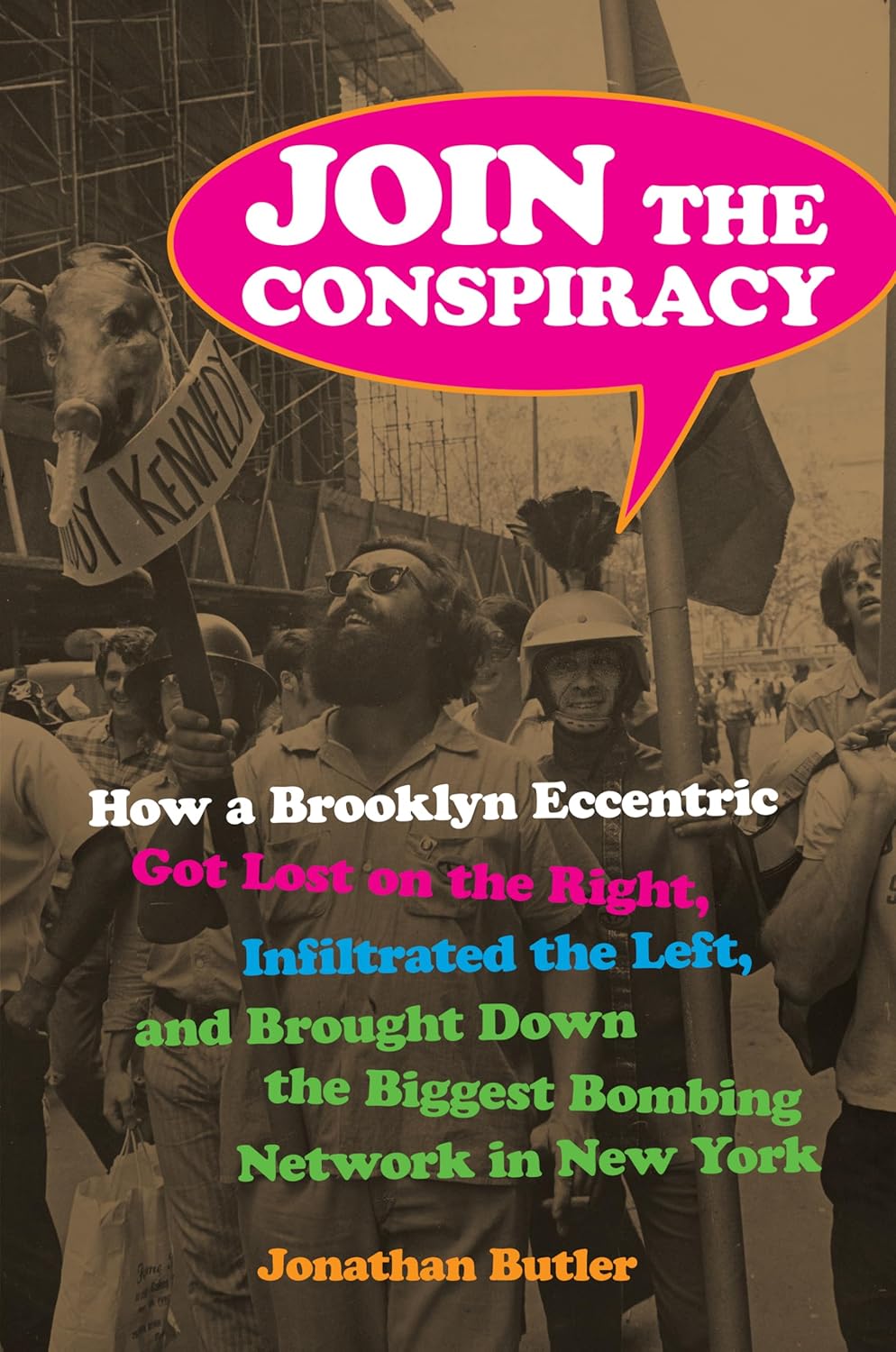
New York City at the height of anti-Vietnam War activism had to accommodate political divisions that make our present polarization seem tame, only without the benefit of cable-news and social-media release valves. A little detail in Jonathan Butler’s scene-setting history, Join the Conspiracy, gives a clue about the atmosphere: “Steve Weiner, a twenty-two year old undercover cop who’d joined the NYPD in early 1969 to avoid the draft…”
Imagine the United States government conscripting people into a war so unpopular that even law-and-order squares sought loopholes, while the countercultural Left devoted itself to upending the entire system. With young men’s lives literally on the line in Southeast Asia, politics turned from abstract to physical, fought at the level of human bodies. Join the Conspiracy is the story of a multiyear insurrection, based partly in Manhattan, and how federal and local law enforcement sought to contain it via surveillance and force.
As his protagonist, Butler chose the flamboyantly dressed George Demmerle, known among Gotham’s far Left as “King Crazie,” the leader of a spin-off group from Abbie Hoffman’s Yippies. An orphan, street-smart martial artist, and charismatic personality with a lot of empathy for the lost kids who found themselves among the sometimes dangerous leftist leaders of the East Village and Lower East Side, Demmerle might’ve gone down in history as a legendary revolutionary if not for the fact that he was actually an FBI informant.
Born in 1930, Demmerle grew up in orphanages and foster homes, an experience that left him with a longing for community that, as a young adult, he found in places like the far-right John Birch Society. Convinced that leftist radicals were maliciously trying to replace the U.S. system with the repressive communism of Chairman Mao and Leonid Brezhnev, Demmerle set out to learn everything he could by collecting and reading their literature. Writes Butler:
“Toward the end of 1966, worried that his obsession with collecting radical literature might land him in hot water with the FBI at some point, George Demmerle decided it was time to move ahead with the next stage of his plan. On August 9, 1966, just before noon, he dialed the number for the New York office of the FBI and asked to speak to Special Agent Arthur Greene, a name he had been given by a John Birch Society contact.”
This passage is a good example of the reportorial detail Butler brings to the story. People, times, and dates are meticulously recorded here, sourced to a combination of media reports, public records, and firsthand accounts. In his rigor and exactitude, Butler proves himself a worthy successor to the late sociologist and activist Todd Gitlin, whom he cites frequently. There are a lot of moving parts here, and the reader will refer often to the book’s glossary of activist groups and detailed dramatis personae.
Demmerle started his journey with the FBI as a war on the Left erupted. On one side were the radical heirs of the Merry Pranksters, led by Hoffman and devoted to absurdist theatrics, alongside the Black Panthers and the Amiri Baraka-inspired group Up Against the Wall Motherfuckers. On the other were the comparatively staid Students for a Democratic Society. Demmerle infiltrated the radicals.
They journeyed to the 1968 Democratic National Convention in Chicago, where Demmerle witnessed abuses of police power at close range, as well as the public’s unsympathetic reaction to antiwar protestors. Though he remained an FBI informant, sometimes filing multiple reports a week alerting the feds to who was who and what they were up to, he began to wonder if his own government has turned villainous.
Over the years, Demmerle was arrested numerous times. While his status as a snitch helped him avoid serious trouble, he saw the government’s surveillance and enforcement systems at work. He also made close friends on the Left, including one romantic relationship that developed into a marriage. He never gave up his role with the FBI but began to feel trapped by it, in limbo between pig and radical.
At the same time, Montreal separatists taught an activist named Sam Melville bomb-making techniques. Melville and his crew organized a heist of an industrial company in the Bronx, absconding with dynamite and blasting caps. The Melville Collective, which detonated more than 80 bombs around New York City in late 1969, became the blueprint for the Weathermen and the Symbionese Liberation Army. These were real rebels waging real war, and they make the January 6th Insurrection look like cosplay.
Demmerle fell in with the Melville Collective and ended his infiltration (and his life as a radical) by turning them in. Readers will have to decide if he’s a hero or a villain, though neither title feels wholly accurate.
Michael Maiello is an author, journalist, and playwright. He worked for 10 years as a writer and editor at Forbes, and his work has appeared in McSweeney’s, the New Yorker, the New York Times, and other publications. Find his free Substack here.