Jungle Red!: The Making of MGM’s The Women
- By Illeana Douglas
- Lyons Press
- 304 pp.
- Reviewed by Bob Duffy
- October 5, 2026
A detailed look at a 1930s film with an all-female cast.
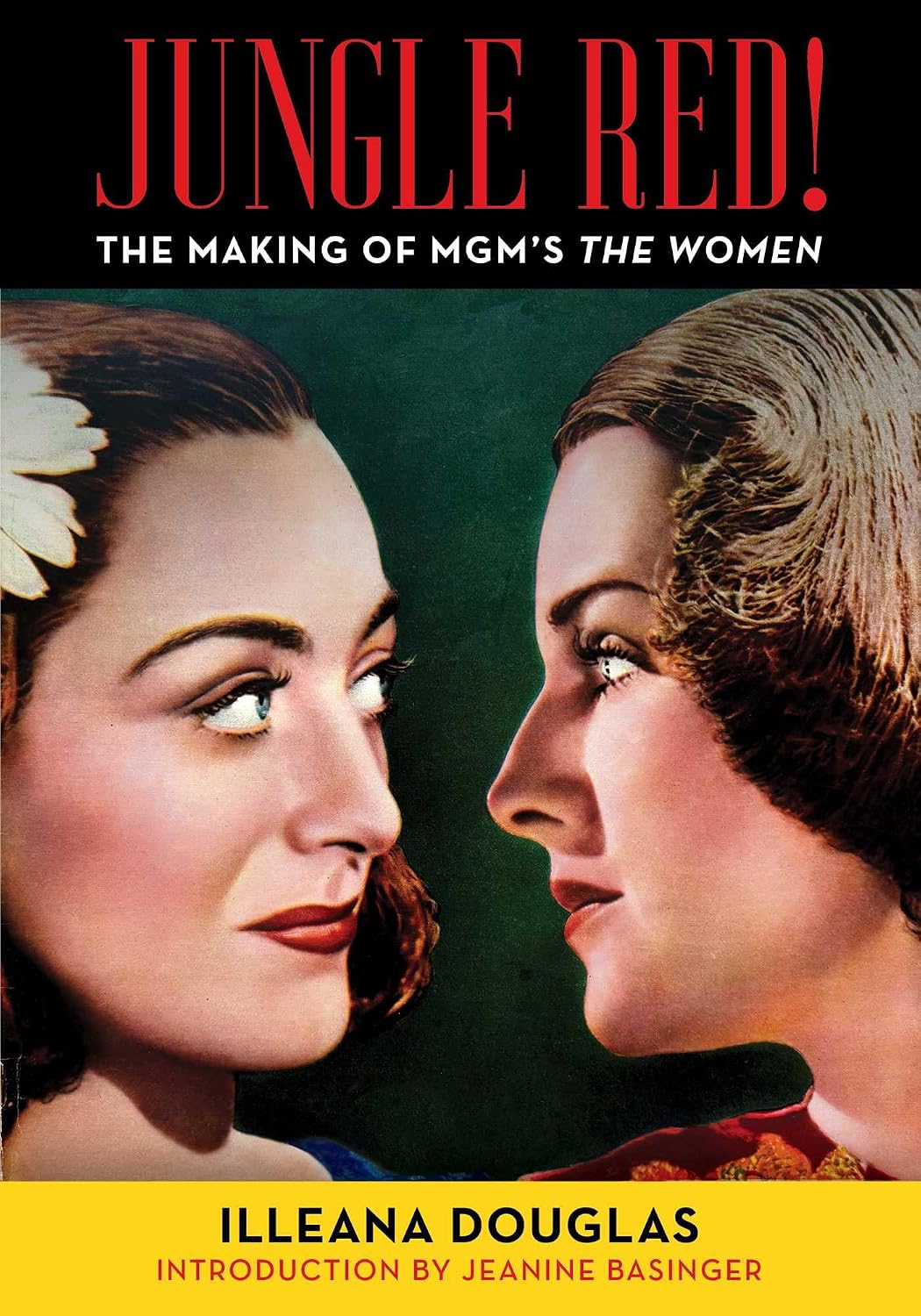
Jungle Red!, from actress-turned-film-commentator Illeana Douglas, takes a crack at transporting us to the halcyon days of American film comedy in the 1930s and early 1940s. It’s a commendable effort, thoroughly researched, richly illustrated, and knowledgably navigated by the author, the granddaughter of two-time Oscar-winning actor Melvyn Douglas.
“The Women” (1939) is a sardonic comedy of manners, an anomaly amid the period’s frothy tide of playful romantic comedies. The film’s modest departure from the standard formula — rather than its relative quality (B-) or vaguely satiric edge — makes this movie a curiosity worth discussing. But “The Women” is extraordinary for another reason: Its cast is exclusively female. Although husbands and male lovers figure significantly in the plot, they remain offscreen and unseen. What’s more, even onscreen pets — kittens, dogs, horses, and a trio of monkeys — are all female.
This cinematic outlier was adapted from playwright Clare Boothe Luce’s acerbic Broadway hit of 1936-38. A platoon of “prestige” Hollywood hands, including F. Scott Fitzgerald, stepped up, one by one, to massage Luce’s hard-edged original to fit MGM’s more lighthearted blueprint. None of these efforts — too self-consciously highbrow, it seems — passed muster with studio bigwigs, until novelist Anita Loos, of Gentlemen Prefer Blondes fame, came aboard as script doctor. Loos, author Douglas reports, would sit with director George Cukor during shooting and feed him on-the-spot gag lines and comedic stylings more in keeping with the MGM brand — and more overtly targeted to its core Middle American audiences.
Even so, the suits apparently decided that the picture needed an extra shot of box-office pizzazz. They figured that a brief fashion show, levered in midway through, would reliably lure in female filmgoers. The sequence, only loosely linked to the plot of its black-and-white vehicle, would be shot in Technicolor, the innovation used that same year in “Gone with the Wind” and “The Wizard of Oz.” Cukor, despite his reputation as a “woman’s director,” was disinclined to shoot the segment, so the task fell to the film’s costume designer, the fashionably single-named Adrian. He conjured up a procession of ultra-haute-couture getups that promised to inspire wishful murmurs of class envy down front.
“The Women” stars Norma Shearer, Joan Crawford, and Rosalind Russell, backed by a handful of familiar supporting players, including rising stars Joan Fontaine and Paulette Goddard. Shearer has the central role: She’s part of the upper-middle class, blithely horsey set and is attended by at least three uniformed domestics. She’s ostensibly happy in her marriage, until she discovers that her husband is stepping out with a shopgirl (!) played by Crawford, who prowls the perfume counter at a prominent New York department store. Broken-hearted, she throws the scoundrel out and sets off for Reno, the epicenter of quickie six-week divorces. There, somewhat remarkably, she’s joined by friends who are also divorcing their roving spouses.
But, as we fast-forward two years, all turns out happily. Shearer’s ex-hubby, shaken by his new wife’s own infidelity, returns to her in a teary-eyed embrace. We never actually see the clinch — in keeping with the movie’s ground rules — but Shearer’s close-up makes the point.
Douglas does a marvelous job of profiling playwright-originator Luce and the show’s cast, as well as many of the creative folk behind the camera. And she excels at calling the play-by-play at each stage of the film’s creation, taking a Hollywood insider’s delight in recounting the simmering feuds, compulsive one-upmanship, and scene-stealing ploys of the lead actresses.
The author is also adept at capturing the filmdom culture of the time, ever ready to insert a tidbit of high shock value for the uninitiated. But some readers might find Douglas’ straight-faced narration of the stars’ real-life sexual adventurism a bit seamy. (Do we really need to know that 38-year-old Norma Shearer was sleeping with Mickey Rooney, 18, or that thirtyish Joan Crawford was canoodling with 17-year-old Jackie Cooper?)
In fairness, though, Jungle Red! is not a work of academic film criticism. It’s crafted to capture the interest of the casual reader, just as the original film explicitly targeted its own mass audience. With it, Douglas follows the lead of recent personality-focused and anecdotal volumes on Marilyn Monroe and Alfred Hitchcock, among others.
(Two notes for the curious: “Jungle Red” is a shade of nail polish that supports a running bit in the film. And “The Women” has been remade twice since its original release: first in 1956 as a June Allyson musical, with male actors in the mix, and again in 2008 in another all-woman iteration, this time starring Kate Hudson.)
Bob Duffy, a frequent contributor to the Independent, is a retired advertising executive and former academic who’s taught university courses in classic film and dramatic comedy.
_1.png)