Killing Baby Hitler: A Novel
- By Michael Tomasky
- OR Books
- 320 pp.
- Reviewed by Wiley Clements
- July 17, 2026
If you could go back and do it, would you?
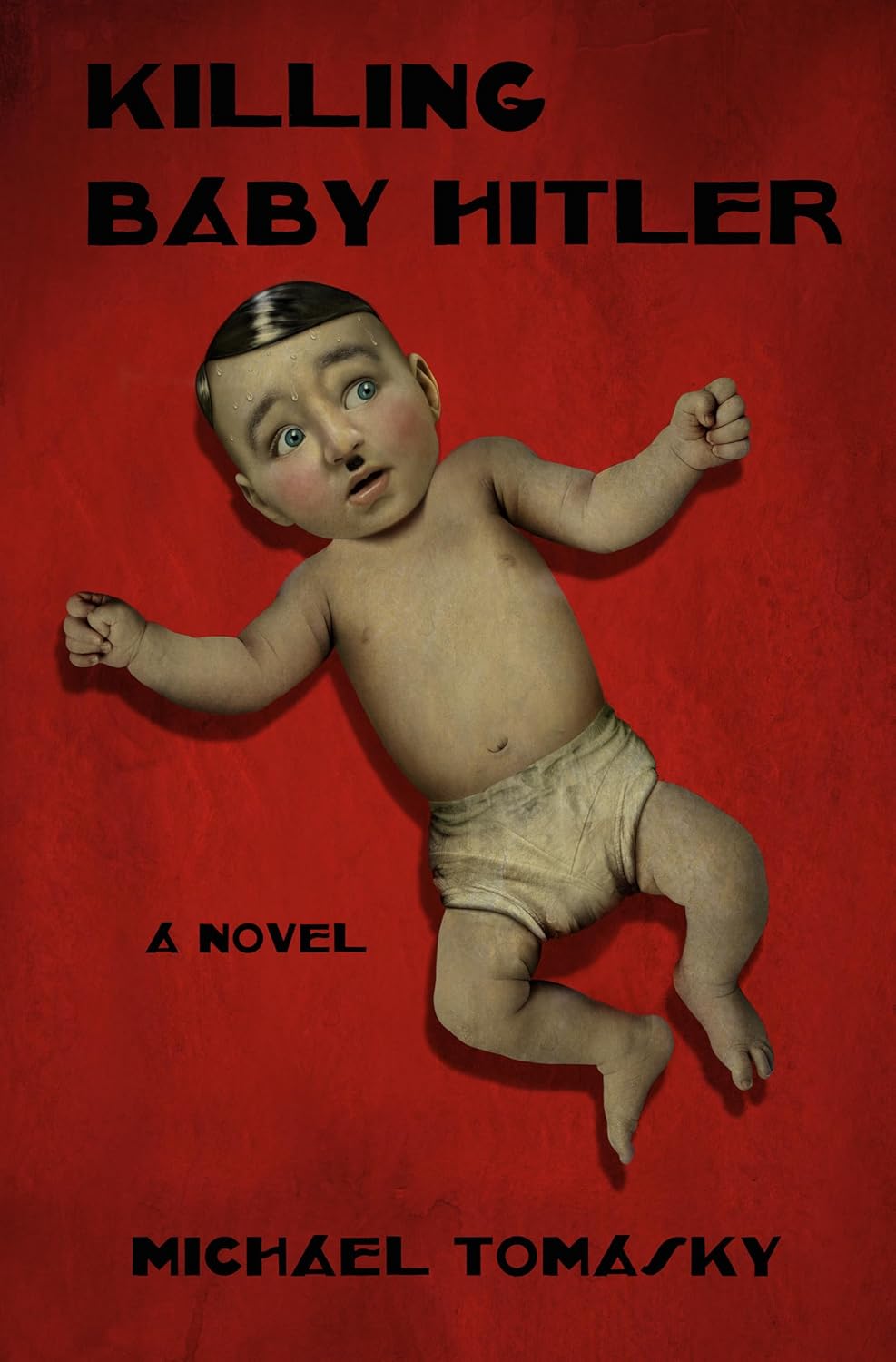
Michael Tomasky is no stranger to furious political writings, but Killing Baby Hitler may be his first foray into a fictional one. The editor of the New Republic, a progressive magazine known for its upper-class commentary on the state of the union, Tomasky delivers in this part-sci-fi, part-historical, and wholly enraged novel a story of five scientists in the year 2141 who consider using time travel to murder the infant Adolf Hitler.
The idea of “killing baby Hitler,” of course, isn’t new; it’s a popular thought experiment for exploring the ethics of taking one life to save (possibly millions of) others. But the author takes the concept and turns it on its head, considering not whether someone like the Führer deserves to be offed, but grappling with what kind of person would do the actual deed. Harry David, one of the scientists, mulls it over:
“I thought in that moment — and I had, I had like a thousand thoughts, every one of them deep and complex, if I may say so, but also, every one of them instantaneous, none lasting more than a few split seconds — of the people who do kill. Who enjoy killing. The power they must feel. The godlike power. I think to be able to kill, you must be comfortable playing God.”
The five folks tasked with the undertaking, all of whom work for the subtly fascist, ironically named Freecorps, serve as exaggerated archetypes of the people who might wrestle with such philosophical issues. Along with Harry, a California Jew whose chief concern is getting women to sleep with him, there’s uptight Pittsburgher Helvetica Cope, also Jewish, who’s introduced to the reader as proudly judgmental. Karl Schumacher is a no-nonsense German who, in addition to working at Freecorps, teaches physics at West Virginia University. The rule-following Devika Raghavan, from Jaipur, Rajasthan, is first and foremost “sensible.” And Wadjda Saad, a forward-thinker from the Free Arabian Republic, is the most revolutionary of all.
Their ex-pop-star, current authoritarian boss, Jayden, considers the team:
“[She], who knew about Versailles only because of her study of and fascination with Hitler, wondered how it was that two of these five people were Jews. And an Indian, a German, and an Arab. She wondered quickly if there was any tension within the group, given their clashing ethnicities, and made a mental note to hire an investigator to poke around.”
In order to force his characters’ collective hand — to make them want to go back and kill Hitler in the first place — the author creates a suitably grim, hopeless reality. The world he presents (separated into regions like “Bezos Two” and “Trump One”) is owned by 33 wealthy men and one wealthy woman; terrorized by incessant bombings; and organized into a social and political hierarchy based upon the idea that true equality is found through oppression and obedience. Helvetica attempts to make peace with it all:
“But look — she was free, more or less. She could work. She could vote. She could get an abortion, if she needed one, without her name being skywritten in red vapor above the city skyline like how they did in a lot of places. And it was safe, in Pittsburgh, to be Jewish. She could go to temple, when the spirit moved her, which was pretty close to never.”
The novel is divided into three sections. Part One explores the future of the world if we continue on as is; Part Two offers a trip back to Austria in 1889, when Hitler was just 3 months old; and Part Three returns to the year 2141, where we witness the aftermath of messing with the past (which, as every time-travel story ever written warns us, comes with consequences).
Killing Baby Hitler is absurd, though given the absurd world we live in, it also supplies a kind of logic that makes its premise plausible. It is self-aware and has one foot planted squarely in the here and now. Among other pop-culture mentions, Tomasky references Bruce Springsteen and Bob Dylan, makes cracks at President Trump, and conjures an antagonist with a “Bond-villain” laugh.
More than anything, this is a conceptual novel born out of the author’s anger at the state of our world — one that supplies likeminded readers with a vehicle for vicariously expressing their own outrage. There’s nothing subtle about Killing Baby Hitler, but it’s obvious there isn’t meant to be.
Wiley Clements is a writer living in Brooklyn. Her next read is Tender Is the Flesh by Agustina Bazterrica.