Kolkhoz
- By Emmanuel Carrère; translated by John Lambert
- Farrar, Straus and Giroux
- 416 pp.
- Reviewed by Ken Kalfus
- October 26, 2026
A man unpacks his complicated bonds with Russia and his late mother.
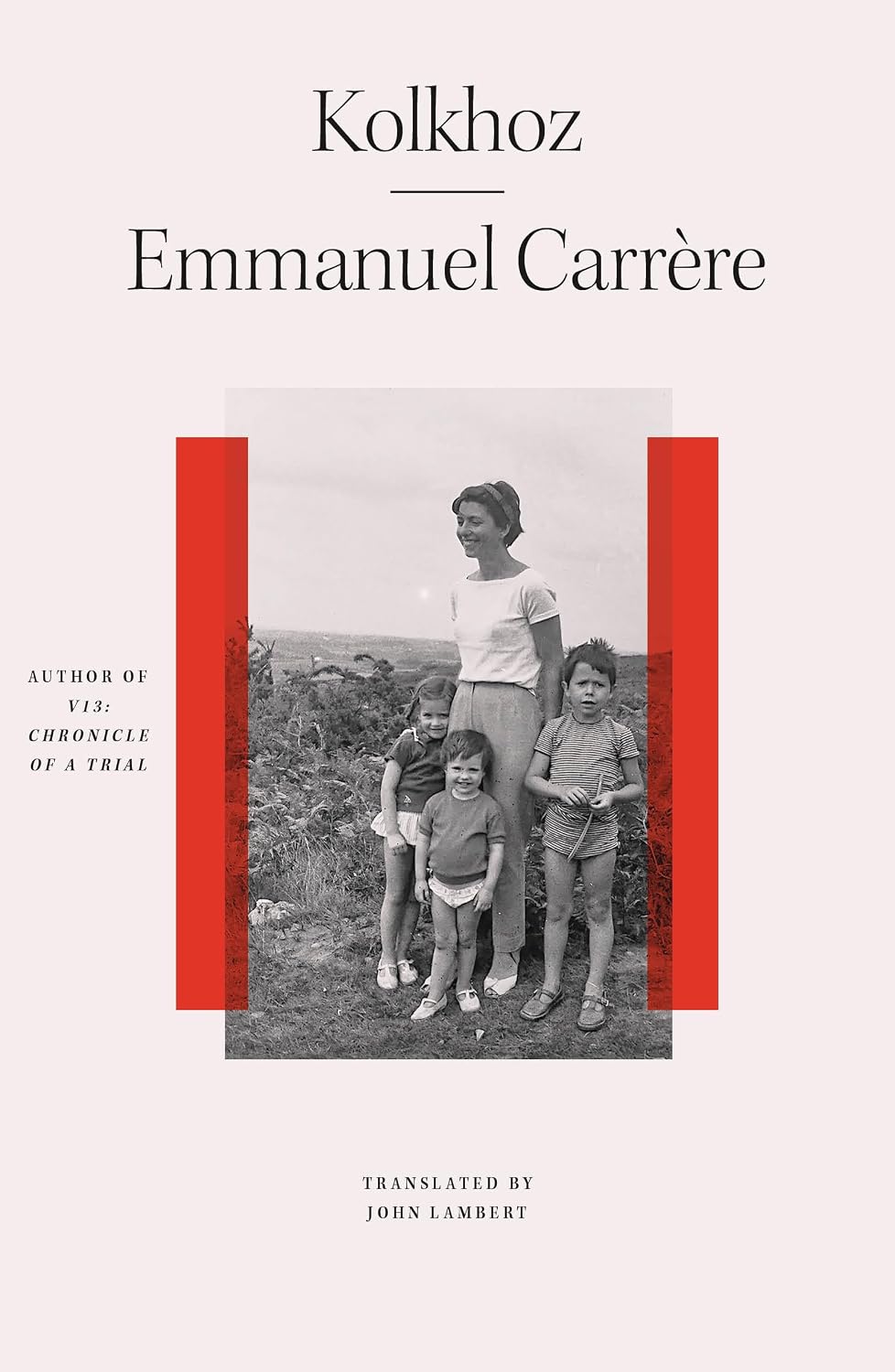
Over the course of his long career, the French novelist and journalist Emmanuel Carrère has shown a profound fascination with Russia and its past. This was in part because his mother’s ancestors had taken vital roles in Russian history going back centuries. Then came the 2022 invasion of Ukraine and his mother’s death in Paris the following year. Carrère’s personal obsessions were abruptly thrown into sharp relief.
The result is Kolkhoz, an illuminating, often searing memoir that engages a difficult family story in the shadow of Russia’s national tragedies, as well as France’s. The book’s colorful tales of emigration may remind the reader of Edmund du Waal’s The Hare with Amber Eyes. Carrère, however, is a much more tortured memoirist, struggling against filial bitterness and resentment. There’s some score-settling here.
Most of these points are scored against his mother, admittedly the most important person in his life. Hélène Carrère d’Encausse, an historian of Russia and the Soviet Union, was a famous right-wing French intellectual. She was a leading member of the Académie Française, a so-called “immortal,” and she was awarded many other honors across Europe. Emmanuel Macron spoke at her funeral in the courtyard of Les Invalides. The author warmly recalls the president’s praise.
Less warmth emerges in Carrère’s own depiction of the woman. Proud and imperious, Hélène was the person on whom he was most dependent for approval, which was often withheld. They evidently saw each other as literary competitors. He continues to compete, taking the opportunity to slight her methods of scholarship as old-fashioned. He also says she held contempt for the common Russian people, identifying instead with her noble forebears. She argued in bad faith and was not above lying. She was also vain about her celebrity.
The low point in their relations came when Carrère published a previous memoir, My Life as a Russian Novel, whose English-language edition appeared in 2010. In that book, he writes about his mother’s Tbilisi-born father, Georges, who immigrated to France in the 1920s and worked for the Germans during the Occupation in World War II. The extent of his “collaboration” remains disputed within the family, a dispute Carrère continues to litigate. The first book was a “family cataclysm.” Hélène believed her son was trying to sabotage her reputation. They didn’t see each other for two years.
Kolkhoz, fortunately, works to lighten the picture of discord; Carrère offers many instances of intimacy and affection. He enjoys the memory of his childhood bedtimes, when he cuddled with his two sisters and their mother in her bedroom. Although resolutely anti-communist, Hélène called themselves a little kolkhoz, a Soviet collective farm. This happened, however, only when her husband, Louis, an insurance executive, was away on business. Carrère notes with sadness that in the last 50 years of their lives together, he never saw his parents exchange a word or gesture of tenderness.
Hélène’s public stature survived her son’s book about his grandfather, but it took another hit with Russia’s war against Ukraine. She’d been the most famous French expert on Russia, had spoken often with Russia’s then president, Boris Yeltsin, and first met Vladimir Putin in Yeltsin’s office. She initially liked them both. She was made a member of the Russian Academy of Sciences. In the run-up to the invasion of Ukraine, she argued that Putin was committed “body and soul” to good relations with Europe. She was all over French TV “repeating that Putin was a brutal but rational man…and that of course he would never, ever, do such a crazy thing” as start a war.
This proved incorrect. A headline in the French press derided her as “An Immortal in a Fog.”
Carrère himself is in Moscow on the day of the invasion, invited to take a bit part in a movie being filmed there based on his 2011 Russia-themed novel, Limonov. The film’s star, Ben Whishaw, leaves right away, but Carrère stays. The next few days suggest a melancholic, muted ending to his lifelong affair with Russia. He’s mostly stuck in his hotel, struggling to comprehend what the war means for the country. When he finally does catch a flight out, it’s clear that he’s leaving “a nation plunging into a gigantic dystopia.”
This may have been Carrère’s last opportunity to observe that nation firsthand. For many of us with an attachment to Russia, its people, its language, and its literature, a journey there has sadly become too perilous or at least problematic. When Kolkhoz concludes with a 46-page account of Hélène’s death from cancer, at 94, the mother and son’s leave-taking seems somewhat analogous. It’s his last intimacy with a many-faceted woman of prodigal attractions and confounding faults, a beloved country unto herself.
Ken Kalfus is the author of five novels and three short-story collections. Two of his books, The Commissariat of Enlightenment and Pu-239 and Other Russian Fantasies, are set in Russia, where he lived for four years in the 1990s. The Independent has reviewed two of his other books, the novels Equilateral and 2 A.M. in Little America. His latest novel, A Hole in the Story, takes place in Washington, DC.