Life on the Octopus Farm: The Ethics and Future of Growing the World’s Most Intelligent Invertebrate
- By Richard Schweid
- University of North Carolina Press
- 186 pp.
- Reviewed by Paul D. Pearlstein
- October 23, 2026
What to do about sentient delicacies?
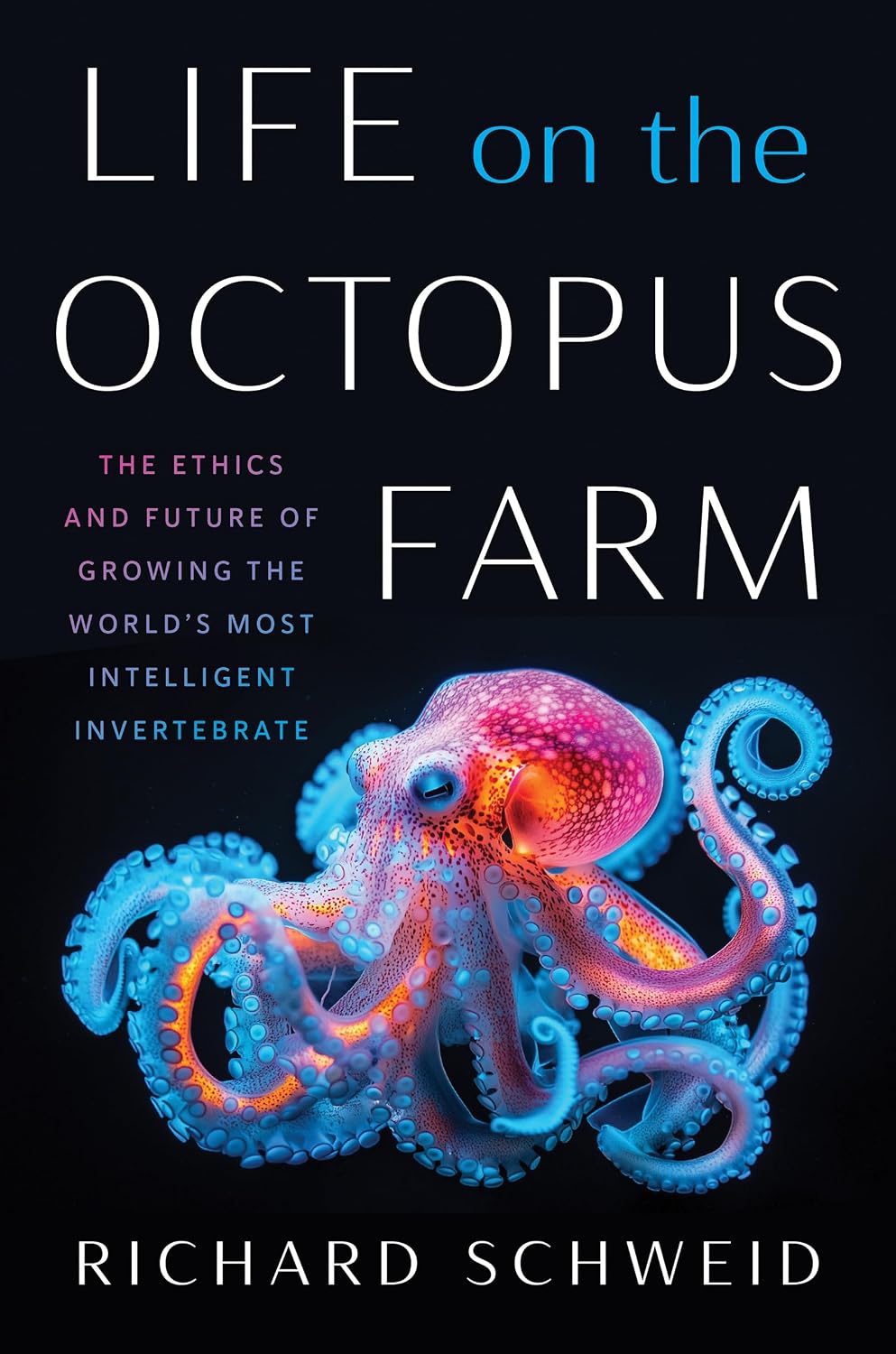
Once, on a dare in Italy, I ate a tiny, rather chewy octopus and was not impressed. In many countries, I’d be dismissed as just another unsophisticated American troglodyte sadly lacking in culture, because octopus is among the most popular international delicacies. But should it be? That’s what author Richard Schweid sets out to answer in Life on the Octopus Farm: The Ethics and Future of Growing the World’s Most Intelligent Invertebrate.
Many studies have praised the extraordinary intelligence of octopuses and their ability to almost instantly camouflage themselves, and that admiration has been reinforced by such movies and books as “My Octopus Teacher,” “The Soul of an Octopus,” and Remarkably Bright Creatures. Octopuses have nine brains (one in each arm and one in their mantle, or head) and are the smartest of the invertebrates, competing with the intellect of chimpanzees, pigs, and crows.
While there are over 300 different species of octopus, only two are typically eaten: the fast-growing (and most coveted among gourmands) common octopus vulgaris, which weighs around 20 pounds and averages three feet long, and the giant Pacific octopus, which weighs around 150 pounds (with some exceeding 600 pounds) and stretches 12 to 18 feet.
A female vulgaris can produce 100,000 to 500,000 tiny, rice-like eggs, but most are devoured as plankton by other marine life. Until they hatch, the mother will provide 24-hour care for them in an act called brooding. Having not eaten throughout her maternal duties, she will die from exhaustion soon after they hatch. Neither parent will reproduce again, and the father, too, will soon die. A few hatchlings may sink to the sea floor to mature; only one in 10,000 will survive to adulthood and achieve a typical lifespan of two to three years. Given octopuses’ short, precarious lives, farming them for profit is a gamble.
Schweid is not a scientist or a farmer but a curious journalist, and he takes readers on a tour of octopus aquaculture in several countries. At each stop, we meet many of the people and entities engaged in the octopus-meat trade, which is big business in places. The author begins in Sisal, Mexico, on the Yucatán Peninsula, where octopus farming produces up to 25 tons of meat per year, generating $55 million for investors. From there, he moves onto Galicia on the Atlantic coast of Spain, the region said to produce the tastiest octopuses.
Apparently obsessed with the Pacific variety of the mollusks, Japan boasts the highest per-capita octopus consumption in the world. But the country’s fascination with octopuses doesn’t stop at the dinner table; it has reached the art world. Japan seems especially — if cautiously — proud of a famous erotic portrait titled “The Dream of the Fisherman’s Wife” by Katsushika Hokusai.
The demand for octopus in Japan and elsewhere is limitless, but the supply is not. The availability of commercial octopus is unpredictable and changing: The waters of North Africa now provide most of the octopus sold to Asian countries. Its high protein makes octopus a nutritious food, but the once-humble mollusk is becoming a luxury. (False labeling has injected a tinge of corruption into the trade; the idea of counterfeit octopus sounds outrageous, but corruption is not an unknown path in capitalism.)
The author ends his discussion with his baseline question regarding the eating of such a smart creature: Should we? While there’s a nascent global movement against consuming octopuses, the creatures — unfortunately for them — aren’t the cutest animal in the world. It will take some serious PR to keep them off the plate.
The flow and organization of the book is somewhat higgledy-piggledy, given that it covers aquaculture — as well as geography and anthropology — in multiple regions. Along the way, Schweid refrains from strongly condemning the octopus business, instead gingerly criticizing the process and warning about the consequences of expanded farming. He closes with this aquarium-half-full suggestion:
“And if we eventually farm octopuses, perhaps we should do so with the goal of reshaping the market so aquacultured octopuses provide the neediest among us with a healthy, tasty meat at the same time that we reduce livestock farming and the harm it causes to us and our planet.”
After finishing Life on the Octopus Farm, some readers will be disgusted that anyone would ever eat such a complex, brainy fellow creature. Other readers will be hungry.
Paul D. Pearlstein is a retired lawyer who is opposed to eating anything that is obviously smarter than he is, which is a very low bar.