Listening to the Law: Reflections on the Court and Constitution
- By Amy Coney Barrett
- Sentinel
- 336 pp.
- Reviewed by Paul D. Pearlstein
- October 30, 2025
The far-right justice presents a mostly evenhanded peek behind the curtain.
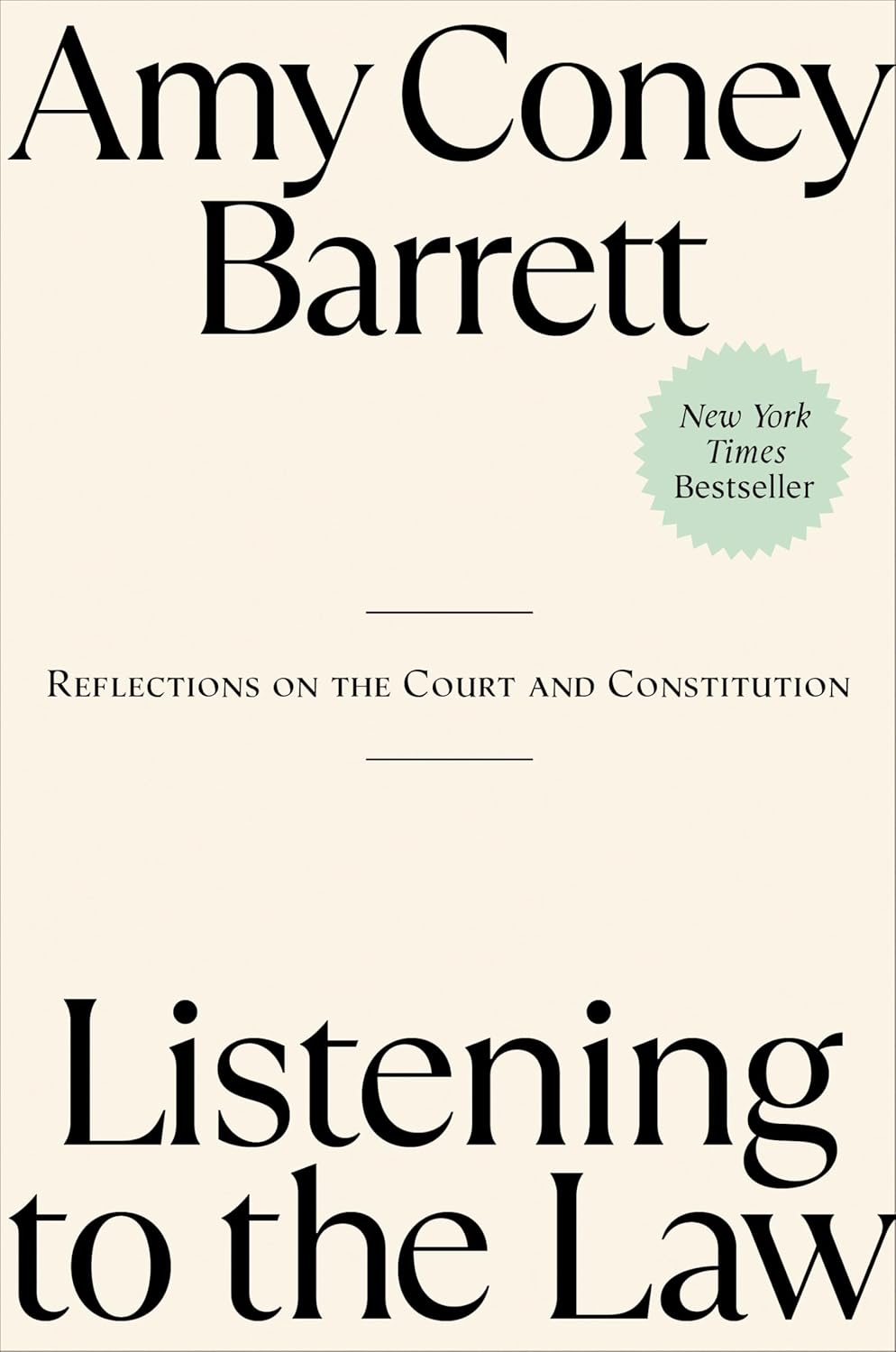
Amy Coney Barrett is the 103rd associate justice of the Supreme Court. She was appointed after the death of Ruth Bader Ginsburg, but she’s definitely no clone of the liberal “Notorious RBG.” Barrett’s has long been a staunchly conservative, Catholic voice. She enjoys support from religious-rights groups and was strongly endorsed by the Federalist Society, of which she was a member in 2005-2006 and again in 2014-2017.
Barrett was a superstar student: Phi Beta Kappa, Omicron Delta Kappa, summa cum laude as an undergrad at Rhodes College (where she was named most outstanding English Department graduate), and magna cum laude — and first in her class — at Notre Dame’s law school. I find her, in Listening to the Law, to be a gifted writer, and her publisher must agree: Barrett reportedly received a $2 million advance.
As a professor, Barrett’s forte was analysis and semantics, although she taught courses on everything from statutory interpretation to stare decisis. She clerked for and was mentored by the late Justice Antonin Scalia. As anyone who follows the high court — or current events — already knows, Barrett leans sharply to the right and supports the same judicial philosophies of textualism and originalism that Scalia promoted.
She devotes several pages to explaining her use of both. Textualism is to identify the plain meaning of the U.S. Constitution’s words at the time they were written, rejecting notions of intent or purpose. Originalism is to begin analysis of the text by learning its history and what it was originally meant to accomplish. By employing these approaches, so the thinking goes, a “correct” interpretation will be discerned, one free of contemporary influences that might change a passage’s fundamental meaning.
Yet these two methods are declared incompatible by some scholars. The terms are rather imprecise, and both approaches often yield wholly different conclusions when wielded by liberal jurists. Fortunately, disputes on the Supreme Court aren’t as common as the media would have us believe. Most unsigned decisions are unanimous, and in the 2024 term, over 41 percent of the signed decisions were also unanimous. Scalia defended his frequent controversial positions by claiming they had merit since “I am not a nut,” and Barrett seems to endorse that rationale.
She cautiously plays down her contentious vote to overturn Roe v. Wade in Dobbs v. Jackson Women’s Health Organization and attempts to explain why she agreed to give President Donald Trump unlimited, king-like powers in Trump v. United States. She presents herself as a neutral, open-minded observer compelled to reach her unassailable conclusions via originalism and textualism. (“Elementary, my dear Watson.”) Barrett believes her analytical methods foster an unbiased, almost algorithmic-like process for resolving statutory disputes that all but mandates the inevitable, extremely conservative results.
The book starts as a memoir, but then Barrett becomes a teacher again. At least half of it beautifully explains the U.S. Constitution and the Supreme Court to readers of any level. Beginning law students can benefit from Listening to the Law before they start to read complex cases and are subjected to the Socratic method. It would likewise offer any first-year law students coming from STEM backgrounds a welcoming introduction to their looming coursework. I imagine Professor Barrett was a very popular and effective teacher of the mandatory “Con Law” course.
The book includes a careful analysis of our federal system of government in which Barrett points out that most of the divisive questions before the court concern structural or policy matters that should be determined by the body politic (aka lawmakers), not by a non-legislative body (aka the judiciary). Unfortunately, we’ve made it exceptionally difficult — far more difficult than in most democracies — to alter our constitution, which explains why we’ve had only 27 amendments since 1789. Because of this, litigants find it much easier to “amend” things through the back door: the Supreme Court.
Barrett also devotes a chapter to what it’s like being a Supreme Court law clerk. Currently, each justice may have up to four clerks to do basically whatever she or he wants. Of course, clerks’ standard duties include conducting research, writing memoranda, helping with the review of petitions for certiorari, and being prepared to discuss cases with the judge. But accompanying justices to lunch, driving their family or friends around, attending social functions, and essentially being available 24/7 can be among their less scholarly roles.
Whether you agree with her brand of jurisprudence or not, Justice Barrett has authored a readable, enjoyable volume on the U.S. Constitution and the Supreme Court. If you’re a liberal, Listening to the Law is necessary so that you can know your enemy. If you’re a conservative, it’ll feel like a comforting homiletic message to the choir.
Paul D. Pearlstein is a retired lawyer. He believes that many of our controversial national issues, along with Article V of the U.S. Constitution, should be reviewed by a constitutional committee or convention established to meet on a periodic basis.
.png)