A teen uncovers ghostly happenings at a shadowy former artists’ colony.
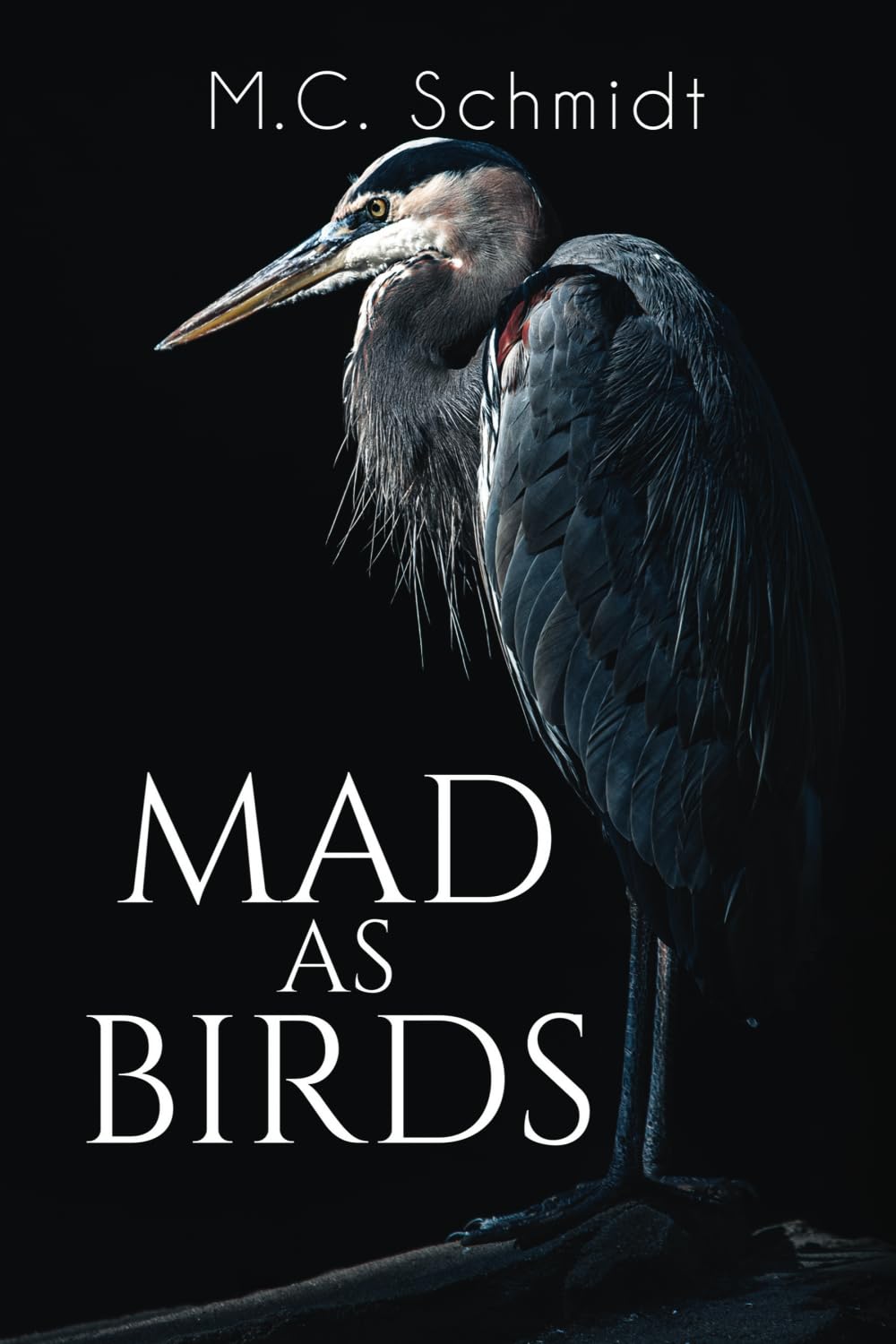
If the past few months have taught 17-year-old Milo Selby anything, it’s that “life could be cruel, and it was best to keep your expectations low.” Expelled from school and branded a bully (and worse) by classmates and neighbors, Milo doesn’t have much left in Muncie, Indiana. His parents are dead and, as his older brother, Jack, is quick to remind him, “Life doesn’t care about our plans.” Milo isn’t sure about Jack’s decision to move them to a “Luddite community” in South Bend, but going to a place where nobody knows them does sound nice.
With a checkered past — part of which readers discover in Mad as Birds’ dramatic prologue set in 1947 — “the Castle,” in its latest incarnation, sees the “impressive gothic-looking stone mansion” transformed into an “intentional community” complete with communal meals and a ban on electronic devices.
Milo soon learns that the history of the grounds goes back much farther, including the Castle’s initial incarnation as a wellness center built by Standford Kayo, the creator of Corn Nibs, “one of the most famous breakfast cereals in the world. We’re talking Kleenex or Jell-O levels of universal recognizability.” After Kayo’s facility closed, the site briefly housed an artists’ retreat that hosted notables like Salvador Dali before abruptly shuttering under strange circumstances and falling into disrepair.
Now, Milo, a painter himself, hopes it will be the site of his second chance — a feeling that increases the moment he sees the Castle for the first time:
“Not a sense that I’d been there before as much as a feeling like I’d finally arrived somewhere I had always wanted to be…Looking up at the building’s floors of stone and glass, I felt as insignificant as an ant. I loved that feeling. It might sound crazy, but after months of fearing I might burst from guilt and sadness it was comforting to stand in The Castle’s giant shadow and feel shrunken to something tiny and meaningless.”
He’s further drawn into the strange atmosphere when his new neighbor and potential friend, Sam, reveals that she’s seen an unprecedented increase in her painterly abilities since moving in. It’s almost as if something — someone, really — is painting through her. Until, that is, that something turns its attention to Milo instead. Desperate to create again, Milo keeps painting with help from the spectral hand until the lines between them begin to blur. “She controlled me but that didn’t mean I wasn’t myself,” he insists. “I was just myself in a more significant form.”
Of course, readers already know from the ominous and bloody prologue that something is very wrong at the Castle — something Milo reluctantly helps Sam investigate, although he secretly hopes it can’t be stopped. He cannot imagine losing his newfound skill, even if the price of his artistry may be the lives of everyone around him.
This novel, author M.C. Schmidt’s debut, is an introspective exploration of possession and individualism, one that lets both Milo and readers decide how much responsibility the boy has for his actions. Milo’s close-first-person narration leaves room for interpretation as his unreliability increases. Deep dives into the supernatural phenomena and mythology at play here — including a creature called a lamia — as well as numerous tangents on the history of the Castle interrupt the otherwise tense narrative. And long passages of exposition, such as a lengthy description of microfiche machines — “two boxy pieces of electronics, each with its own small display screen. The units were the beige plastic of old-time personal computers like the ones Dad used to store in our garage” — further slow the momentum.
Nonetheless, with its surprising twists and gothic suspense, Mad as Birds capitalizes on its unreliable narrator to deliver a shocking finish that readers won’t see coming.
Emma Carbone is a librarian and reviewer. She has been blogging about books since 2007.