Magic Can’t Save Us: Eighteen Tales of Likely Failure
- By Josh Denslow
- University of New Orleans Press
- 176 pp.
- Reviewed by Molly McGinnis
- June 5, 2025
These sweet, silly offerings read like fairytale postscripts.
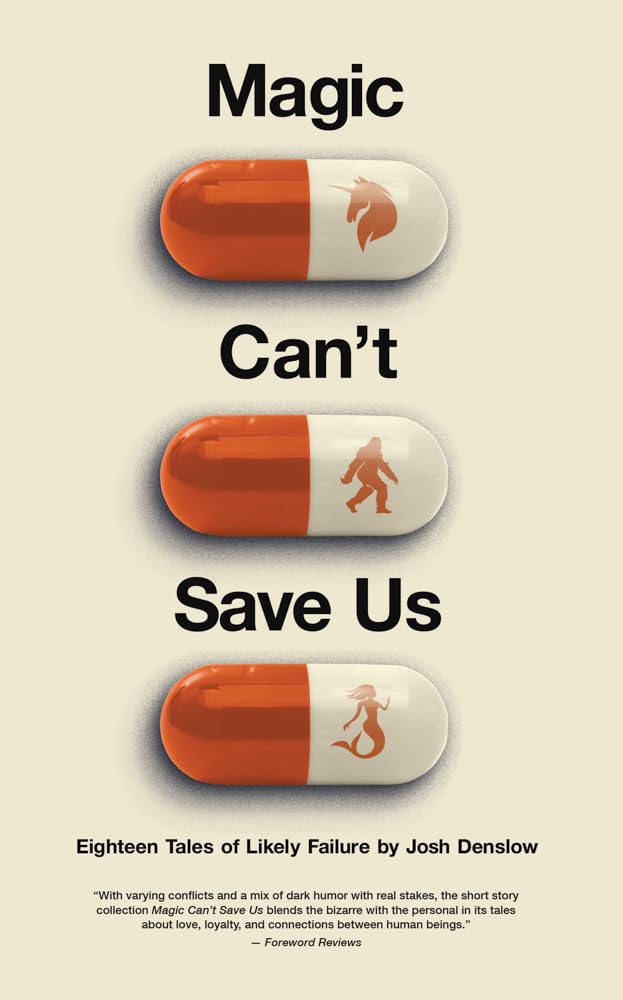
Josh Denslow’s charming third book, Magic Can’t Save Us, offers more than a hint of fantasy: Once readers look beyond the protagonists’ near worshipful devotion to their girlfriends, they might notice the dragon in the room (or the tooth fairy, living statue, or perverted mermaid). Many of the tales end with a twist, like the answer to the sort of riddle one might encounter in these pages. Happily, Denslow’s stories are reliable without being repetitive, which is as much a mark of his unique style as it is a nod to traditional fairytales.
In “Tale #1: Keening,” a young man is followed by a banshee who first appeared after a childhood accident. While it’d be tempting to reach for a trauma metaphor, the narrator seems to think that the circumstances of most hauntings, like most relationships, can be improved with clearer communication from both parties. The story ends with a development that’s satisfying in its predictability, and the story swings open into the rest of the collection like the door to a maze.
The next two, “Tale #2: Bingo” and “Tale #3: Infinite Possibilities Outside the Screen,” solidify and expand on the themes in “Keening.” Both feature men struggling in their romantic relationships against a backdrop of serious magic. “Bingo” takes place at a coffeeshop, the zombie apocalypse roaring outside, while “Infinite Possibilities” introduces something even worse than a work husband — a handsome centaur who occasionally appears on Zoom calls. Such are the burdens of the bewitched modern world.
Denslow’s writing defies labels, which, on one hand, might make it perfect for the slipstream genre. On the other, so many of these stories operate with the logic of fables that they seem more suited to a shelf of contemporary fairytales in which characters bat against the constraints of isolation, neurosis, and misunderstandings. You might assume it’s hard to encounter miracles and curses in the age of telework, but the creatures here would disagree.
In one of the eeriest entries in the collection, “Tale #5: Where the Magic Is,” a couple turns to eating unicorn meat to rekindle their love. Because all things in this book are possible (many of them horrifying), some uninvited guests materialize in the pair’s back yard during dinner. The encounter is clear and beautiful:
“Maggie was breathing heavily, her chest heaving, waiting for me to respond. Through the window behind her, I saw a faint white glow.
“‘What is that?’ I asked.
“She turned and saw it too. We moved to the window in unison and looked into our unkempt yard. Standing between the mailbox and the driveway was a unicorn.”
Denslow’s realms are chockfull of ordinary hauntings and cursed bonds. Images of unicorns standing beneath basketball hoops or a lover picking his way up the side of an office building to battle harpies are compelling in their strangeness and specificity. One of the few stories with more challenging visuals, “Tale #8: Waves,” has a disembodied feel. The book quickly course-corrects, however, with further offerings whose protagonists journey to the center of their own bewilderment to find monsters, sure, but untapped wells of bravery, too. These characters suggest a modern-day chivalry; heroism, for them, doesn’t involve locating brute force within the self, but rather confronting that force head-on when it crashes into their world.
The penultimate “Tale #17: Loss” is the most moving. In it, a father tries to save his marriage while maintaining his relationship with his young daughter — and, of course, while feeding what might be a Chupacabra out back. It’s as much a reflection on taming one’s fears as it is a meditation on whose caretaking skills are valued and whose are dismissed, particularly when viewed through the lens of gender norms. Even in the dark, unsure of what’s been living behind his house, the dad goes out to say hello:
“Then I heard it. The raspy breath somewhere not too far behind me. I should have taken the bowl with me, something to distract it. I couldn’t turn around. I felt the creature sidle up next to me. Its ragged breath hot on my legs. I waited for the feel of its teeth. For its claws to eviscerate me. Instead, I felt its coarse flesh brush gently against my leg.”
If Denslow ever wanders into a labyrinth, he’ll move toward its center not because he’s lost, but because he wants to meet the Minotaur. Anyone eager to follow him should start the journey with this book.
Molly McGinnis studied literature at American University. Her work has appeared in Guernica, CQ Researcher, CommonLit, the Sierra Nevada Review, the Journal of Clinical Oncology: Oncology Practice, and elsewhere. She lives and works in Washington, DC.