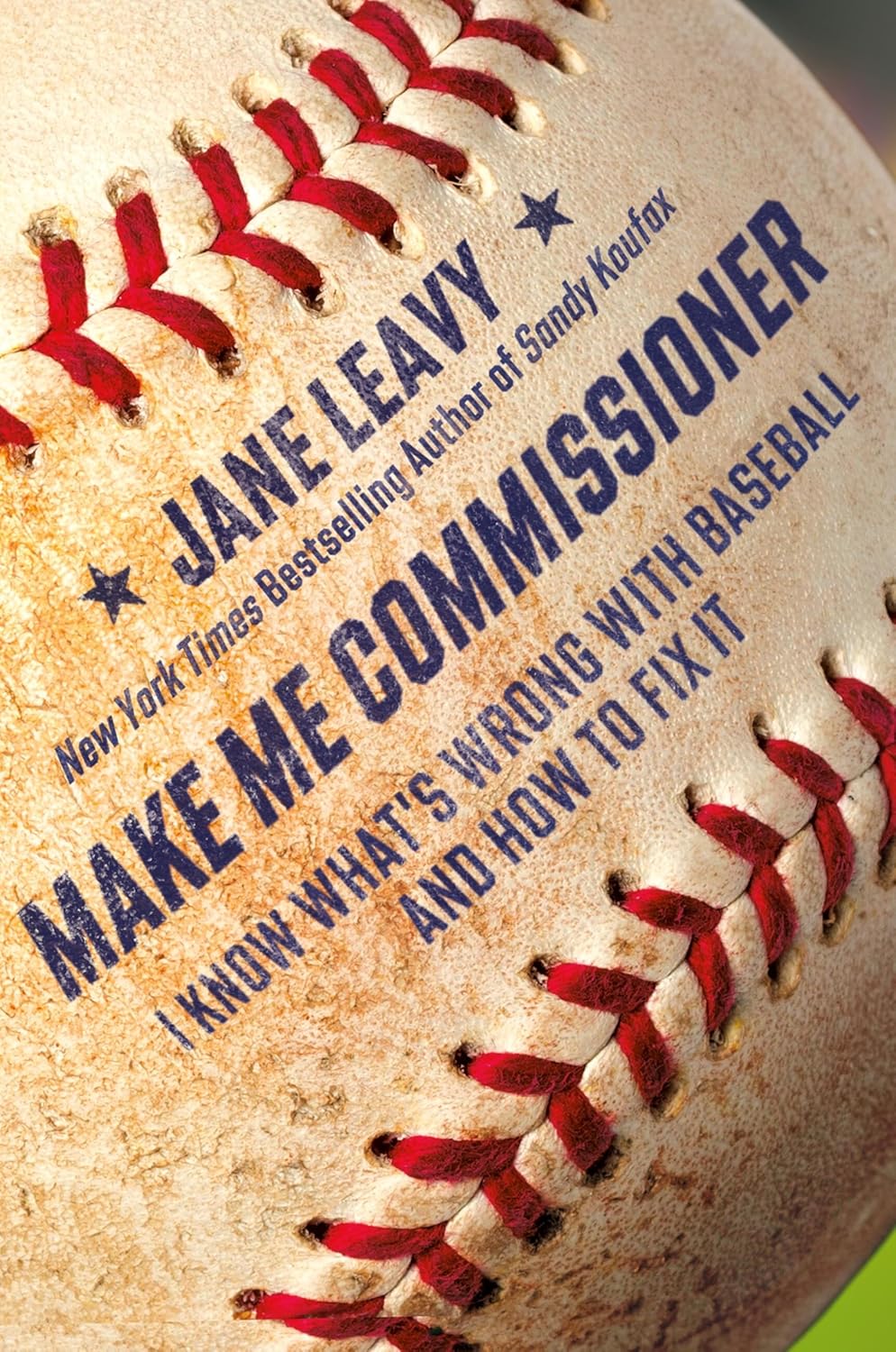
Make Me Commissioner: I Know What’s Wrong with Baseball and How to Fix It
- By Jane Leavy
- Grand Central Publishing
- 384 pp.
- Reviewed by Randy Cepuch
- September 2, 2025
A frustrated sportswriter winds up and pitches.
A few months ago, I went to my first-ever baseball game in Japan. I don’t remember the final score or any specific plays, but I’ll never forget the experience.
Young women dressed in bright colors representing different beer brands scampered around selling suds dispensed from tanks worn on their backs. Cheerleading squads did elaborate routines around the pitcher’s mound between innings. Fans of the home team (Tokyo Yakult Swallows) enthusiastically waved small umbrellas to show their support, while those favoring the visitors (Nagoya Chunichi Dragons) made nonstop joyful noises — everything from singing and chanting to marching-band music — throughout the evening, no matter what was happening on the field.
It wasn’t boring, as Major League Baseball (MLB) games in this country too often are.
Why has America’s national pastime become less fun? While researching Make Me Commissioner, former Washington Post sportswriter Jane Leavy (whose previous books include biographies of Sandy Koufax, Mickey Mantle, and Babe Ruth) asked players, managers, fans, umps, ushers, ballpark designers, reporters, and fellow authors that very question. She also spent a lot of time huddling with Mike Rizzo and Davey Martinez, both recently fired as general manager and manager, respectively, of the Washington Nationals.
Perhaps the clearest answer came from Bill “Spaceman” Lee, a long-retired pitcher known for eccentricity. “Because everyone knows what’s going to happen,” he said. “Somebody is gonna hit a home run and the closer is going to strike out the side in the ninth.”
Leavy makes a strong case that the advent of analytics — basing managerial decisions on detailed data rather than gut feelings — sapped the magic out of a game where it once seemed anything could happen. (Michael Lewis’ 2003 book, Moneyball, detailing how the Oakland A’s used number-crunching to make the most of undervalued players, popularized the now-ubiquitous practice. Lewis is among those interviewed in Make Me Commissioner.) As she understandably grouses:
“A whole damn industry of data scientists, and baseball operations guys, and layers of management...conspired to remake baseball into a world where the improbable has been rendered moot or not worth the trouble. Where the most likely outcome has been given sole dominion, and the zeal for finding fractional advantages has compromised originality, precluding the forever plays that run on a loop in baseball’s collective memory.”
The quest for those fractional advantages has dramatically changed the game over the past two decades and ended more than a few players’ careers. Pitchers, for example, are taught how to throw faster and harder, but at the cost of rarely completing nine innings and too often having to go under the knife to repair overtaxed arms. (In 2024, nearly 40 percent of big-league pitchers were candidates for “Tommy John” surgery. Some, including Shohei Ohtani, have had it more than once.)
Also contributing to the diamond dullness dilemma: too-expensive tickets financing high-priced players; fewer minor-league teams creating interest and opportunities; expanded playoffs rendering regular-season games meaningless; and complex broadcast-licensing agreements making it difficult for fans to follow favorite teams.
But the biggest problem had become that games were taking longer than ever — more than three hours (and, in 2021, the average time between balls in play was a too-leisurely three minutes and 52 seconds). The MLB dealt with that in 2023 by implementing a pitch clock, a controversial move that’s proved to be very successful.
(I’m among those who always believed one of the best things about baseball was that it wasn’t subject to the tyranny of a clock: Games simply took as long as they took. But the pitch clock has trimmed more than 20 minutes off typical game times, a remarkable improvement.)
Other 2023 changes included bigger bases, fewer attempted pickoffs, no infield shifts, and “ghost runners” on second base at the beginning of each half inning if there’s a tie after nine innings.
Some of these changes have helped, Leavy concedes, but more are needed. Throughout this book, scattered among stories which don’t always further the narrative but will tickle most fans anyway, she offers dozens of ideas (her own and others’) to make the game fun again. Among them:
• Entertain more. Willie Mays used to wear a too-small cap because he noticed fans “like to see the hat fall off.” Leavy devotes two chapters to the Savannah Bananas, baseball’s version of the Harlem Globetrotters, who combine genuine talent with antics like playing ball on stilts.
• Hustle more. Limit side changes between innings to 90 seconds, with longer breaks between the third and fourth and sixth and seventh innings. Consider taking cues from the Bananas, whose rules include no bunting, no mound visits, no intentional walks, no stepping out of the batter’s box, and no games longer than two hours.
• Be more accessible. Play weekend games during the day, except for four designated showcase games on TV on Friday nights. Install 18-foot-high Plexiglas outfield fences to make home runs more difficult and to give fans a better view. Have designated autograph-signers wander through the stands, in uniform, when not playing. And admit children under 10 for free.
• Experiment more. Maybe try two outfielders rather than three to get more balls in play.
But when it comes to embracing technology, Leavy — observing that using “robo-umps” can take away the joy of yelling at flesh-and-blood umpires — cautions care. It’s another reminder that unpredictable human behavior is crucial to making baseball fun.
Randy Cepuch is a member of the Independent’s board of directors and a frequent reviewer whose favorite moments ever at Nats Park were the two occasions when his cat’s picture was among those that appeared on the Jumbotron during a “Caturday” promotion.