Medea: A Life
- By Edith Hall
- Yale University Press
- 256 pp.
- Reviewed by Stuart Kay
- September 22, 2026
An epic ode to an epic enchantress.
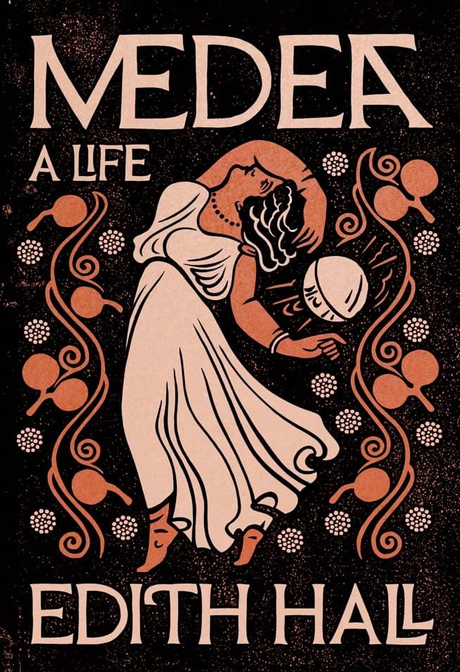
Greek mythology is well stocked with chilling gods and mortals. Cronus castrated his father with a sickle and ate his children. King Lycaon killed and cooked his son and served him to Zeus. Procrustes laid travelers on a bed and cut short their limbs or stretched them according to whether they were too long or too short for it.
Various myths associated with Medea are no less shocking. The sinister sorceress born on the eastern shores of the Black Sea is said to have killed and dismembered her brother, inflicted hideous deaths on King Creon’s daughter, Glauce (for whom Medea’s husband, Jason, had abandoned her), and King Creon himself, and murdered her own sons. She lives on as the enduring archetype of an evil, vengeful woman.
In Medea: A Life, Professor Edith Hall of Durham University in the U.K. has stitched together diverse Medean myths to produce the first “biography” of a character whose existence the ancient Greeks had no doubt about. As Hall says, nearly every ancient author who mentions Medea has been used at some point in her narrative — Euripides’ superb Medea (which formed part of his group of plays that famously came in third and last in the City Dionysia competition in Athens in 431 BCE) and Apollonius’ 3rd-century BCE epic Argonautica are particularly relied on. Hall has also drawn on her impressions from her travels to places where Medea is said to have lived or visited, from Colchis in the modern Republic of Georgia to Iolcus in Thessaly and the city of Athens.
That extensive research has resulted in a beautifully written retelling of the Medean myths in a continuous narrative using modern language and everyday dialogue. Hall divides the story into five “acts”: Medea’s childhood in Colchis, as the daughter of King Aeëtes and the elusive nymph Eidyia; her escape to Greece with the Argonauts and their leader, Jason, with whom she has fallen in love; her murder of King Pelias of Thessaly, who had usurped Jason’s throne; the deaths of her children in Corinth; and her attempt, as queen of Athens, to poison King Aegeus’ son, Theseus.
It’s a story of love, exile, jealousy, despair, scheming, and death chockful of drama, from Medea’s birth in a terrifying thunderstorm to Glauce’s spectacular flame-engulfed death and Medea’s machinations in asylum in Athens. Medea is in turns playful, serious, furious, and callous but always resourceful, charismatic, and fiercely intelligent. She commits terrible crimes — but she is also, crucially, a victim.
Medea’s treatment as an outsider — as a woman and a foreigner in a world in which obedience from women was expected and xenophobia was rife — and her responses to that treatment are key elements of the story. As Hall demonstrates in her fascinating introduction and excellent notes on her subject’s afterlives and influence, Medea lived under unbearable patriarchal constraints and was subject to sexist and racist abuse. She was oppressed by her domineering father in Colchis, and she feared rape at his court. She was humiliated by Jason’s abandonment of her and brutally banished by Creon. Jason comes to think of himself as insane for having brought her to Greece from her “barbarous homeland.” “No Greek woman would ever have done this,” he bewails in his confrontation with her over her murder of their children. “Why didn’t I marry one of them?”
Medea speaks for women and immigrants. “It’s always hard for foreigners,” she muses in an address to the women of Corinth. She flees from her father’s court, in which she’d lived virtually as a prisoner, and refuses to accept that Jason should abandon and divorce her with impunity. She spurns submission to male authority and talks about societal prejudice. She is defiant, complex, and emotionally relatable.
As Hall points out, writers whose societies have suffered from conflicts related to ethnic difference, immigration, and intermarriage have long been attracted to the issue of Medea’s ethnicity. An 1821 trilogy by Austrian dramatist Franz Grillparzer suggests parallels between Medea’s experience and that of Ostjuden (Eastern Jews) in Austria in the first half of the 19th century. The first biracial Medea was probably the 1926 version by German writer Hans Henny Jahnn, which relocated Colchis to Africa at a time when racist ideas were becoming more prominent in Germany.
Medea has also won many admirers among women who feel they’ve been humiliated and treated with contempt, and she has been mobilized in the cause of women’s rights, becoming intimately associated with suffragettes and divorce campaigners, among others. Songs and speeches from Euripides’ play were recited at suffragist meetings. Hall tells us that a stream of dramas about Medea flooded the London stage after Queen Victoria’s accession in 1837, partly in response to the prominence of divorce as an issue in public discourse.
(In 1809, the archbishop of Canterbury lamented that the divorce rate in Britain had risen to a scandalous three per year. At the time, dissolving a marriage was possible only through a private act of Parliament.)
Now, as Hall says, Medea is everywhere. Her story has been translated, adapted, and performed in thousands of theaters; presented by opera singers and ballet dancers; and painted, sculpted, and told in poetry and prose. No fewer than three feature films about her appeared in 2021 and 2022. In 2007, a massive statue of her, conceived by the then president of the Republic of Georgia, Mikheil Saakashvili, as an emblem of the country’s pro-Western orientation following the collapse of the Soviet Union, was erected in the city of Batumi on the Black Sea coast. Somehow, a late-Bronze Age malefactor obsessed with acquiring freedom from domination has been embraced as a heroine in her homeland.
Hall recounts a revealing tale. At the premiere of a celebrated production of Euripides’ play at the National Theatre in London in 2014, a cheer went up in the audience when actress Helen McCrory delivered the protagonist’s famous statement that she would rather stand three times in the front line of battle than give birth to a single child. The cheer was followed by a loud clapping of hands. As Hall looked around the auditorium, she noticed that all those who were applauding were women.
It seems Medea continues to divide us.
Stuart Kay is a freelance writer based in Edinburgh, Scotland. He is a former reporter and sub-editor for the Scottish Parliament’s Official Report.