Medium Rare: A Novel
- By A. Natasha Joukovsky
- Melville House
- 304 pp.
- Reviewed by Serena Zets
- March 20, 2026
In filling out a perfect March Madness bracket, a man flies too close to the sun.
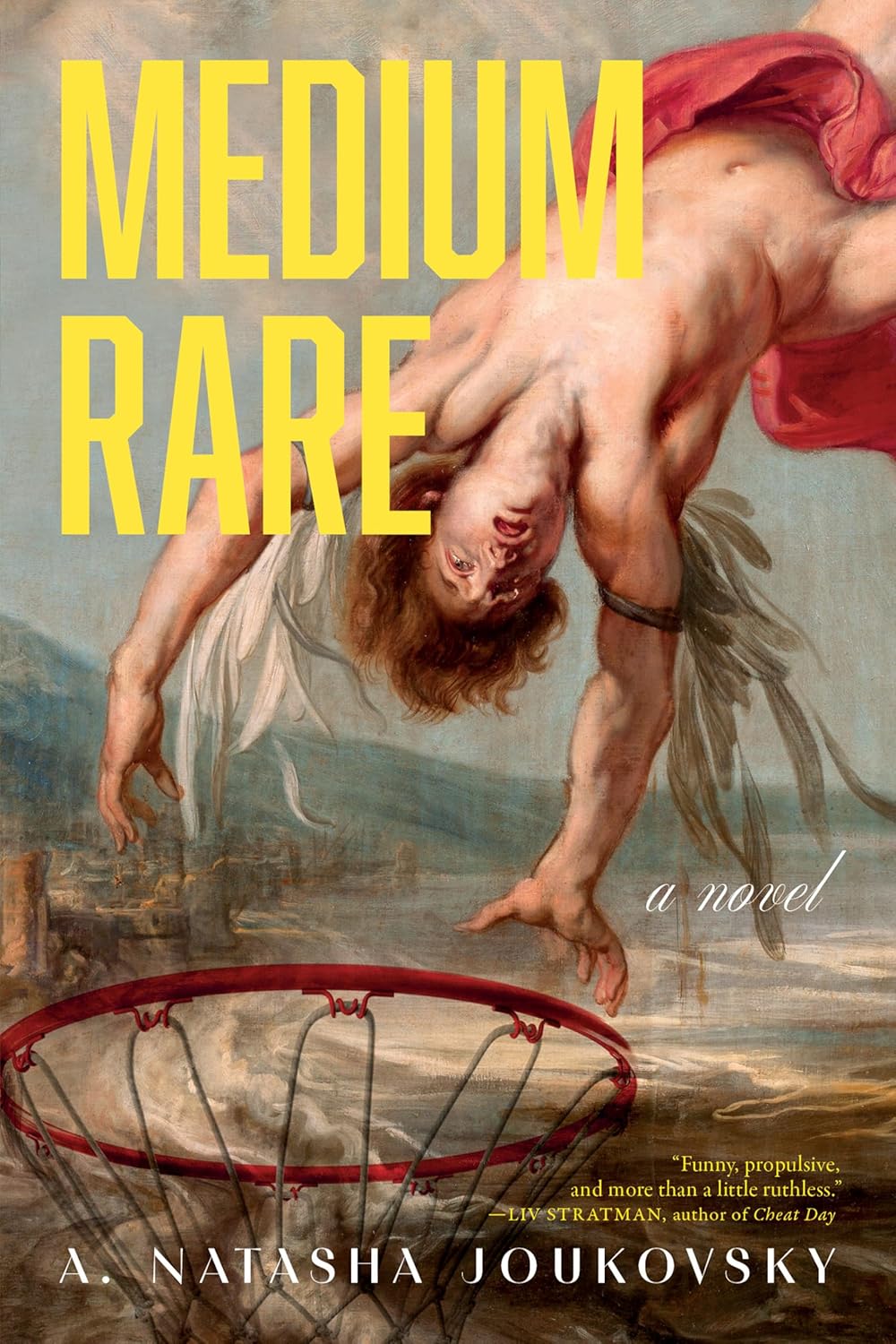
On its face, A. Natasha Joukovsky’s Medium Rare is about college basketball, but tucked beneath the surface is a searing look at the Olympic-level athleticism required to survive life in Washington, DC. The novel follows Phil Fayeton, an unremarkable mid-level lobbyist, whose path takes a dramatic turn when he enters a March Madness competition in 2019.
That year, the billionaire owner of the city’s arena (known as DaedaDome) offers a $1 billion prize to anyone who fills out a perfect NCAA men’s bracket — a feat never before achieved in the history of the tournament. As the competition unfolds, Phil’s bracket somehow continues to correctly predict the games’ outcomes. Soon, the billionaire, statisticians, and basketball experts across the country demand to know how he did it. Is he clairvoyant? No, Phil insists, he just loves basketball. Even he doesn’t know how it’s happening.
Joukovsky’s first book, 2021’s The Portrait of a Mirror, was a modern interpretation of the Narcissus myth, and in Medium Rare, she once again sets an iconic Greek myth — in this case, the cautionary tale of Icarus — against a contemporary backdrop. As Phil’s profile rises over the course of the competition, his career and personal life are impacted, as well. He takes leave from his lobbying job so he can focus on the championship. Politicians who once refused to return his calls suddenly invite him to watch the games from their private boxes. When he’s featured on ESPN as a wunderkind talking head, his pregnant wife, Raleigh, watches on their TV at home.
At the start of the story, Phil and Raleigh are the picture of marital bliss: college sweethearts who followed each other from UVA to the nation’s capital to support one another’s professional aspirations. Since then, Raleigh has set her career aside to care for their home and start their family. During the hubbub surrounding the tournament, she finds herself quite literally sidelined. While she sometimes accompanies Phil to games, she’s mostly left on her own as he jets around the country.
Enter Joukovsky’s narrator, the oracle Cassandra. A onetime sorority sister of Raleigh’s and now a seasoned political-event planner, she has crossed paths with Phil and Raleigh over the years without giving the couple much thought. But as sports fans, politicians, and the uber-wealthy begin to pay attention to Phil, so does she.
Cassandra’s years spent observing DC’s social ecosystem have prepared her to understand the world of college sports, another complicated environment full of egos and scheming. A Democrat, she never much liked the moderate Republican Phil or the apolitical Raleigh. Still, when she realizes that getting close to Phil could be advantageous, she begins to orbit the couple. She befriends — and comes to genuinely care for — the increasingly lonely Raleigh, who’s trying to make sense of her upended life ahead of giving birth. The two women witness Phil’s journey together.
At its core, Medium Rare is about watching someone accomplish the unimaginable. Joukovsky is clever in positioning Cassandra as the teller of Phil’s tale because it turns the observation of his story into the story. In this social-media age, we all claim to know each other better than we really do, but Medium Rare tackles our voyeuristic culture head-on. How well does Cassandra actually know Phil? Does she have a legitimate claim to any of his success? The reader is left to decide.
As someone largely unfamiliar with the inner workings of college basketball, let alone March Madness, I found Medium Rare fun, digestible, and compelling. Phil’s arc is as much about ambition and luck as it is about sports. He isn’t a very likable hero — he’s cocky and often annoying — but the author is as intentional and thoughtful in depicting these traits as she is in capturing Cassandra’s observation of them.
Even though Phil is abrasive, I can understand why readers might root for him. It’s less about wanting him to win and more about wanting to see if he can. If he does manage to pull off the impossible, what will it mean for him, for Raleigh, and for Cassandra? And if he doesn’t manage it — if he ultimately flies too close to the sun — what will that mean? Just like in March Madness, you might find yourself hoping for a Cinderella-story finish here.
Serena Zets is an essayist and journalist in Washington, DC, by way of Appalachia. Serena has worked as a freelance writer for the past decade and is currently an arts writer at Washington City Paper and weekly writer for 730DC. Their forthcoming work includes a chapter in the 2026 anthology Here for All the Reasons: #BachelorNation on Why We Watch.